
Hat Ihr Computer noch ein bisschen Speicherplatz und Rechenkapazität übrig? Dann beschäftigen Sie ihn doch, bevor er sich langweilt, mit kosmologischen Fragen: in Anlehnung an das Projekt SETI@home sucht Cosmology@Home nach möglichen Lösungen von theoretischen Modellen und vergleicht sie mit ganz realen Messwerten. So beteiligen Sie sich ganz entspannt an der großen Frage nach dem Universum, dem Leben und dem ganzen Rest.
http://www.cosmologyathome.org/
Solscape
Free MIT Educational Materials
The MIT OpenCourseWare program places course materials from a huge number of MIT courses on the web for free download by anyone. Some of the 1.700 courses even include video lectures and demonstrations. Many of the courses have a direct download feature: this is a ZIP-file that contains all the materials structured into folders that follow the on-line web structure for the course. Simply unzip them with „use folder names“ to preserve the folder structure, and you’ve got it all in convenient local form. Of particular interest to astronomy and space enthusiasts are the following courses:
Introduction to Astronomy
Hands-On Astronomy: Observing Stars and Planets
Note that while there are many readings, worksheets, and other materials in PDF or XML form, there is still quite often a text or a book required for assigned readings, and these are not available online.
Ein Gürtel aus kleinen Monden
Das prächtige Ringsystem des Saturn geht auf die Zerstörung kleinerer Monde zurück. Für diese Theorie spricht nun auch die Entdeckung von acht Minimonden in einem der Saturnringe durch amerikanische, deutsche und finnische Forscher. Wahrscheinlich handelt es sich bei diesen Minimonden um Bruchstücke größerer Objekte, die allmählich durch Kollisionen mit anderen Brocken zermahlen wurden und so den Ring auffüllten. Die kleinen Monde dürften bestenfalls 140 Meter messen, schätzen Miodrag Sremcevic von der University of Colorado und seine Kollegen in einem Artikel im Fachmagazin „Nature“. Für ihre Untersuchungen wertete die Gruppe Aufnahmen der Raumsonde Cassini aus. Auf den Bildern sind die Winzlinge selbst zwar nicht zu sehen, sie verraten sich jedoch durch propellerförmige Dichteschwankungen des Ringmaterials in ihrer Nähe. Sieben der acht Minimonde liegen im A-Ring, dem äußeren der beiden hellsten und größten Saturnringe. Während der Ring etwa 14.000 Kilometer breit ist, befinden sich die sieben in einem 3.000 Kilometer schmalen Gürtel. Sie könnten auf das Auseinanderbrechen eines gut zehn Kilometer großen Mondes zurückgehen, schätzen die Forscher anhand der Gesamtmasse der großen Objekte im betreffenden Gürtel. Monde ähnlichen Kalibers ziehen noch heute um den Saturn, beispielsweise Pan und Daphnis. Der achte Minimond kreist knapp außerhalb der Encke-Teilung, einer Lücke im A-Ring, um den Saturn. Erst im letzten Jahr war über die ersten vier „Propeller“ in dem Ringsystem berichtet worden. Eine weitere Studie über diese Objekte im A-Ring haben Carolyn Porco vom Space Science Institute in Boulder, Colorado, und ihre Kollegen kürzlich zur Begutachtung eingereicht.
New CU-Boulder Study Confirms First-Known Belt Of Moonlets In Saturn Rings
Huge comet outburst
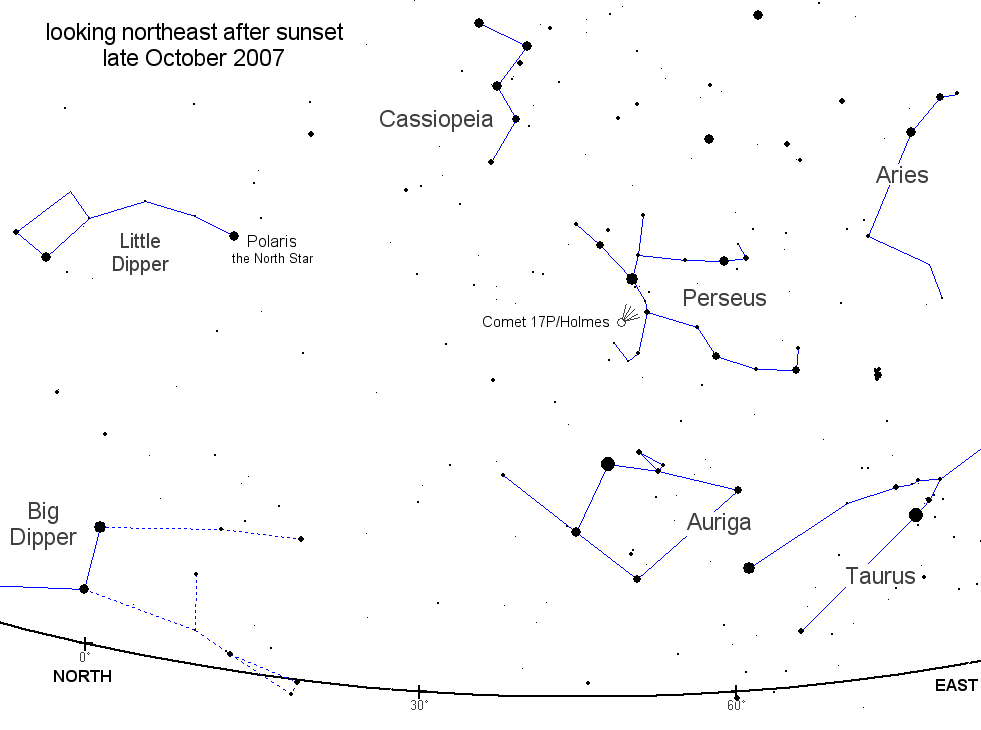
In the past 24 hours, a spectacular event has taken place involving the periodic comet 17P/Holmes. Its predicted brightness is about magnitude 17, however, last night it was discovered by Spanish amateur astronomer Juan Antonio Henriquez Santana to have undergone a tremendous outburst having attained magnitude 10 at that time. A similar outburst in 1892 led to the discovery of the comet.
Latest reports indicate that it is stellar in appearance and 3rd magnitude in brightness: so bright that it is visible to the unaided eye!
17P/Holmes is currently 245 million kilometres away from the Earth.
17P/Holmes (2007)
NASA Satellites Capture New Images of California Wildfires
NASA satellites continue to capture remarkable new images of the wildfires raging in Southern California. At least 15 massive fires are reported to have scorched about 415.000 acres, from north of Los Angeles to the Mexican border southeast of San Diego. Dry, drought-stricken vegetation and Santa Ana winds, which can reach hurricane speeds, have contributed to the devastating effect of these blazes. According to news reports, the blazes have killed one person and injured at least 70 more. Thirty-four firefighters have been hurt. More than 1.300 homes have been destroyed and nearly a million people have been forced to evacuate.
California Wildfires Continue to Grow: NASA Satellite Images Show Fire’s Immense Size
For more information about individual fires in Southern California, visit the Fire Information page of the National Interagency Fire Center Website:
https://www.nifc.gov/fire-information/nfn
ESA's Envisat captures Californian wildfires
This Envisat image – acquired on October 22, 2007 – shows desert winds blowing smoke from wildfires in Southern California:
https://esamultimedia.esa.int/images/envisat/California_fires_3_H1.jpg

China launches first lunar probe
A new mission to the Moon was launched today by the Chinese National Space Administration (CNSA). Chang’e-1 blasted off from the Xichang Satellite Launch Center in Sichuan atop a Long March 3A rocket. Chang’e-1 represents the first step in the Chinese ambition to land robotic explorers on the Moon before 2020. ESA is collaborating with the Chinese on this mission by providing spacecraft and ground operations support services to CNSA.
Launch photos @ scitech.people.com.cn
Striking new image from Chandra
A spectacular new image shows how complex a star’s afterlife can be. By studying the details of this image made from a long observation by NASA’s Chandra X-ray Observatory, astronomers can better understand how some stars die and disperse elements like oxygen into the next generation of stars and planets. At a distance of about 20.000 light years, G292.0+1.8 is one of only three supernova remnants in the Milky Way known to contain large amounts of oxygen.
G292.0+1.8: Stellar Forensics with Striking Image from Chandra
Discovery lifts off
Space shuttle Discovery lifted off Tuesday morning on a mission to the International Space Station. Discovery launched on schedule at 11:38 a.m. EDT, having dodged poor weather that had been forecast, as well as a last-minute concern about ice buildup on a liquid hydrogen line. The 14-day mission to the station features the delivery of „Harmony“, a new docking node for the station, and the move of a solar panel to its permanent location on the station’s port-side truss.
NASA – Space Shuttle Section
Kanal zum Nil
Jeder Ägyptenreisende hat ihn schon gesehen: den unvollendeten Obelisken im Granitsteinbruch von Assuan. Wie er seine Reise zum einige Kilometer entfernten Nil unternehmen sollte, haben nun Geologen um Richard Parizek von der University of Pennsylvania herausgefunden. Sie entdeckten Hinweise auf einen Kanal, der den Steinbruch mit dem Nil verband. Den Graben hatten die Forscher mit Hilfe von Temperaturmessungen lokalisiert. Die im Kanal abgelagerten Sedimente weisen durch das zirkulierende Grundwasser eine andere Temperatur auf als der umgebende Fels. Mit dieser Entdeckung können sich die Wissenschaftler nun auch die Salzkrusten erklären, die in dem Steinbruch die Felswände und alten Graffitis gefährden. Der 1.100 Tonnen schwere Spitzpfeiler trat seine Reise nie an. Er hatte bei der Bearbeitung Risse bekommen.
Aswan Obelisk Quarry more than meets the eye