Solscape

Phoenix Lander Arrives in Florida

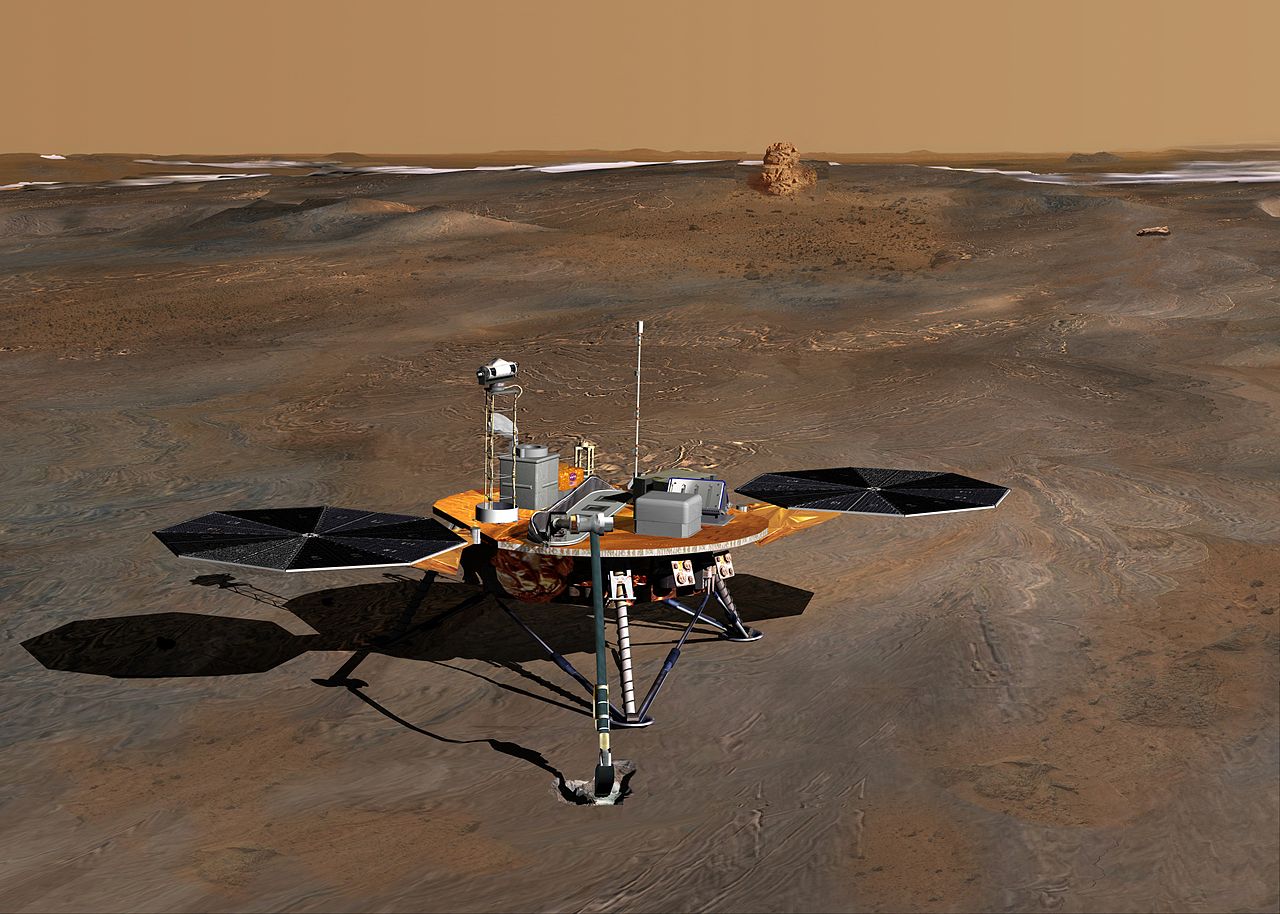
The long-lasting Mars rovers Spirit and Opportunity are still wandering across the surface of the Red Planet, but they’re about to get a new friend. Next up to land on the surface of Mars is Phoenix, which recently arrived in Florida in preparation for its upcoming launch. Phoenix was delivered by a US Air Force C-17 cargo aircraft from its manufacturer in Colorado. If all goes well, Phoenix will blast off atop a Boeing Delta II rocket as early as August 3rd, 2007. It will make a six month trip to Mars, and then land in a flat plain near the planet’s arctic ice cap. It will use its robotic digging arm and a suite of instruments to determine if the soil holds quantities of water ice. The detection of ice would bring the possibility of microbial life on Mars one step closer.
Phoenix Website

First Map of an Extrasolar Planet

For the first time, astronomers have created a rough map of a planet orbiting a distant sun-like star, employing a technique that may one day enable mapping of Earth-like worlds.

CfA Press Release: First Map of an Extrasolar Planet

CfA Press Release Images

Extreme Winds Rule Exoplanet’s Weather

NASA Finds Extremely Hot Planet, Makes First Exoplanet Weather Map

Scientists Map Weather on Distant World

A Tale of Two Exoplanets: One Incredibly Hot, the Other Extremely Windy

"Bumpy" ice on Mars points to active water cycle

For the first time, scientists have found that water ice lies at variable depths over small-scale patches on the Red Planet. The discovery draws a much more detailed picture of underground ice on Mars than was previously available. The new results appear in the May 3, 2007, issue of the scientific journal „Nature“. The findings come from data sent back to Earth by the Thermal Emission Imaging System (THEMIS) on NASA’s Mars Odyssey orbiter.
NASA – Sharp Views Show Ground Ice on Mars Is Patchy and Variable

JPL – Sharp Views Show Ground Ice on Mars Is Patchy and Variable

Mars’s Ice Patchy, Water Cycle Quite Active, Study Reveals

Mercury is Soft in the Middle

A team of astronomers has discovered that tiny Mercury has a molten core, just like our own planet. The discovery was made using three ground-based radio observatories that bounced radio waves off the planet, and then analysed the return signals. Before this research, scientists were divided about the structure of Mercury. Most models predicted that it has an iron-rich core, but it wasn’t known if it had completely cooled, or was still liquid inside.
NASA Antenna Cuts Mercury to Core, Solves 30 Year Mystery

Mercury has molten core, Cornell researcher shows

Mercury’s Soft Center – Ground-based telescopes find strong evidence that Mercury has molten core

Liquid Mercury: Tiny Planet Has Molten Core

New Horizons Provides New Look at Jupiter System

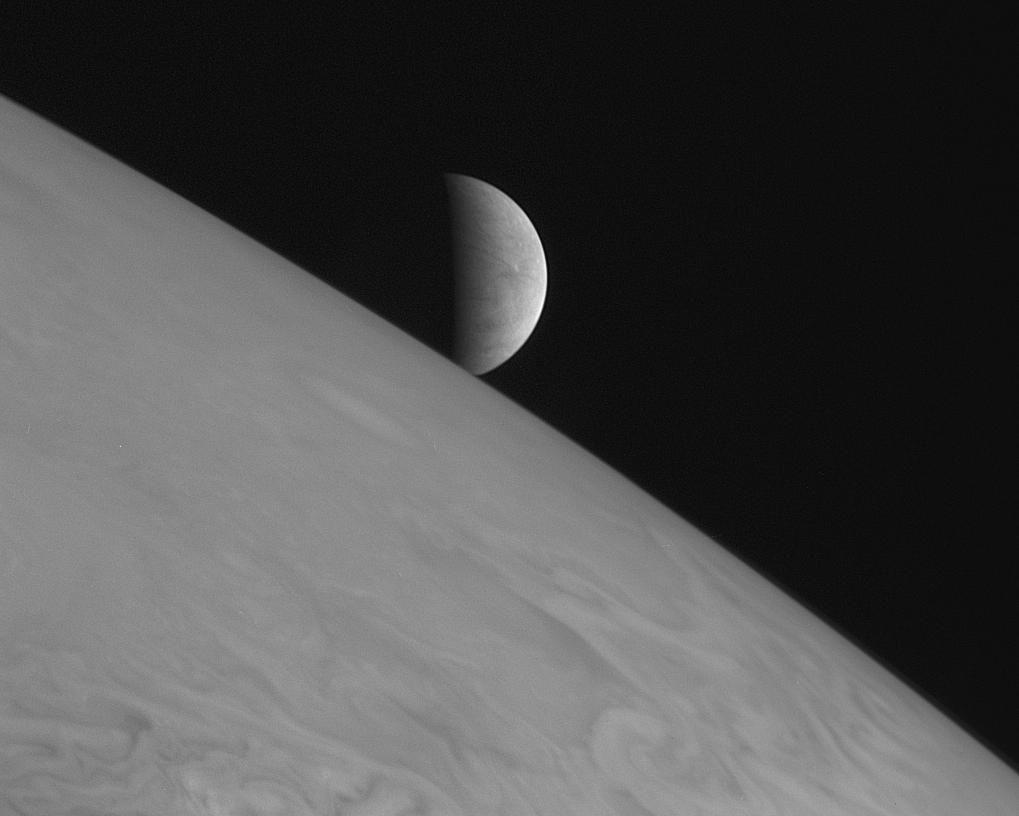
NASA’s New Horizons spacecraft has provided new data on the Jupiter system, stunning scientists with never-before-seen perspectives of the giant planet’s atmosphere, rings, moons and magnetosphere. These new views include the closest look yet at the Earth-sized „Little Red Spot“ storm churning materials through Jupiter’s cloud tops; detailed images of small satellites herding dust and boulders through Jupiter’s faint rings; and of volcanic eruptions and circular grooves on the planet’s largest moons. New Horizons came to within 1,4 million miles of Jupiter on February 28, 2007, using the planet’s gravity to trim three years from its travel time to Pluto. For several weeks before and after this closest approach, the piano-sized robotic probe trained its seven cameras and sensors on Jupiter and its four largest moons, storing data from nearly 700 observations on its digital recorders and gradually sending that information back to Earth. About 70 percent of the expected 34 gigabits of data has come back so far, radioed to NASA’s largest antennas over more than 600 million miles. This activity confirmed the successful testing of the instruments and operating software the spacecraft will use at Pluto.
New Horizons at Jupiter – Graphics and Presenters

Earthlike exoplanet found

Astronomers have discovered the most earthlike planet outside our solar system to date.
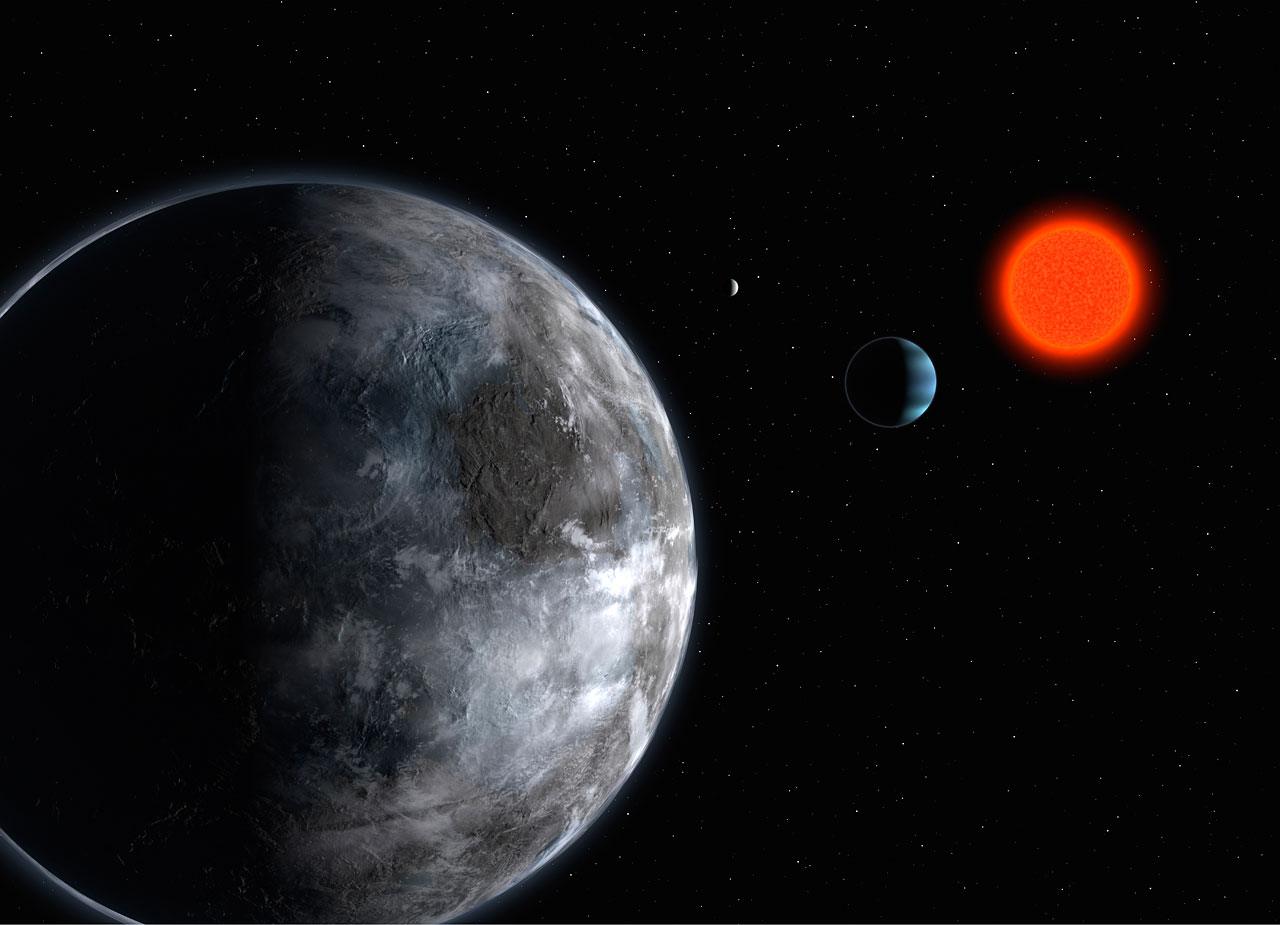
Using the ESO 3.6m telescope at La Silla, Chile, a team of Swiss, French, and Portuguese scientists discovered a super-Earth about 5 times the mass of the Earth that orbits a red dwarf, already known to harbour a Neptune-mass planet. The astronomers have also strong evidence for the presence of a third planet with a mass about 8 Earth masses. The newly discovered exoplanet is the smallest ever found up to now and it completes a full orbit in 13 days. It is 14 times closer to its star than the Earth is from the Sun. However, given that its host star, the red dwarf Gliese 581, is smaller and colder than the Sun, the planet nevertheless lies in the habitable zone, the region around a star where water could be liquid!
„We have estimated that the mean temperature of this super-Earth lies between 0 and 40 degrees Celsius, and water would thus be liquid,“ explains Stephane Udry from the Geneva Observatory (Switzerland) and lead-author of the paper reporting the result. „Moreover, its radius should be only 1,5 times the Earth’s radius, and models predict that such a planet should be either rocky or covered with oceans,“ he adds. „Because of its temperature and relative proximity, this planet will most probably be a very important target of the future space missions dedicated to the search for extra-terrestrial life. On the treasure map of the Universe, one would be tempted to mark this planet with an X.“
The host star, Gliese 581, is among the 100 closest stars to us, located only 20,5 light-years away in the constellation Libra. It has a mass of only one third the mass of the Sun. Such red dwarfs are at least 50 times fainter than the Sun and are the most common stars in our Galaxy: among the 100 closest stars to the Sun, 80 belong to this class.
Two years ago, the same team of astronomers already found a planet around Gliese 581. With a mass of 15 Earth-masses, i.e. similar to that of Neptune, it orbits its host star in 5,4 days. At the time, the astronomers had already seen hints of another planet. They therefore obtained a new set of measurements and found the new super-Earth, but also clear indications for another one, an 8 Earth-mass planet completing an orbit in 84 days. The planetary system surrounding Gliese 581 contains thus no fewer than 3 planets of 15 Earth masses or less, and as such is a quite remarkable system.
Story adapted from the ESO Press Release:
Astronomers Find First Earth-like Planet in Habitable Zone

Hubble’s 17th anniversary

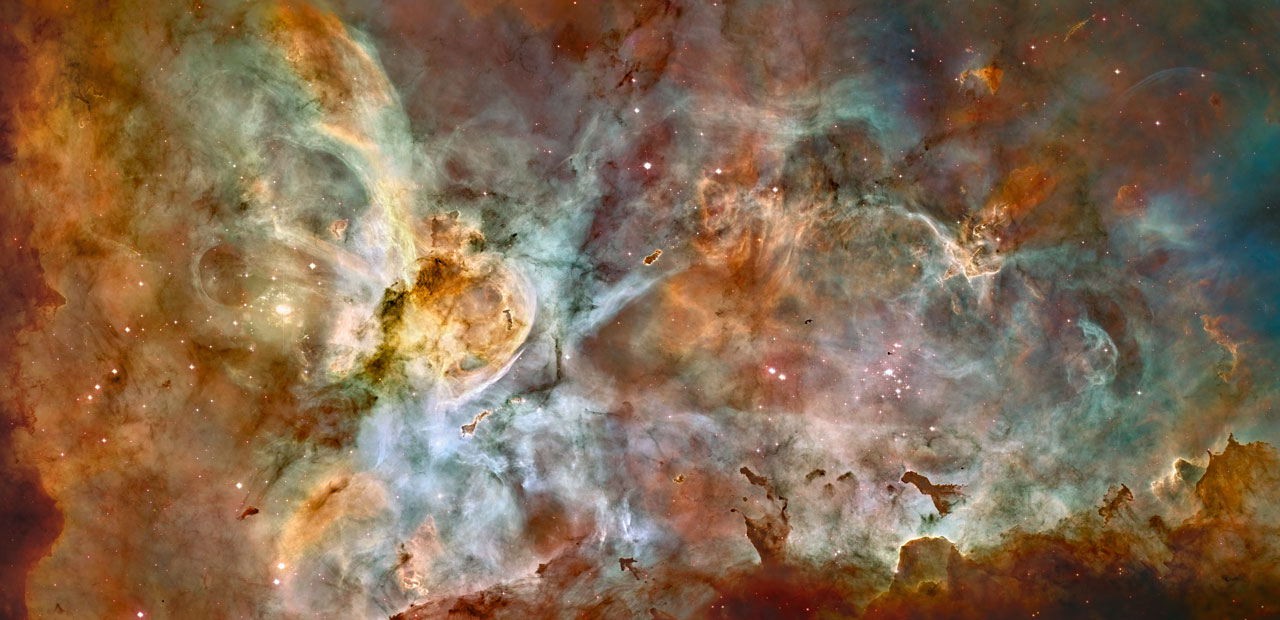
One of the largest panoramic images ever taken with Hubble’s cameras has been released to celebrate the 17th anniversary of the launch and deployment of the NASA/ESA Hubble Space Telescope. The image shows a 50 light-year-wide view of the tumultuous central region of the Carina Nebula where a maelstrom of star birth – and death – is taking place.

https://esahubble.org/news/heic0707/