
Japan’s lunar orbiter, Kaguya, has returned its first pictures:
https://global.jaxa.jp/press/2007/10/20071009_kaguya_e.html
Solscape
Astronaut Trio Rockets Toward Space Station
A Russian Soyuz rocket roared into orbit yesterday carrying Malaysia’s first spaceflyer and a veteran astronaut team to the International Space Station.
Space station commander Peggy Whitson, the first woman ever to lead an ISS mission, launched into space alongside veteran cosmonaut Yuri Malenchenko and Malaysian astronaut Sheikh Muszaphar Shukor. Their Soyuz TMA-11 spacecraft rocketed into orbit at 9:22 a.m. EDT from the Baikonur Cosmodrome launch site on the steppes of Kazakhstan.
Possible Explanation for Two-Toned Iapetus
Saturn’s moon Iapetus is one of the most mysterious objects in the Solar System. It’s shaped like a walnut, with a strange ridge that runs along its equator, and it’s got vastly different hemispheres. One side is as white as snow, and the other side is dark as tar. Scientists think they’ve at least got an answer for this mystery.
Cassini is on the Trail of a Runaway Mystery
Fifty Times sharper than Hubble
The Inner Jet of the Radio Galaxy M87, located in the center of the Virgo cluster some 50 million light years away from Earth, was observed by Yuri Kovalev from the Max Planck Institute for Radio Astronomy in Bonn and his colleagues with the Very Long Baseline Array (VLBA) at 2 cm wavelength. The resulting image provides details down to a resolution of one milli-arcsecond, corresponding to a linear resolution of only three light months. This is fifty times better than the resolution of the Hubble Space Telescope at optical wavelengths.
Geologists Recover Rocks From The San Andreas Fault
For the first time, geologists have extracted intact rock samples from 2 miles beneath the surface of the San Andreas Fault, the infamous rupture that runs 800 miles along the length of California.
From depths of Earth, a fault’s secrets
Star System Just Right For Building An Earth
An Earth-like planet is likely forming 424 light-years away in a star system called HD 113766, say astronomers using NASA’s Spitzer Space Telescope. Scientists have discovered a huge belt of warm dust – enough to build a Mars-size planet or larger – swirling around a distant star that is just slightly more massive than our sun. The dust belt, which they suspect is clumping together into planets, is located in the middle of the system’s terrestrial habitable zone.
APL Astronomer Spies Conditions ‚Just Right‘ for Building an Earth
Japan Lunar Probe Reaches Orbit
Japan puts its first satellite successfully into lunar orbit!
JAXA Press Release
Earth celebrates Sputnik's 50th birthday
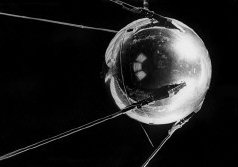
Modell von Sputnik
Fifty years ago today, on October 4, 1957, the world’s first artificial satellite was launched by the former Soviet Union, marking the start of the Space Age.
Called Sputnik, meaning „fellow traveler“, it was about the size of a basketball, weighed only 83 kilograms, and took about 98 minutes to orbit the Earth while transmitting a series of rapid beeps. Then, on November 3rd, 1957, the Soviets launched Sputnik II, carrying a heavier payload including a dog named Laika. On January 31, 1958, the United States entered the space race by launching Explorer I, a satellite that discovered the magnetic radiation belts surrounding the Earth. The Sputnik launch also led to the creation of NASA on October 1st, 1958. Since then, humans have walked on the moon, created the International Space Station, sent robots to Mars and dispatched numerous spacecraft to explore the universe.
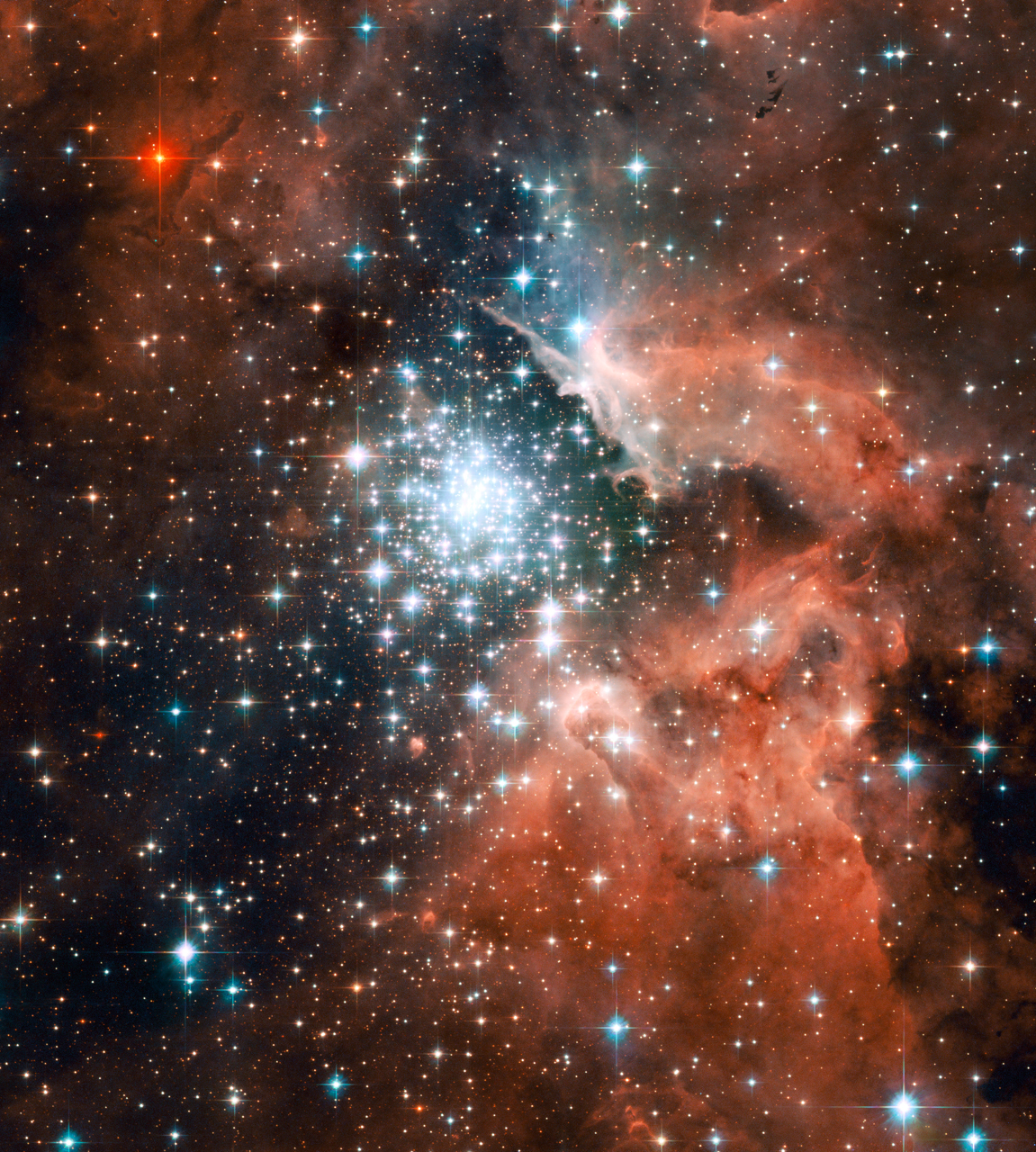
Star Cluster Bursts Into Life in New Hubble Image
The Hubble Space Telescope has captured a spectacular image of NGC 3603, a giant nebula hosting one of the most prominent massive young star clusters in the Milky Way, thus supplying a prime template for star formation studies. NGC 3603 lies about 20.000 light-years away from Earth in the Carina spiral arm.
Images, videos and additional information about NGC 3603 are available at:
https://hubblesite.org/contents/news-releases/2007/news-2007-34.html
https://esahubble.org/news/heic0715/
https://www.esa.int/Science_Exploration/Space_Science/Extreme_star_cluster_in_new_Hubble_images
Inspiring Talk on Exploring the Saturn System
Planetary scientist Carolyn Porco is the leader of the Imaging Team for the Cassini mission. She gave an 18 minute talk on the Cassini-Huygens mission and on some of the amazing scientific results from Titan, Enceladus, and Saturn itself at the TED conference in Monterey in March 2007. Here is the video of that inspiring talk.
Link to this talk: https://www.ted.com/talks/carolyn_porco_this_is_saturn