
Archeologists unveiled Tuesday the tombs of a Pharaonic butler and scribe that had been buried in the sand for more than 3.000 years. The tombs, along with the painted coffins of a priest and his girlfriend, were discovered early this year at Saqqara near the famous Step Pyramid of King Djoser – the oldest of Egypt’s more than 90 pyramids.
Solscape
Surprises from the Sun’s South Pole
In keeping with the first and second south polar passes (in 1994 and 2000), the latest high-latitude excursion of the joint ESA-NASA Ulysses mission has already produced some surprises. In mid-December 2006, although very close to the minimum of its 11-year sunspot cycle, the Sun showed that it is still capable of producing a series of remarkably energetic outbursts. The solar storms, which were confined to the equatorial regions, produced quite intense bursts of particle radiation that were clearly observed by near-Earth satellites. Surprisingly, similar increases in radiation were detected by the instruments on board Ulysses, even though it was three times as far away and almost over the south solar pole.
https://www.esa.int/Science_Exploration/Space_Science/Surprises_from_the_Sun_s_South_Pole
Delta rocket blasts off with five NASA probes
The United Launch Alliance (ULA) Delta 2 rocket roared away from Cape Canaveral at 6:01 p.m. EST today carrying a quintet of NASA probes that seek to understand the physics of Earth’s auroras.
THEMIS and ARTEMIS
Chandra Gives Another Look at the Pillars of Creation
Probably the most famous photograph ever taken by the Hubble Space Telescope is of the „Pillars of Creation“, a star-forming region inside the Eagle Nebula (M16). Astronomers always wanted to know just how much star formation is actually going on inside the nebula. So one of Hubble’s co-observatories, the Chandra X-Ray Observatory, has observed the region too, and helped answer that question.
The Eagle Nebula (M16): Peering Into the Pillars Of Creation
Staubscheiben um Weiße Zwerge
Im Jahr 1987 wurde bei der 500 Millionen Jahre alten Sternleiche G29-38 (ZZ Piscium) erstmalig eine Staubscheibe um einen Weißen Zwerg entdeckt. Spektren, die das Weltraumteleskop „Spitzer“ Ende November/Anfang Dezember 2004 aufgenommen hatte, wiesen dabei auf Spuren von Kometenmaterial hin: bei 10 Mikrometer zeigten sich Anzeichen von Silikatkörnern, die denen in Kometen glichen.
NASA’s Spitzer Finds Possible Comet Dust Around Dead Star
18 Jahre nach dieser Entdeckung wurde ein weiteres Exemplar einer Staubscheibe gefunden: um den Weißen Zwerg GD 362.
A Dusty Disk Around GD 362, a White Dwarf With a Uniquely High Photospheric Metal Abundance
Ein Forscherteam um Kate Su von der University of Arizona hat nun eine dritte solche Staubscheibe entdeckt; die Spektren wurden mit Spitzer ebenfalls im Herbst 2004 aufgenommen. Diese Staubscheibe umgibt WD 2226–210, den Weißen Zwerg im Zentrum des Helixnebels (NGC 7293). Der Staub befindet sich in einem Ring, der sich von der heißen Sternleiche zwischen 35 und 150 AU ausdehnt. Bei 24 Mikrometer weist ein rotes Leuchten, welches den Zentralstern umgibt, auf den Staubgürtel hin. Dieses rote Leuchten ist auch in der neu veröffentlichten Spitzer-Aufnahme zu sehen:
Comets Clash at Heart of Helix Nebula
Während bei den zuerst genannten Objekten der Staub von Kollisionen in einem Asteroidengürtel (um G29-38 bei Radien von nur 0,005 und 0,03 AU!) stammen könnte, ist es beim Weißen Zwerg im Helixnebel wahrscheinlicher, dass dieser Staub bei Kollisionen von kometenähnlichen Objekten eines „Kuiper-Gürtels“ oder einer „Oortschen Wolke“ (analog zu unserem Sonnensystem) produziert wird:
A Debris Disk around the Central Star of the Helix Nebula?
New Horizons Image: Full Jupiter Mosaic
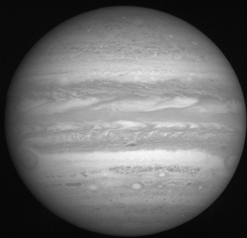
This image of Jupiter was produced from a 2×2 mosaic of photos. The telescopic camera LORRI on board New Horizons snapped the images during a 3-minute, 35-second span on February 10, 2007, when the spacecraft was 29 million kilometres from Jupiter.
http://pluto.jhuapl.edu/Galleries/Featured-Images/image.php?page=1&gallery_id=2&image_id=36
Underground Plumbing System Discovered on Mars
New images taken by the HiRISE camera on NASA’s Mars Reconnaissance Orbiter (MRO) show hills and plateaus with alternating layers of dark and light colored rocks in Candor Chasma, one of several canyons that make up Valles Marineris, a sprawling Martian rift valley that is longer than the contiguous United States and up to seven times deeper than the Grand Canyon. Cutting like a vertical scar across these light and dark bands in Candor Chasma are a series of linear cracks surrounded by „halos“ of light-colored bedrock. In the February 16 issue of the journal „Science“, University of Arizona researchers Chris Okubo and Alfred McEwen argue that the halos are proof that some form of fluid – either water, liquid carbon dioxide, or a combination of the two – once flowed through the bedrock. Similar processes are known to occur on Earth. Veins of gold and silver in rock, for example, are formed when water rich in the dissolved forms of these elements flows through cracks and finally deposit the metals as bright streaks in the rock.
Images showing the haloes along fractures are available on the Web at:
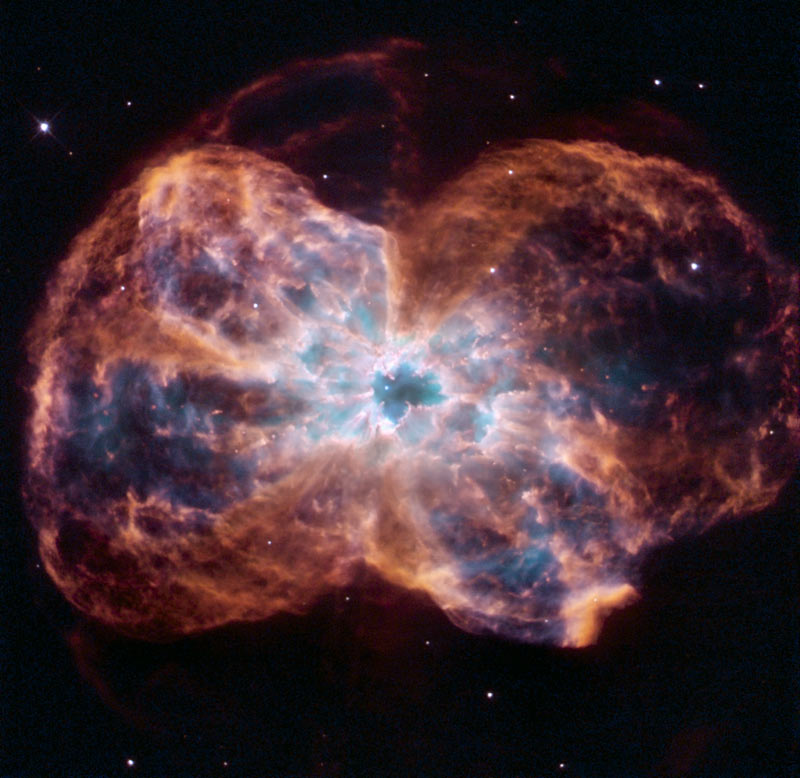
The colourful demise of a Sun-like star
This brand new image taken with Hubble’s Wide Field Planetary Camera 2 shows the planetary nebula NGC 2440 – the chaotic structure of the demise of a Sun-like star.
https://hubblesite.org/contents/media/images/2007/09/2058-Image.html
Hiking maps of Mars
Don’t start packing the sandwiches just yet, but planning a hike on Mars just got a little easier. Scientists have released the first „hiking maps“ of Mars, which show the planet’s topography in the same format as Earth-based hikers‘ maps. The area covered by the maps would certainly make for good, if strenuous, hiking. It is a very rugged area near the equator called Iani Chaos. Some great views would be possible from atop one of the region’s many mesas that overlook gaping canyons hundreds of metres deep.
https://www.esa.int/Science_Exploration/Space_Science/Mars_Express/The_first_hiking_maps_of_Mars
Comets Clash at Heart of Helix Nebula
A bunch of rowdy comets are colliding and kicking up dust around a dead star, according to new observations from NASA’s Spitzer Space Telescope. The dead star lies at the center of the much-photographed Helix nebula, a shimmering cloud of gas with an eerie resemblance to a giant eye.
Press Release