
Yesterday, ESA’s Planck satellite was on display for media gathered in Cannes. The press event took place at the facility of Alcatel Alenia Space, Prime Contractor for building the satellite. Special guest was George Smoot, Nobel Prize winner for Physics in 2006 for his research on the Cosmic Microwave background.
Images
Solscape
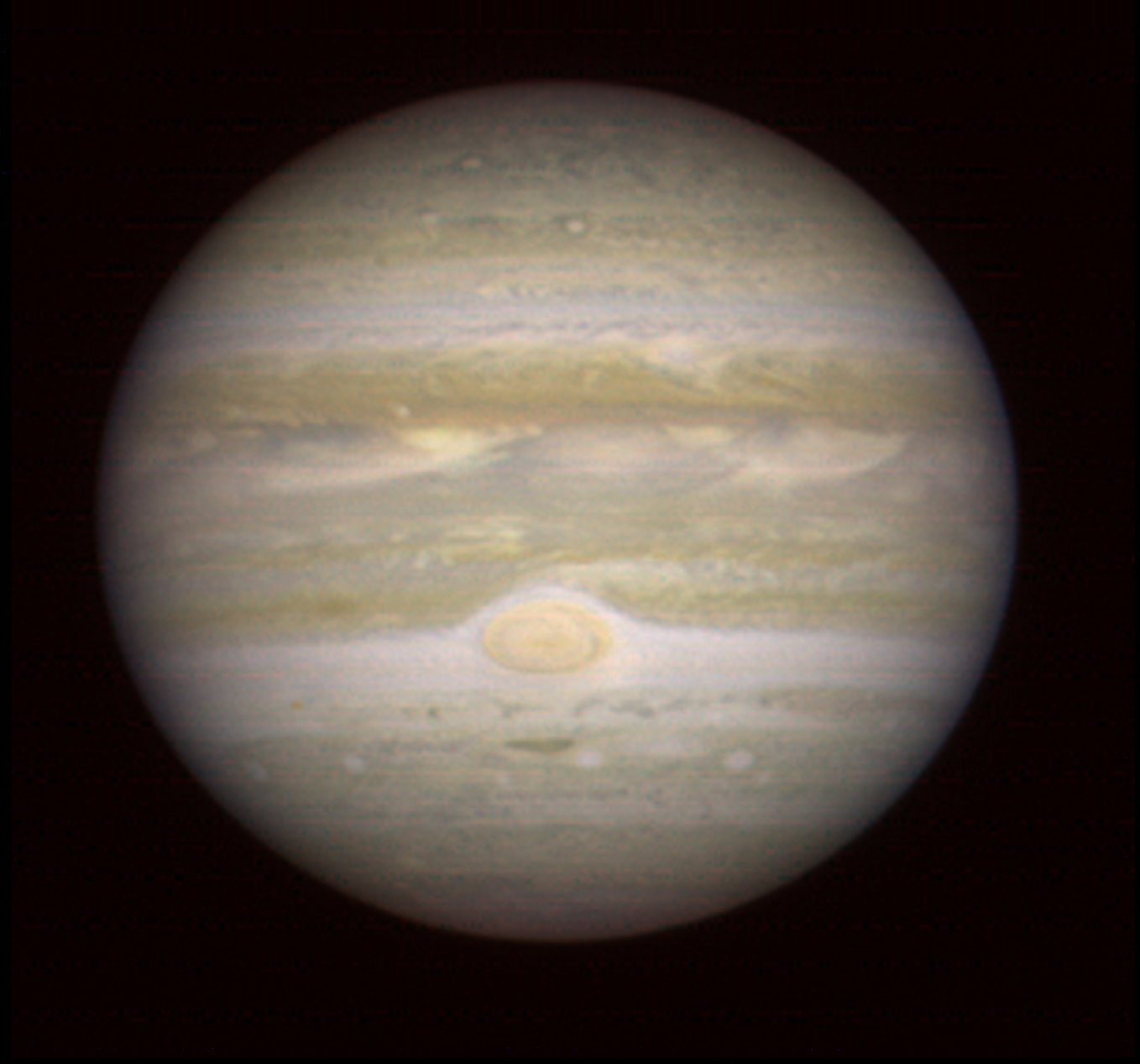
Looking at Jupiter…From Mars!
Guess who took this picture of Jupiter? Hubble? Keck? A well equipped amateur here on Earth?
Nope, it was taken by the HiRISE camera on board the Mars Reconnaissance Orbiter. The picture was taken from orbit around Mars. The HiRISE camera uses the most powerful telescope ever launched out of Earth’s orbit. Since Mars is much closer to Jupiter than Earth, and since the instrument has no atmosphere to peer through, it is much better than a ground-based observatory. This isn’t a completely natural colour image. Since HiRISE is able to detect longer wavelengths of light – into the infrared – it’s different from what you’ll see with your own eyes.
Cassini Images Mammoth Cloud Engulfing Titan's North Pole
A giant cloud half the size of the United States has been imaged on Saturn’s moon Titan by the Cassini spacecraft. The cloud may be responsible for the material that fills the lakes discovered last year by Cassini’s radar instrument.
https://solarsystem.nasa.gov/news/12377/cassini-images-mammoth-cloud-engulfing-titans-north-pole/
Huge Settlement Unearthed At Stonehenge Complex
Excavations supported by National Geographic at Durrington Walls in the Stonehenge World Heritage site have revealed an enormous ancient settlement that once housed hundreds of people. Archaeologists believe the houses were constructed and occupied by the builders of nearby Stonehenge, the legendary monument on England’s Salisbury Plain. The houses have been radiocarbon dated to 2600-2500 B.C., the same period Stonehenge was built – one of the facts that leads the archaeologists to conclude that the people who lived in the Durrington Walls houses were responsible for constructing Stonehenge. The houses form the largest Neolithic village ever found in Britain; a few similar Neolithic houses have been found in the Orkney Islands off Scotland. The discoveries help confirm a theory that Stonehenge did not stand in isolation but was part of a much larger religious complex used for funerary ritual.
News @ National Geographic
Martian Clouds Pass By On A Winter Afternoon
NASA’s Mars Exploration Rover Opportunity captured a view of wispy afternoon clouds, not unlike fair weather clouds on Earth, passing overhead on the rover’s 956th sol, or Martian day (October 2nd, 2006). With Opportunity facing northeast, the clouds appear to drift gently toward the west in the movie taken with the rover’s navigation camera. The 10 frames, taken 32 seconds apart, show the formation and evolution of what are likely mid-level, convective water clouds.
https://photojournal.jpl.nasa.gov/catalog/PIA09170
Hubble images exoplanet atmosphere
US astronomers say the Hubble Space Telescope has allowed them to study for the first time the atmospheric structure of a planet orbiting another star. Hubble discovered a dense upper layer of hot hydrogen gas where the super-hot planet’s atmosphere is bleeding into space. The planet, designated HD 209458b, is unlike any world in our solar system. Researchers say it orbits so close to its star and becomes so hot that its gas is streaming into space, making the planet appear to have a comet-like tail. The new research reveals the layer in the planet’s upper atmosphere where the gas becomes so heated it escapes, like steam rising from a boiler.
https://hubblesite.org/contents/news-releases/2007/news-2007-07.html
Planck satellite on view
ESA’s Planck satellite, due to study relic radiation from the Big Bang, is on display for the media in Cannes. Images of the spacecraft in all its glory will be published on the web at the end of Thursday’s press conference.
http://planck.esa.int/science-e/www/area/index.cfm?fareaid=17
How SMART-1 has made European space exploration smarter
A unique way to travel to the Moon, new technologies successfully tested and brand-new science: a few months after the end of the SMART-1 mission scientists and engineers gathered to recap on these and all the other achievements of the first European mission to the Moon.
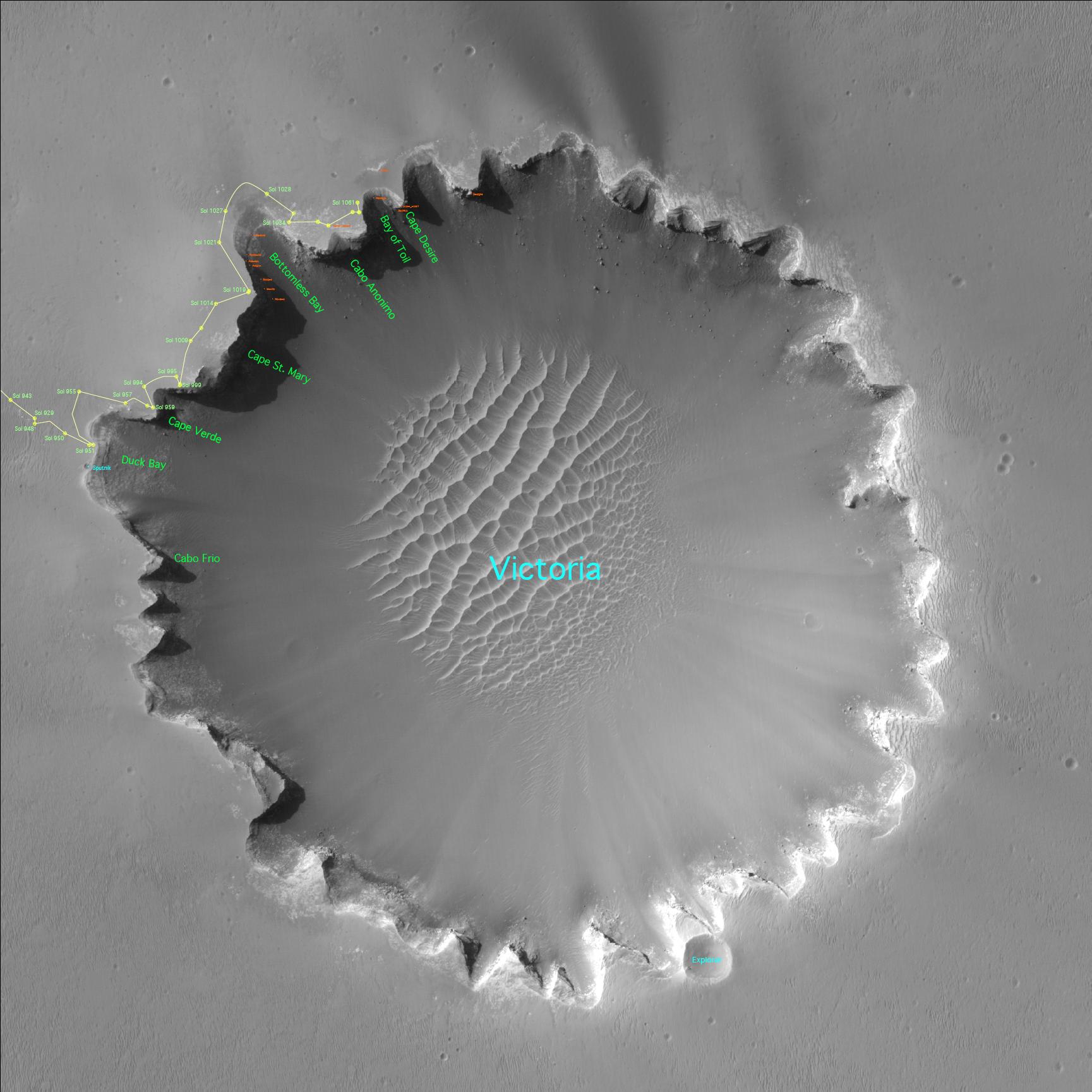
Opportunity's Journey around Victoria Crater
Three years after embarking on a historic exploration of the red planet and six miles away from its landing site, NASA’s Mars Exploration Rover Opportunity is traversing „Victoria Crater“ ridge by ridge, peering at layered cliffs in the interior. To identify various alcoves and cliffs along the way, science team members are using names of places visited by the 16th-century Earth explorer Ferdinand Magellan and his crew aboard the ship Victoria, who proved the Earth is round.
Satellite View of Opportunity’s Journey around „Victoria Crater“ (Annotated)
Nanochip moves molecular computers a step closer
Don’t throw away your laptop yet, but there’s a promising new high-tech invention being announced this week. Researchers have created a memory circuit the size of a white blood cell that has 160 kilobits of capacity – it’s the densest memory circuit ever fabricated. A team of UCLA and California Institute of Technology chemists successfully demonstrated a large-scale, „ultra-dense“ memory device that stores information using reconfigurable molecular switches. This research represents an important step towards the creation of molecular computers that are much smaller and could be more powerful than today’s silicon-based computers.
Caltech and UCLA Researchers Create Memory Circuit the Size of a Human White Blood Cell