
A hail storm pounded the Space Shuttle Atlantis on Monday evening, chewing up foam at the top of the shuttle’s external fuel tank. The damage was so significant that managers decided to delay the shuttle’s launch until the damage can be repaired. Atlantis was originally supposed to launch as early as March 15, but the golf ball-sized hail pushed that date back. Workers found nearly 2.000 divots in the foam, and several damaged heat tiles on the shuttle’s left wing. The shuttle was rolled back from the launch pad to the Vehicle Assembly Building, to analyze the damage and begin repairs. Managers are currently hoping for a launch date starting as early as April 22.
https://www.nasa.gov/home/hqnews/2007/feb/HQ_07060_Atlantis.html
Solscape
Pluto probe swings by Jupiter
A small spacecraft en route to Pluto flew past Jupiter early on Wednesday, picking up enough speed from the giant planet’s gravity field to shave three years off what would have been a 12-year voyage. New Horizons‘ closest approach to Jupiter occurred at 12:43 a.m. ET, when it passed 1.4 million miles from the planet. The studies of Jupiter and its four largest moons began several weeks ago and are scheduled to continue through June.
Pluto-Bound New Horizons Spacecraft Gets a Boost from Jupiter
NASA's Pluto Probe Set for Gas Giant Rendezvous
Jupiter, the largest planet in the solar system, is about to welcome a robotic visitor. NASA’s New Horizons probe will make its closest pass by the gas giant at about 12:45 a.m. EST Wednesday in a sort of cosmic stopover on its long trek to distant Pluto and the Kuiper Belt. The planetary flyby comes just 13 months after New Horizons‘ launch, with the probe hurtling through space at about 75.640 kilometers per hour. At its closest approach, New Horizons is expected to fly within 2.3 million kilometres of Jupiter.
New Horizons is the first probe to visit Jupiter since NASA’s Galileo orbiter plunged into the gas giant’s atmosphere to end its 14-year mission in 2003. The Cassini orbiter, currently circling the planet Saturn, swung past Jupiter in December 2000.
New Horizons Web Site
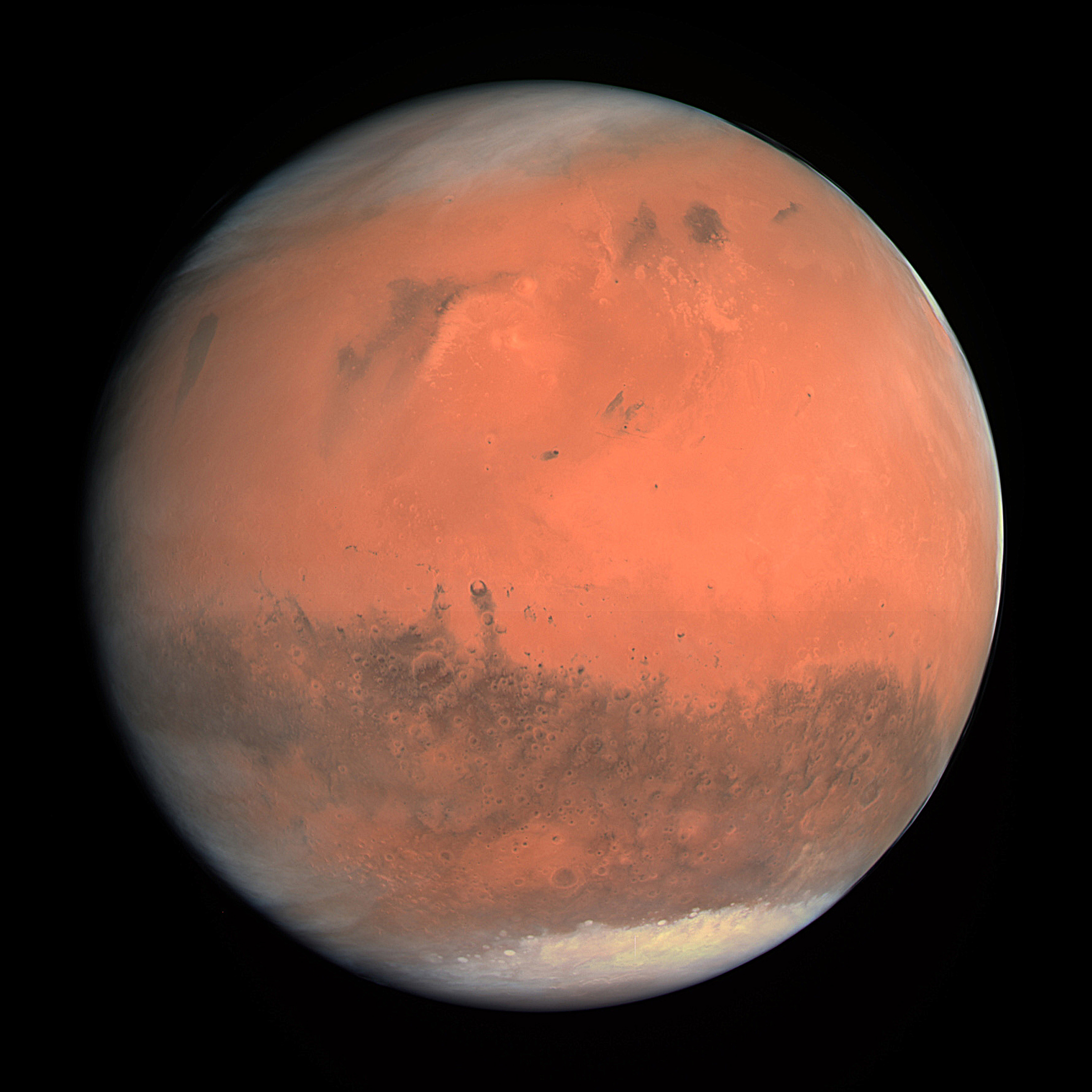
Beautiful new images from Rosetta’s approach to Mars
At 03:57 CET today, mission controllers at ESOC, ESA’s Space Operations Centre in Darmstadt, Germany, confirmed Rosetta’s successful swingby of Mars, a key milestone in the journey of this unique spacecraft to its target comet 67P/Churyumov-Gerasimenko in 2014.
https://www.esa.int/Science_Exploration/Space_Science/Rosetta/Beautiful_new_images_from_Rosetta_s_approach_to_Mars_OSIRIS_UPDATE
Stunning view of Rosetta skimming past Mars
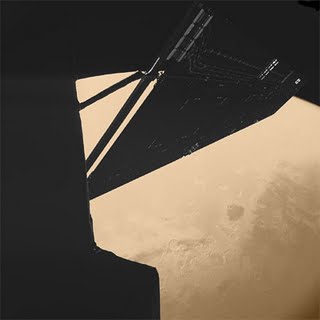
Stunning image of Rosetta above Mars
taken by the Philae lander camera.
(CIVA/Philae/ESA Rosetta)
This stunning view, showing portions of the European Rosetta spacecraft with Mars in the background, was taken by the Rosetta Lander Imaging System (CIVA) on board Rosetta’s Philae lander just four minutes before the spacecraft reached closest approach to the Red Planet earlier this morning.
https://www.esa.int/About_Us/ESOC/Stunning_view_of_Rosetta_skimming_past_Mars
Alien worlds have dry atmospheres
Scientists taking their first „sniffs of air“ from planets outside our solar system are a bit baffled by what they did not find: water. One of the more basic assumptions of astronomy is that the two distant, hot gaseous planets they examined must contain water in their atmospheres. The two suns the planets orbit closely have hydrogen and oxygen, the stable building blocks of water. These planets‘ atmospheres – examined for the first time using light spectra to determine the air’s chemical composition – are supposed to be made up of the same thing: good old H2O. But when two different teams of astronomers used NASA’s Spitzer Space Telescope for this new type of extrasolar planet research, they both came up dry, according to their studies published in Thursday’s edition of „Nature“ and the online version of the „Astrophysical Journal Letters“. The study of one planet found hints of fine silicate-particle clouds. Research on the other planet found no chemical fingerprints for any of the molecules scientists were seeking.
So far, scientists have found 213 planets outside our solar system, but only 14 have orbits that make it possible for this type of study; only eight or nine of those are close enough to see. One team studied the closest, which goes by the catchy name HD 189733b. It is about 360 trillion miles from Earth in the constellation Vulpecula. The other planet, HD 209458b, studied by the other team, is about 900 trillion miles away in the constellation Pegasus and it is the one with the strange silicate clouds.
NASA’s Spitzer First To Crack Open Light of Faraway Worlds
Powerful Solar Winds Colliding Head On
Off to one corner of NGC 346, a star cluster in the Small Magellanic Cloud, there’s an amazing collision between two stars. Well, not the stars themselves, but the powerful winds they are ejecting. The two stars are collectively known as HD 5980. They are a binary system of stars separated by only 90 million kilometres; this is roughly half the distance from the Earth to the Sun. One star has 50 times the mass of the Sun, while the other weighs in at 30 times the mass of the Sun. And both are radiating more than a million times the energy of the Sun. Both stars are producing terrifyingly strong solar winds, each dumping the mass of the Earth into space every month, and then accelerating this mass away with the pressure from all the photons they’re emitting. Since the stars are so close to each other, their solar winds interact. ESA’s XMM-Newton Observatory measured the X-ray output from this collision zone, and found that the energy from only X-rays is 10 times the amount of energy output by our own Sun.
First X-ray detection of a colliding-wind binary beyond the Milky Way
From icehouse to hothouse
Three hundred million years ago, Earth’s climate shifted dramatically from icehouse to hothouse, with major environmental consequences. That shift was the result of both rising atmospheric carbon dioxide concentrations and the melting of vast ice sheets, new research by University of Michigan paleoclimatologist Christopher Poulsen shows. The changes occurred during the period of Earth’s history when the continents were consolidated into a single supercontinent, Pangaea. Toward the end of the Paleozoic Era, tropical regions of Pangaea became much warmer and drier, winds in the region shifted direction, and tropical flora drastically changed. At the same time, atmospheric carbon dioxide increased and the enormous ice sheets that blanketed Gondwana began disappearing.
From icehouse to hothouse: melting ice and rising CO2 caused climate shift
Sight and sound are parallel
More than three centuries ago, Sir Isaac Newton reflected on the similarities between the sense of hearing and the sense of sight. Newton’s speculations were impossible to test scientifically – until now. A novel Brandeis University study confirms the Newtonian idea that sight and sound are indeed parallel – at least when it comes to encoding and retrieving short-term memories from the two senses.
K. Visscher, E. Kaplan, M.J. Kahana & R. Sekuler: Auditory short-term memory behaves like visual short-term memory (PDF, 975 KB)
Das Erz des Kolumbus
Das vermeintlich erste von europäischen Kolonisten in Amerika gefundene Silber stammt in Wirklichkeit aus der Alten Welt: die von Archäologen in Christoph Kolumbus‘ Karibiksiedlung La Isabela Ende der 1980er Jahre ausgegrabenen Erzklumpen sind spanischen Ursprungs, wie amerikanische Forscher nun nachweisen konnten. Kolumbus hatte das Erz als Vergleichsmaterial auf seine zweite Amerikareise mitgenommen, vermuten die Forscher um Alyson Thibodeau von der Universität von Arizona in Tucson.
https://www.wissenschaft.de/geschichte-archaeologie/das-erz-des-kolumbus/