
A Saturnian moon with active geysers is coating a number of other moons with ice particles. In a paper published in the journal „Science“, researchers found that ice geysers on the moon Enceladus had ejected ice particles that were coating the surfaces of at least 11 other moons of Saturn. That coating of ice particles explains why those small moons, which are themselves not geologically active, have bright surfaces that must be renewed regularly to remain highly reflective. Enceladus and the other moons all orbit in Saturn’s E-ring, which itself is formed by ice particles from Enceladus.
University of Virginia Press Release
Solscape
First evidence for water existing in Earth's deep mantle
A seismologist at Washington University in St. Louis has made the first 3-D model of seismic wave damping – diminishing – deep in the Earth’s mantle and has revealed the existence of an underground water reservoir at least the volume of the Arctic Ocean. It is the first evidence for water existing in the Earth’s deep mantle.
Distant Quasars Live in Massive Dark Matter Halos
Using a map of more than 4.000 luminous quasars in the distant universe, scientists from the Sloan Digital Sky Survey (SDSS-II) have shown that these brilliant beacons are strongly clumped, with huge quasar superclusters separated by vast stretches of empty space. The strong clustering shows that the quasars lie within massive concentrations of dark matter.
Article @ Sloan Digital Sky Survey
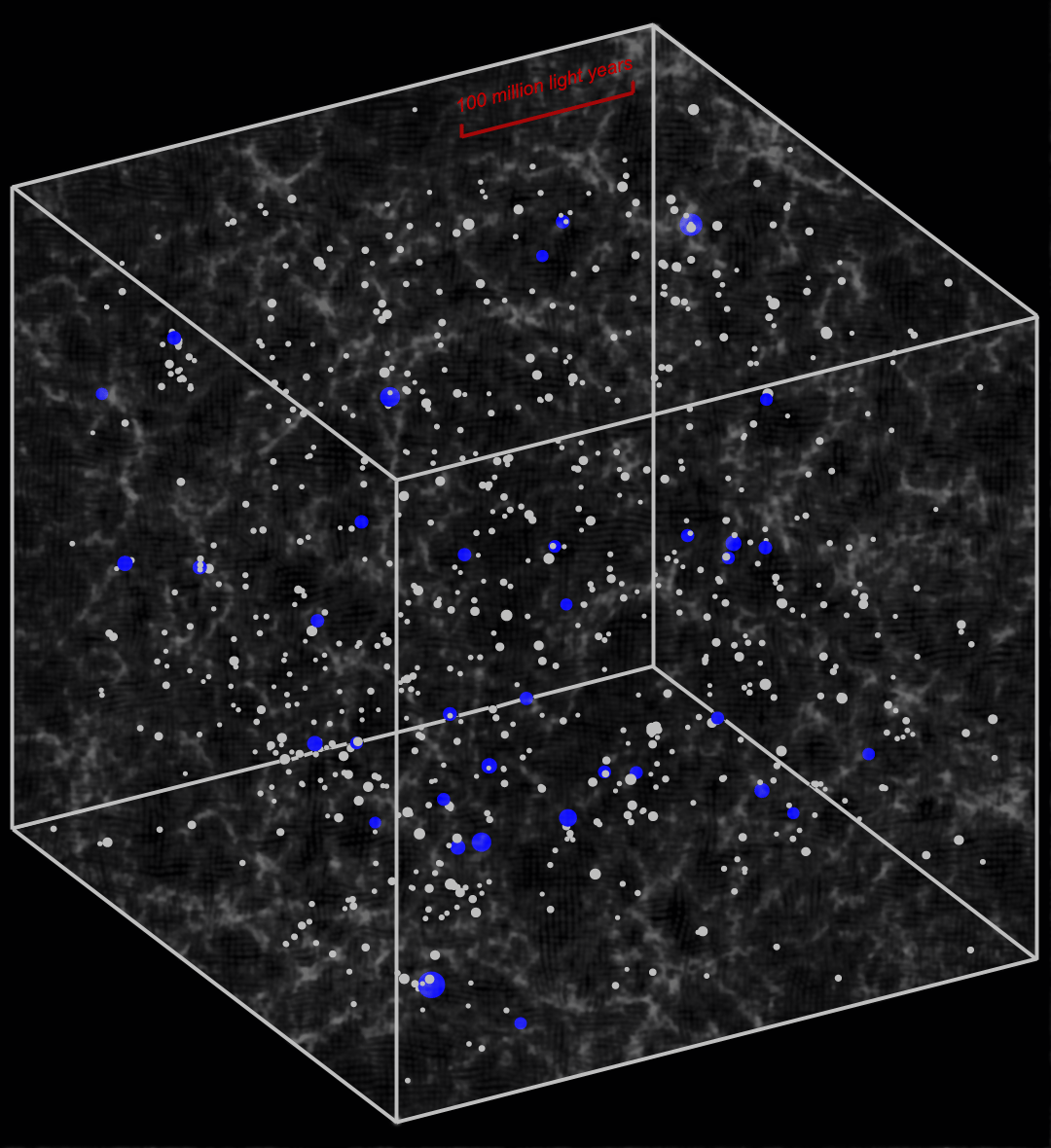
Yue Shen et al.: Clustering of High Redshift (Z > 2.9) Quasars from the Sloan Digital Sky Survey
NASA's Largest Space Telescope Mirror Will See Deeper Into Space
When scientists are looking into space, the more they can see, the easier it is to piece together the puzzle of the cosmos. The James Webb Space Telescope’s mirror blanks have now been constructed. When polished and assembled, together they will form a mirror whose area is over seven times larger than the Hubble Telescope’s mirror. JWST’s mirror is made up of 18 mirror segments that form a total area of 25 square-meters when they all come together.
https://www.nasa.gov/vision/universe/starsgalaxies/mirror_size.html
COROT started its science mission
COROT, the satellite to probe into the interiors of stars and to look for extra-solar planets, has completed its in-orbit verification and started its science observations on February 3rd this year.
Images
Supernovae als kosmische Entfernungsmesser
Wie kosmische Leuchtfeuer stehen Supernovae am Himmel. Wissenschaftler vom Max-Planck-Institut für Astrophysik und dem Nationalen Astronomischen Institut Italiens haben nun einen Weg gefunden, um Entfernungen im All mit den kosmischen Leuchtfeuern künftig genauer zu messen. Die Forscher konnten zeigen, dass alle Supernovae eines bestimmten Typs mit der gleichen Masse und der gleichen Energie explodieren – die Leuchtstärke hängt nur davon ab, wie viel Nickel die Supernova enthält. Mit diesem Wissen können die Forscher die Helligkeit der Supernovae jetzt genauer eichen. Daher können sie aus der Helligkeit einer Supernova, die sie mit ihren Teleskopen beobachten, künftig präziser bestimmen, wie weit von der Erde entfernt der kosmische Leuchtturm strahlt.
Supernovae als kosmische Leuchttürme:
Astrophysiker erklären Unterschiede in der Helligkeit von Sternexplosionen
Tour de Saturn Set For Extended Play
The Cassini spacecraft is now two and half years through its official „primary tour“ of the Saturn system which is scheduled to last another 17 months before ending on June 30, 2008. During this primary tour Cassini will have made 46 close flybys of Titan (during one of which it dropped off the successful European Space Agency’s Huygens Titan lander), four close flybys of the unexpectedly fascinating moon Enceladus, and one each of Tethys, Dione, Rhea, Hyperion, Iapetus and Phoebe. On the basis of what is done so far Cassini must be considered a scientific and space art spectacular. It has revealed major new mysteries about Titan and Enceladus which have a direct relevance to the possibility that one or both moons have evolved microscopic life. Moreover, Cassini has apparently solved at least two of the biggest scientific mysteries about the Saturn system: the mysterious longevity of its ring system, and the remarkable difference between Iapetus‘ black leading side and its bright whitish trailing side. Later this year in September, having completed most of the planned flybys of Saturn’s smaller moons, Cassini will make its one close flyby of the distant and hard-to-reach moon Iapetus. Coming within 1.500 km it will be able to make its best observations of Iapetus and hopefully solve the remaining puzzles about it. The following March in 2008 Cassini will make its closest flyby of Enceladus skimming a mere 23 km above the geyser-like water and ice plumes which are erupting from the south polar region. Scientists working with Cassini are looking at how an extended mission would work. From the time Cassini first entered orbit around Saturn, they have been working on the design of a possible extended tour, re-planning it on the basis of the craft’s new discoveries about the Saturn system.
Cassini: Mission to Saturn
Carbon dioxide may have saved Earth from freezing over
The greenhouse gas that has become a bane of modern society, may have saved Earth from freezing over early in the planet’s history, according to the first detailed laboratory analysis of the world’s oldest sedimentary rocks. Scientists have theorized for years that high concentrations of greenhouse gases could have helped Earth avoid global freezing in its youth by allowing the atmosphere to retain more heat than it lost. Now a team from the University of Chicago and the University of Colorado at Boulder that analyzed ancient rocks from the eastern shore of Hudson Bay in northern Quebec, Canada, have discovered the first direct field evidence supporting this theory. The study shows carbon dioxide in Earth’s atmosphere could have sustained surface temperatures above freezing before 3,75 billion years ago.
Identification of chemical sedimentary protoliths using iron isotopes in the > 3750 Ma Nuvvuagittuq supracrustal belt, Canada
Mars probe snaps dramatic new images of gullies
Dramatic new images of gullies and dried-up streambeds bolster evidence that water once gushed across the surface of Mars. The images are the latest from NASA’s Mars Reconnaissance Orbiter (MRO), which boasts the most powerful camera ever sent to Mars.
Evidence of Multiple Episodes of Gully Formation
X-Ray technology will see moving bones inside living body
Brown University researchers are creating a technology that will allow doctors and scientists to do the seemingly impossible: see inside living humans and animals and watch their bones move in 3-D as they run, fly, jump, swim and slither. The new high-resolution, high-speed X-Ray imaging system will contribute to better treatments for knee, shoulder, wrist and back injuries and help scientists understand the evolution of complex movements – from the flight of birds to the leap of frogs.