An extraordinary underwater trackway with 12 consecutive prints provides the most compelling evidence to date that some dinosaurs were swimmers. The 15-meter-long trackway, located at the La Virgen del Campo track site in Spain’s Cameros Basin, contains the first long and continuous record of swimming by a non-avian therapod dinosaur.
Solscape
Astronomers View First Mutual Event For Uranus
An international team of astronomers led by Apostolos Christou at Armagh Observatory has made the first ever observation of one of the satellites of the planet Uranus passing in front of another. The observation was made on the night of May 4, 2007, by using the robotic Faulkes Telescope South at Siding Spring Observatory, Australia.
https://web.archive.org/web/20160701213854/http://www.arm.ac.uk/press/2007/uranus_event03.html
https://web.archive.org/web/20170701014326/http://star.arm.ac.uk/~aac/uranus/
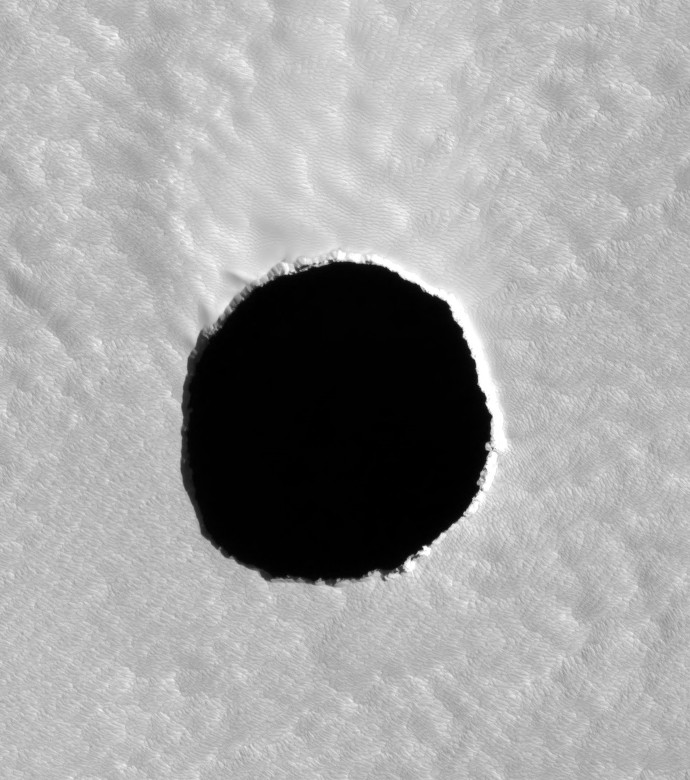
The Bottomless Pit of Tharsis
This cavern opening, about 100 meters across, is found on a lava plain in the volcanic Tharsis region of Mars. It’s so dark and deep that even the Mars Reconnaissance Orbiter’s sensitive cameras cannot peer into its depths (although the shot was taken at 03:27 p.m. Mars time, so the sun was about 38 degrees above the horizon). It’s probably a collapse pit formed when a lava tube or similar structure underneath the surface gave way. The entrance walls may actually be overhanging, concealing a space who knows how large that hides who knows what.
https://hirise.lpl.arizona.edu/PSP_003647_1745
Multi-planet system found
Using the McDonald Observatory, astronomers have discovered a system of two Jupiter-like planets orbiting a star whose composition might seem to rule out planet formation.
A Planetary System Around HD 155358: The Lowest Metallicity Planet Host Star
Berliner Humboldt-Uni stellt Sammlungen ins Internet
Rund 14.000 Stücke aus den wissenschaftlichen Sammlungen der Berliner Humboldt-Universität können von nun an im Netz betrachtet werden. Darunter befinden sich in digitalisierter Form u.a. frühe Grafiken aus der Bibliothek der Universität, Objekte aus einer historischen Instrumentensammlung und Mikropräparate der Zoologischen Lehrsammlung. Der Hochschule zufolge können viele der Ausstellungsstücke erstmals von der Öffentlichkeit betrachtet werden, weil die entsprechenden Archive nicht zugänglich waren oder es zum Teil immer noch nicht sind.
Scientists Evolve New Proteins From Scratch
Nature, through the trial and error of evolution, has discovered a vast diversity of life from what can only presumed to have been a primordial pool of building blocks. Inspired by this success, a new Biodesign Institute research team, led by John Chaput, is now trying to mimic the process of Darwinian evolution in the laboratory by evolving new proteins from scratch. Using new tricks of molecular biology, Chaput and co-workers have evolved several new proteins in a fraction of the 3 billion years it took nature.
A new wrinkle in evolution – Man-made proteins
Künstliche Evolution – Ein vom Menschen geschaffenes Protein
Clumps found in Saturn's rings
Scientists working with data from NASA’s Cassini spacecraft have concluded that one of Saturn’s major rings is composed of clumps of material rather than a more uniform distribution of smaller objects. Planetary scientists used a series of stellar occultations, where the rings passed in front of a star, to perform a „CAT scan“ of the rings, analyzing the distribution of particles within them. They found that one ring, the B ring, contains tightly-packed clumps of material with wider spacings between the clumps than previously expected. The clumps are constantly forming and being town apart by Saturn’s gravity, often colliding with one another. This clumpiness may mean that Saturn’s rings are two to three times as massive as previously thought.
Cassini ‚Cat Scan‘ Maps Clumps in Saturn’s Rings
Spirit Unearths Evidence Of Mars' Wetter Past
A patch of Martian soil analyzed by NASA’s rover Spirit is so rich in silica that it may provide some of the strongest evidence yet that ancient Mars was much wetter than it is now. The processes that could have produced such a concentrated deposit of silica require the presence of water.
https://mars.nasa.gov/mer/newsroom/pressreleases/20070521a.html
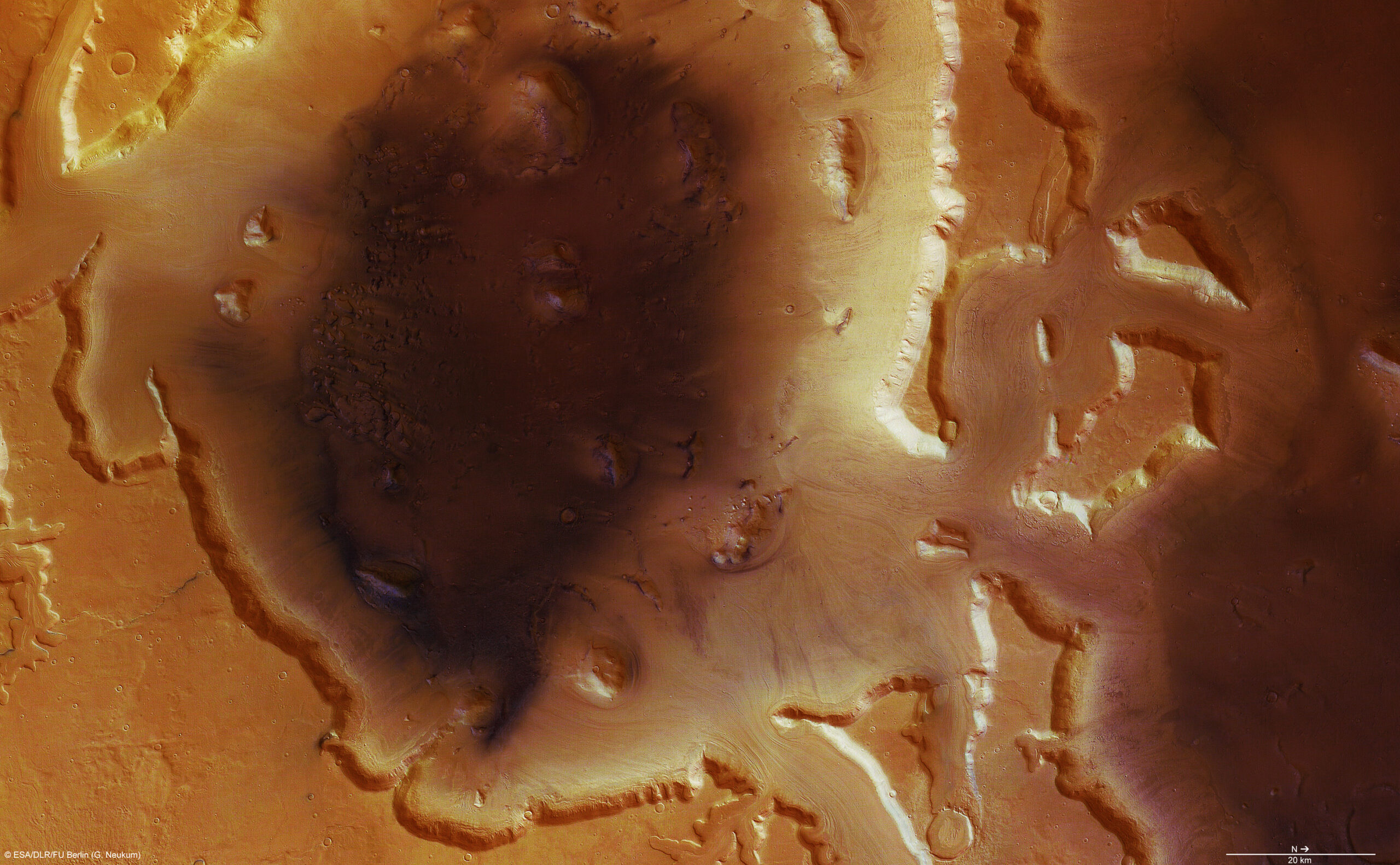
Catastrophic Floods on Mars
A new amazing image captured by ESA’s Mars Express spacecraft shows the Deuteronilus Mensae on Mars, a region shaped by melting glaciers millions of years ago. The large depression in the middle of the image is approximately 2 km deep, and measures 110 km across.
Organic Chemicals in Titan’s High Atmosphere
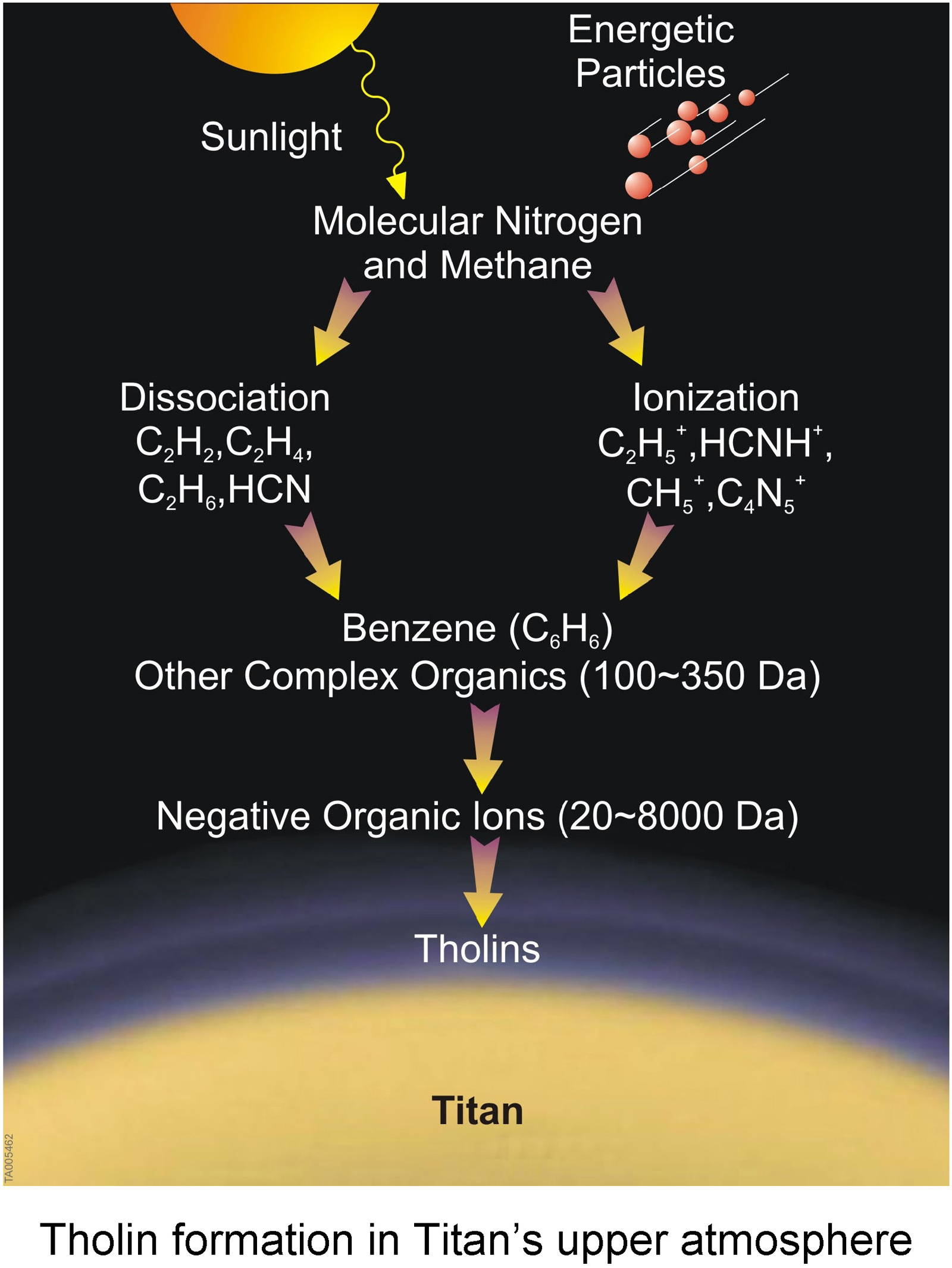
Since the twin Voyager spacecraft flew past Saturn’s moon Titan, scientists have been excited about what its hazy atmosphere can tell us about the earliest days of our own planet. The Voyagers discovered that Titan’s atmosphere is swirling with hydrocarbons and other complex organic molecules that could be the building blocks of life. The latest findings from NASA’s Cassini spacecraft have uncovered that these organic molecules are floating higher in Titan’s atmosphere than scientists originally thought. The latest research, published in the May 11 edition of the journal „Science“, shows that these organic aerosols, called tholins, have been found in altitudes higher than 1.000 kilometres above the surface of Titan. This is important because Titan’s environment is thought to be very similar to Earth’s early history, before the first life formed. A similar process could have happened here.
Hunter Waite et al.: „The Process of Tholin Formation in Titan’s Upper Atmosphere“