Solscape

Dramatic step forward in hunt for an Earth twin

For the first time ever, NASA researchers have successfully demonstrated in the laboratory that a space telescope rigged with special masks and mirrors could snap a photo of an Earth-like planet orbiting a nearby star. This accomplishment marks a dramatic step forward for missions like the proposed Terrestrial Planet Finder, designed to hunt for an Earth twin that might harbor life.

https://www.jpl.nasa.gov/news/nasa-shows-future-space-telescopes-could-detect-earth-twin

The color of plants on planets in other solar systems

NASA scientists believe they have found a way to predict the color of plants on planets in other solar systems. Green, yellow or even red-dominant plants may live on extra-solar planets, according to scientists whose two scientific papers appear in the March issue of the journal „Astrobiology“. The scientists studied light absorbed and reflected by organisms on Earth, and determined that if astronomers were to look at the light given off by planets circling distant stars, they might predict that some planets have mostly non-green plants.
https://www.nasa.gov/centers/goddard/news/topstory/2007/spectrum_plants.html

Spectral Signatures of Photosynthesis. I. Review of Earth Organisms

Spectral Signatures of Photosynthesis. II. Coevolution with Other Stars And The Atmosphere on Extrasolar Worlds

Virtual Planetary Laboratory

Grube Messel – Fenster in die Urzeit

Die Grube Messel in der Nähe von Darmstadt diente von 1859 bis 1962 als Abbaugebiet für Ölschiefer. Dabei wurden bereits 1875 erste Fossilien gefunden, jedoch waren zu jener Zeit die Präparationsmethoden noch nicht ausreichend, um die Funde erhalten zu können. Inzwischen ist die Forschung in der Lage, diese „Nachrichten“ aus der Vergangenheit exakt zu interpretieren: die in der Grube Messel gefundenen Fossilien stammen aus dem Eozän, der sog. „Zeit der Morgenröte“ vor rund 47 Millionen Jahren. Damals war die Ölschiefergrube ein blühender Lebensraum für urzeitliche Tiere und Pflanzen. Nach dem Aussterben der Saurier vor rund 65 Millionen Jahren hatten sich viele Säugetiere explosionsartig entwickelt, wie die einzigartigen Funde in der Grube Messel belegen. Mit bislang rund 10.000 Funden ist sie eine der weltweit ergiebigsten Fossillagerstätten; bekannt wurde sie vor allem durch das sog. „Urpferd“, von dem über 70 Exemplare, darunter 32 vollständig erhaltene Skelette, gefunden wurden. Ungeachtet der einmaligen Fossilienfunde plante die Hessische Landesregierung, die Grube Messel nach der Einstellung des Ölschieferabbaus in Südhessens größte Müllkippe umzuwandeln. Glücklicherweise zwang eine Bürgerinitiative die Verantwortlichen auf einen zähen Weg durch die Rechtsinstanzen; schließlich war es ein Verfahrensfehler, der die Pläne für eine Müllkippe stoppte. Später kaufte das Land Hessen das Gelände auf und unterstellte es dem Frankfurter Forschungsinstitut und Naturkundemuseum Senckenberg, das seither kontinuierlich graben und forschen kann. Am 8. Dezember 1995 wurde die Grube Messel als erste und bislang einzige Naturerbestätte Deutschlands von der UNESCO in die Liste des Weltkultur- und Naturerbes der Menschheit aufgenommen.
Ein Besuch der Grube Messel und die Besichtigung der Ausgrabungen ist in den Monaten April bis Oktober möglich, allerdings nur mit Führung. Eine Aussichtsplattform am Grubenrand ist ganzjährig frei zugänglich und bietet einen eindrucksvollen Blick auf den ehemaligen Ölschiefertagebau, der einst eine Seenlandschaft im urzeitlichen Regenwald war.

Im Dschungel Südhessens – Weltnaturerbe Grube Messel geht „on Tour“

UNESCO Weltnaturerbe Grube Messel

Senckenberg world of biodiversity

Hessisches Landesmuseum Darmstadt – Grube Messel

Water Found in Extrasolar Planet’s Atmosphere

Astronomers have detected water in the atmosphere of a planet outside our solar system for the first time. Using a combination of previously published Hubble Space Telescope measurements and new theoretical models, they found strong evidence for water absorption in the atmosphere of the extrasolar planet HD209458b. HD209458b is a world well-known among planet hunters. In 1999, it became the first planet to be directly observed around a normal star outside our solar system and, a few years later, was the first exoplanet confirmed to have oxygen and carbon in its atmosphere. HD209458b is separated from its star by only 7 million kilometres – about 100 times closer than Jupiter is to our Sun – and is so hot scientists think it is losing about 10.000 tons of material every second as vented gas.

Water Identified in Extrasolar Planet Atmosphere (PDF; 14 KB)

T. S. Barman: Identification of Absorption Features in an Extrasolar Planet Atmosphere

Earth's magnetic field grew strong at a young age

Geophysicists have probed deep into Earth’s childhood and recorded the earliest measurement yet of the magnetic field that protects the planet from devastation by the solar wind. The finding provides new insight into Earth’s early years and could even reveal more about when life began. The history of Earth’s geomagnetic field plays a key role in scientists‘ understanding of the development of our planet’s deep interior, its atmosphere, and even the early evolution of terrestrial life. But scientists have had a hard time pinning down how long ago the magnetosphere first formed. Now, geophysicist John Tarduno at the University of Rochester in New York, and colleagues, have made the earliest direct measurement of Earth’s magnetic field. They discovered that the magnetosphere was already in existence 3.2 billion years ago, 500 million years earlier than previously believed. The researchers extracted minimally disturbed bits of feldspar and quartz from 3.2 billion-year-old rocks in the Archaean Kaapvaal craton in South Africa.
Abstract (PDF): Rory D. Cottrell, John A. Tarduno and Michael K. Watkeys
„Examining the strength of Earth’s early magnetic field“

Earth's Core-Mantle Boundary: Now In High Resolution Images

High-resolution images that reveal unexpected details of the Earth’s internal structure are among the results reported by MIT and Purdue scientists in the March 30 issue of „Science“. The researchers adapted technology developed for near-surface exploration of reservoirs of oil and gas to image the core-mantle boundary some 2.900 kilometers beneath Central and North America.
https://news.mit.edu/2007/mantle

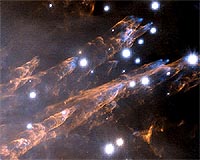
Supersonic bullets shoot through the Orion Nebula

Orion "bullets"
(Gemini Observatory)

Bullet-like clumps of gas hurtle through the Orion stellar nursery at supersonic speed in this new image from the Gemini North observatory. The unusual structures are revealed in unprecedented detail by newly commissioned laser-equipped optics. The so-called „bullets“ are located in the Orion Nebula, a star-forming region about 1500 light years from Earth. Each of the few dozen observed is a dense clump of gas about ten times as wide as Pluto’s orbit around the Sun. Tearing through the surrounding medium of thin gas at 400 kilometres per second, the bullets create shock waves in front of them. As the shock waves propagate, they produce lengthy glowing trails – each about 400 times longer than our entire solar system.

Gemini’s Laser Vision Reveals Striking New Details in Orion Nebula

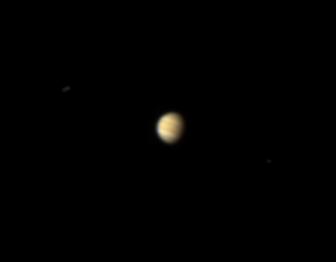
Jupiter As Seen From Saturn

It’s not a great picture of Jupiter, but that’s not the point. The point is that this photograph was taken by NASA’s Cassini spacecraft currently orbiting Saturn. When the picture was taken, Cassini was approximately 1.8 billion kilometres from Jupiter. So, at the time of the photograph, the distance from Saturn to Jupiter was roughly the same as the distance from the Earth to Saturn. A similar picture of Earth would only light up a single pixel in Cassini’s camera.

https://solarsystem.nasa.gov/resources/13540/hello-again-jupiter/

Hinode's Amazing New Images of the Sun's Surface

NASA and ESA have released some absolutely amazing new images of the surface of the Sun, taken by the Japanese Hinode spacecraft (formerly known as Solar-B). For the first time, astronomers are able to see how tiny granules of hot gas rise and fall, caught up in the Sun’s magnetic atmosphere. They’re able to watch how magnetic variations start out, and then spread across the surface.
The photographs are beautiful, but what will really blow your mind are the videos.

Moon affects Saturn's rotation period

Because Saturn doesn’t have a visible surface, scientists have used the rotation period of the planet’s magnetic field to measure the planet’s rotation, a technique used successfully for other gas giants. In a paper published in last week’s issue of „Science“, researchers said that geysers erupting from Saturn’s moon Enceladus eject water vapor and ice that interact with the planet’s magnetic field, weighing down the field and making the planet to appear to rotate more slowly. This effect may explain past observed changes in the planet’s rotation period.
Enceladus Geysers Mask the Length of Saturn’s Day