
Astronomers have discovered the most earthlike planet outside our solar system to date.
Using the ESO 3.6m telescope at La Silla, Chile, a team of Swiss, French, and Portuguese scientists discovered a super-Earth about 5 times the mass of the Earth that orbits a red dwarf, already known to harbour a Neptune-mass planet. The astronomers have also strong evidence for the presence of a third planet with a mass about 8 Earth masses. The newly discovered exoplanet is the smallest ever found up to now and it completes a full orbit in 13 days. It is 14 times closer to its star than the Earth is from the Sun. However, given that its host star, the red dwarf Gliese 581, is smaller and colder than the Sun, the planet nevertheless lies in the habitable zone, the region around a star where water could be liquid!
„We have estimated that the mean temperature of this super-Earth lies between 0 and 40 degrees Celsius, and water would thus be liquid,“ explains Stephane Udry from the Geneva Observatory (Switzerland) and lead-author of the paper reporting the result. „Moreover, its radius should be only 1,5 times the Earth’s radius, and models predict that such a planet should be either rocky or covered with oceans,“ he adds. „Because of its temperature and relative proximity, this planet will most probably be a very important target of the future space missions dedicated to the search for extra-terrestrial life. On the treasure map of the Universe, one would be tempted to mark this planet with an X.“
The host star, Gliese 581, is among the 100 closest stars to us, located only 20,5 light-years away in the constellation Libra. It has a mass of only one third the mass of the Sun. Such red dwarfs are at least 50 times fainter than the Sun and are the most common stars in our Galaxy: among the 100 closest stars to the Sun, 80 belong to this class.
Two years ago, the same team of astronomers already found a planet around Gliese 581. With a mass of 15 Earth-masses, i.e. similar to that of Neptune, it orbits its host star in 5,4 days. At the time, the astronomers had already seen hints of another planet. They therefore obtained a new set of measurements and found the new super-Earth, but also clear indications for another one, an 8 Earth-mass planet completing an orbit in 84 days. The planetary system surrounding Gliese 581 contains thus no fewer than 3 planets of 15 Earth masses or less, and as such is a quite remarkable system.
Story adapted from the ESO Press Release:
Astronomers Find First Earth-like Planet in Habitable Zone
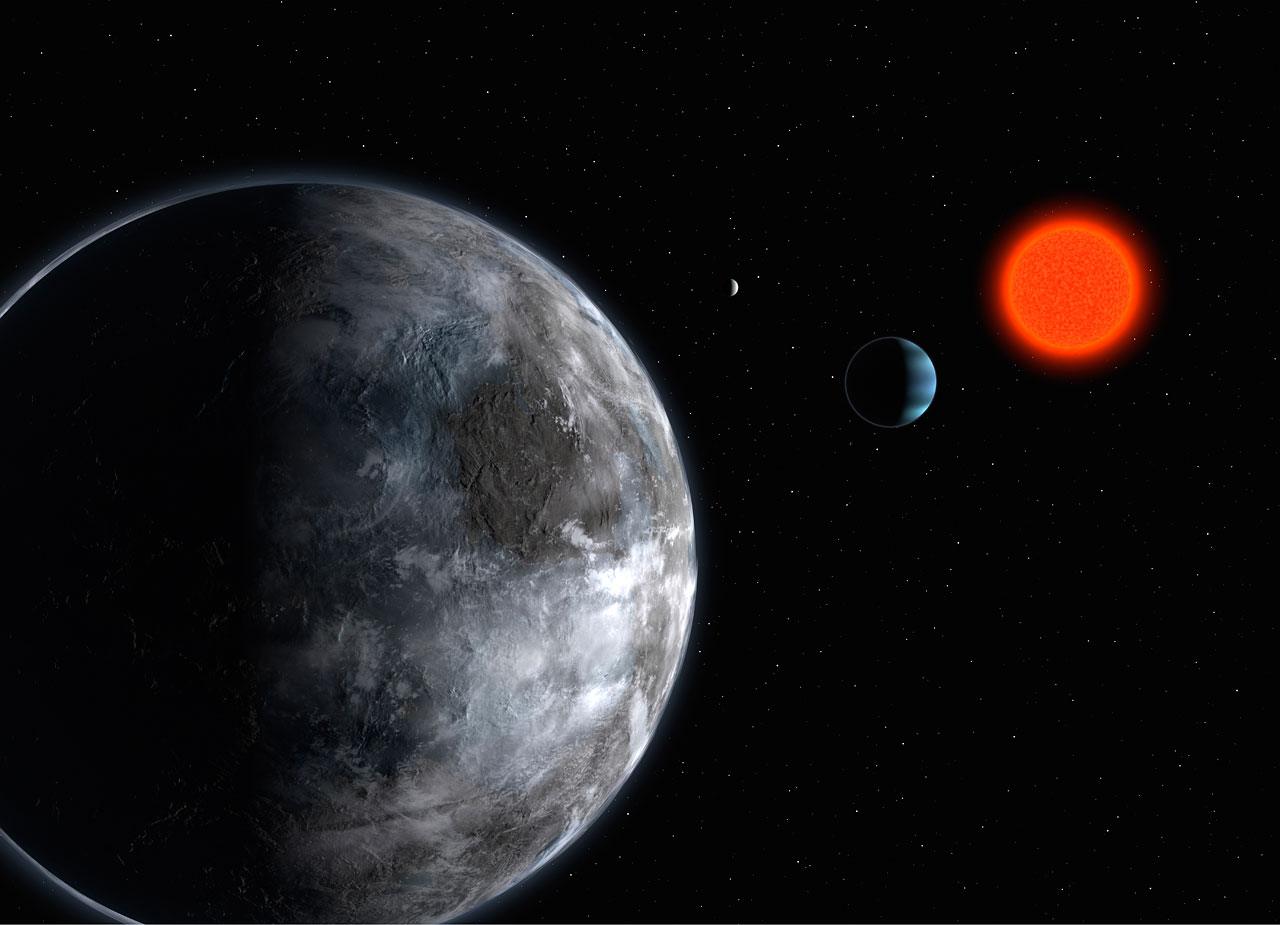
Earthlike exoplanet found
26. April 2007