
Jupiter’s cloud patterns are undergoing dramatic changes, as revealed by new images of the Hubble Space Telescope. Similar transformations of the giant planet’s clouds have been witnessed in the 1980s and early 1990s, but never in such detail – and they have never been explained. Hubble has been keeping an eye on Jupiter to provide context for close-up observations made by NASA’s New Horizons spacecraft, which flew by the solar system’s largest planet in February on its way to Pluto. At this time some changes were already evident. Then, between March 25 and June 5th, a white band in the planet’s northern hemisphere turned brown, while a gap in the cloud layer produced a serpent-shaped dark streak in the same area.
Hubble Catches Jupiter Changing Its Stripes
Solscape
Could a crater solve the 1908 meteor mystery?
In late June of 1908, a fireball exploded above the remote Russian forests of Tunguska, Siberia, flattening more than 800 square miles of trees. Researchers think a meteor was responsible for the devastation, but neither its fragments nor any impact craters have been discovered so far. Italian researchers now think they’ve found a smoking gun: the 164-foot-deep Lake Cheko, located just 5 miles northwest of the epicenter of destruction.
Molecule from frog eggs could help treat brain tumors
A synthetic version of a molecule found in the egg cells of the Northern Leopard frog could provide the world with the first drug treatment for brain tumours. Known as Amphinase, the molecule recognises the sugary coating found on a tumour cell and binds to its surface before invading the cell and inactivating the RNA it contains, causing the tumour to die.
http://www.bath.ac.uk/news/2007/6/26/amphinase.html
Substance from tree bark kills certain kinds of cancer cells
Researchers at UT Southwestern Medical Center have determined how a substance derived from the bark of the South American lapacho tree kills certain kinds of cancer cells, findings that also suggest a novel treatment for the most common type of lung cancer. The compound, called beta-lapachone, has shown promising anti-cancer properties and is currently being used in a clinical trial to examine its effectiveness against pancreatic cancer in humans. Until now, however, researchers didn’t know the mechanism of how the compound killed cancer cells.
Substance in tree bark could lead to new lung-cancer treatment
Atlantis lands in California
Atlantis and its seven astronauts returned to Earth safely on Friday at 3:49 p.m. EDT, ending a two-week mission to deliver an addition to the International Space Station and bring a crew member home from the outpost. NASA managers had hoped skies would clear for one of two landing opportunities at the Kennedy Space Center in Florida on Friday, but dense clouds and rain forced controllers to abandon that plan. NASA had to forego two landing opportunities in Florida on Thursday as well because of bad weather.
Astronaut Sunita Williams returned to Earth on Atlantis after spending more than six months at the space station. She set an endurance record for the longest single spaceflight by a woman at 195 days. During her stay, she also set the record for most time spacewalking by a woman.
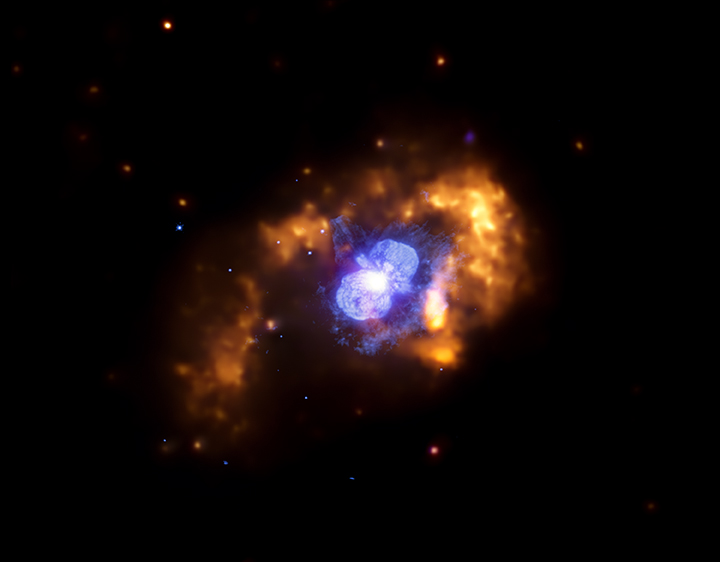

Hubble photographs two huge asteroids
The Hubble Space Telescope has imaged two of the largest known asteroids, revealing craters and other features that will soon be the targets of close-up observations by NASA’s Dawn spacecraft.
Hubble Images of Asteroids Help Astronomers Prepare for Spacecraft Visit
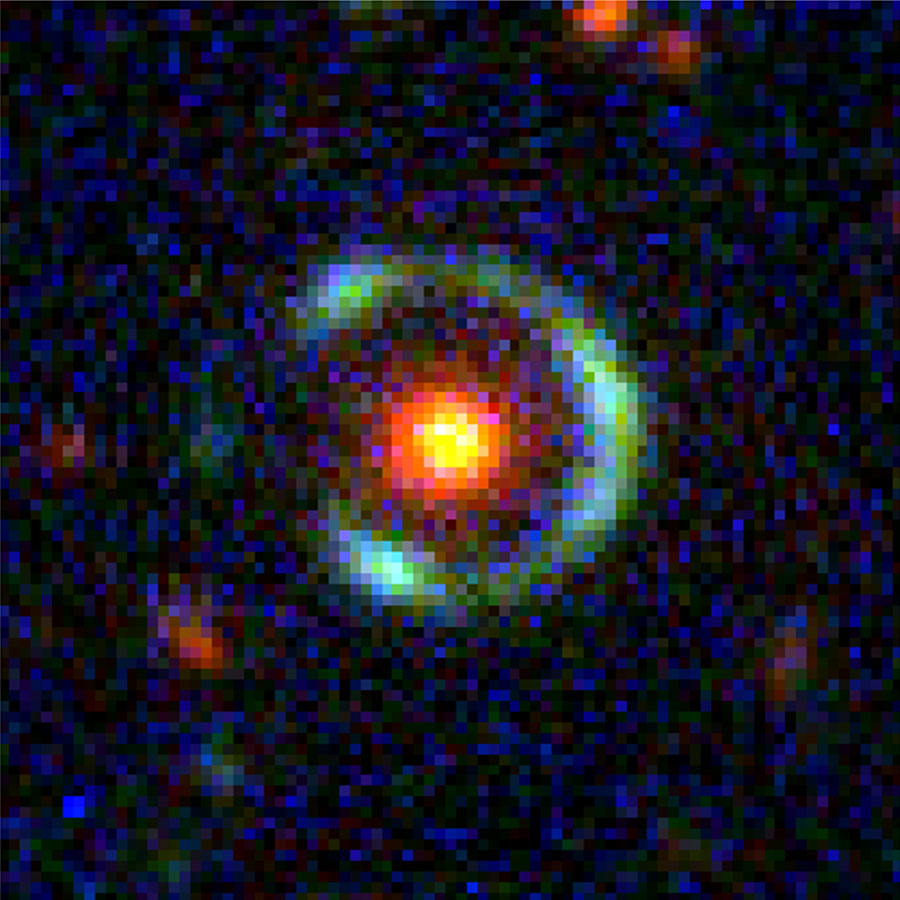
SDSS finds a "Cosmic Horseshoe"
A team led by Vasily Belokurov at the University of Cambridge has found the largest and most complete optical Einstein ring known to date. The object, which was dubbed the „Cosmic Horseshoe“, provides a unique laboratory for studying what the universe was like at less than a quarter of its present age.
An Einstein ring is a kind of cosmic mirage. Gravity from a foreground galaxy distorts light from a background galaxy into an arc. If the alignment between the background galaxy and the foreground „lensing“ galaxy is precise enough, the distant galaxy’s light becomes warped into a complete ring.
Mars was once covered with vast oceans
Mars, the rugged Red Planet, may have once been blue, according to new research that suggests massive ancient oceans that once covered a third of its surface. The new findings by a joint Canada-U.S. research team provide strong evidence that kilometre-high features seen on the planet’s surface today are actually the shorelines of ancient seas.
http://www.berkeley.edu/news/media/releases/2007/06/13_mars.shtml
Two More of Saturn’s Moons are Blasting Out Particles
One of Cassini’s greatest discoveries are the ice geysers pouring out of Saturn’s moon Enceladus. Recent research by the NASA/ESA Cassini team suggests that this icy moon isn’t the only geologically-active world orbiting the ringed planet. Two other Saturnian moons, Tethys and Dione, are shooting streams of charged particles into space, and this may be a sign of geysers like those on Enceladus.