
The most detailed survey of the entire sky at infrared wavelengths has been made by Japan’s AKARI satellite. It will help astronomers produce a complete census of all nearby galaxies.
After one year of observations; The Universe as seen by AKARI (July 11, 2007)
Solscape
Spitzer Finds Water Vapor On Alien Planet
A scorching-hot gas planet beyond our solar system is steaming up with water vapor, according to new observations from NASA’s Spitzer Space Telescope. The planet, called HD 189733b, swelters as it zips closely around its star every two days or so. Astronomers had predicted that planets of this class, termed „hot Jupiters“, would contain water vapor in their atmospheres. Yet finding solid evidence for this has been slippery. These latest data are the most convincing yet that hot Jupiters are „wet“.
https://www.spitzer.caltech.edu/news/ssc2007-12-nasas-spitzer-finds-water-vapor-on-hot-alien-planet
Shuttle Endeavour arrives at launch pad
For the first time in almost five years, space shuttle Endeavour moved to the launch pad Tuesday in preparation for a flight which will deliver teacher-turned-astronaut Barbara Morgan and her six crew mates to the international space station. Endeavour is due to launch August 7.
https://www.nasa.gov/mission_pages/shuttle/shuttlemissions/sts118/main/index.html
Greenland was warmer than previously believed
A team of international researchers has collected the oldest ever recovered DNA samples and used them to show that Greenland was much warmer at some point during the last Ice Age than most people have believed. The ancient DNA was discovered at the bottom of a two kilometer thick ice sheet and came from the trees, plants and insects of a boreal forest estimated to be between 450.000 and 900.000 years old. Previously, the youngest evidence of a boreal forest in Greenland was from 2,4 million years ago.
Ancient DNA reveals Greenland’s warm past
Ancient Biomolecules from Deep Ice Cores Reveal a Forested Southern Greenland
Erde ist kleiner als gedacht
Geodäten der Universität Bonn haben zusammen mit Kollegen aus aller Welt die Erde neu vermessen. Sie machten sich dabei die großen Antennen der Radioastronomen zunutze und beobachteten eines von deren Lieblingsobjekten: weit entfernte Quasare. So konnten sie feststellen, dass unser Heimatplanet kleiner ist als bislang angenommen – wenn auch nur einige Millimeter.
Uni Bonn: Die Erde ist kleiner als angenommen
New tasks given to old NASA spacecraft
NASA said Tuesday it is recycling two used spacecraft to lead new robotic missions to study comets and planets around other stars. The encore performances of the Deep Impact and Stardust probes allow the space agency to further its solar system exploration for a fraction of the cost it would take to start a mission from scratch.
Scientists plan to activate Deep Impact later this year for a two-part mission that includes collecting data on extrasolar planets to determine whether they have rings, moons or other features. Deep Impact will become an observatory looking at distant stars already known to be orbited by giant planets. After that, Deep Impact will pass the comet 85P/Boethin in December 2008.
In 2005, Deep Impact released a copper impactor that smashed into comet Tempel 1. NASA now plans to send Stardust to Tempel 1 to examine the crater created by this impact. Scientists failed to image the crater after the collision because the plume blocked the view, but they hope to get a second chance with Stardust when it flies by the comet in 2011.
NASA Gives Two Successful Spacecraft New Assignments
Computer simulation verifies relationships between black holes and galaxies
By incorporating the physics of black holes into a highly sophisticated model running on a powerful supercomputing system, an international team of scientists has produced an unprecedented simulation of cosmic evolution that verifies and deepens our understanding of relationships between black holes and the galaxies in which they reside. Called BHCosmo, the simulation shows that black holes are integral to the structure of the cosmos.
Direct cosmological simulations of the growth of black holes and galaxies
Modern Brains Have An Ancient Core
Hormones control growth, metabolism, reproduction and many other important biological processes. In humans, and all other vertebrates, the chemical signals are produced by specialised brain centres such as the hypothalamus and secreted into the blood stream that distributes them around the body. Researchers from the European Molecular Biology Laboratory (EMBL) now reveal that the hypothalamus and its hormones are not purely vertebrate inventions, but have their evolutionary roots in marine, worm-like ancestors.
https://www.embl.de/aboutus/communication_outreach/media_relations/2007/070629_heidelberg/index.html
Opportunity is ready to descend into Victoria Crater
NASA’s Mars rover Opportunity has been tentatively checking out the northern rim of Victoria Crater, gathering as much science data as it can before going down inside. Mission controllers announced yesterday that they’re ready to push the rover „over the edge“, and send it on a potentially one-way journey down into the crater.
The plan is that Opportunity will head into the crater on either July 7th or July 9th.
NASA Mars Rover Ready for Descent Into Crater
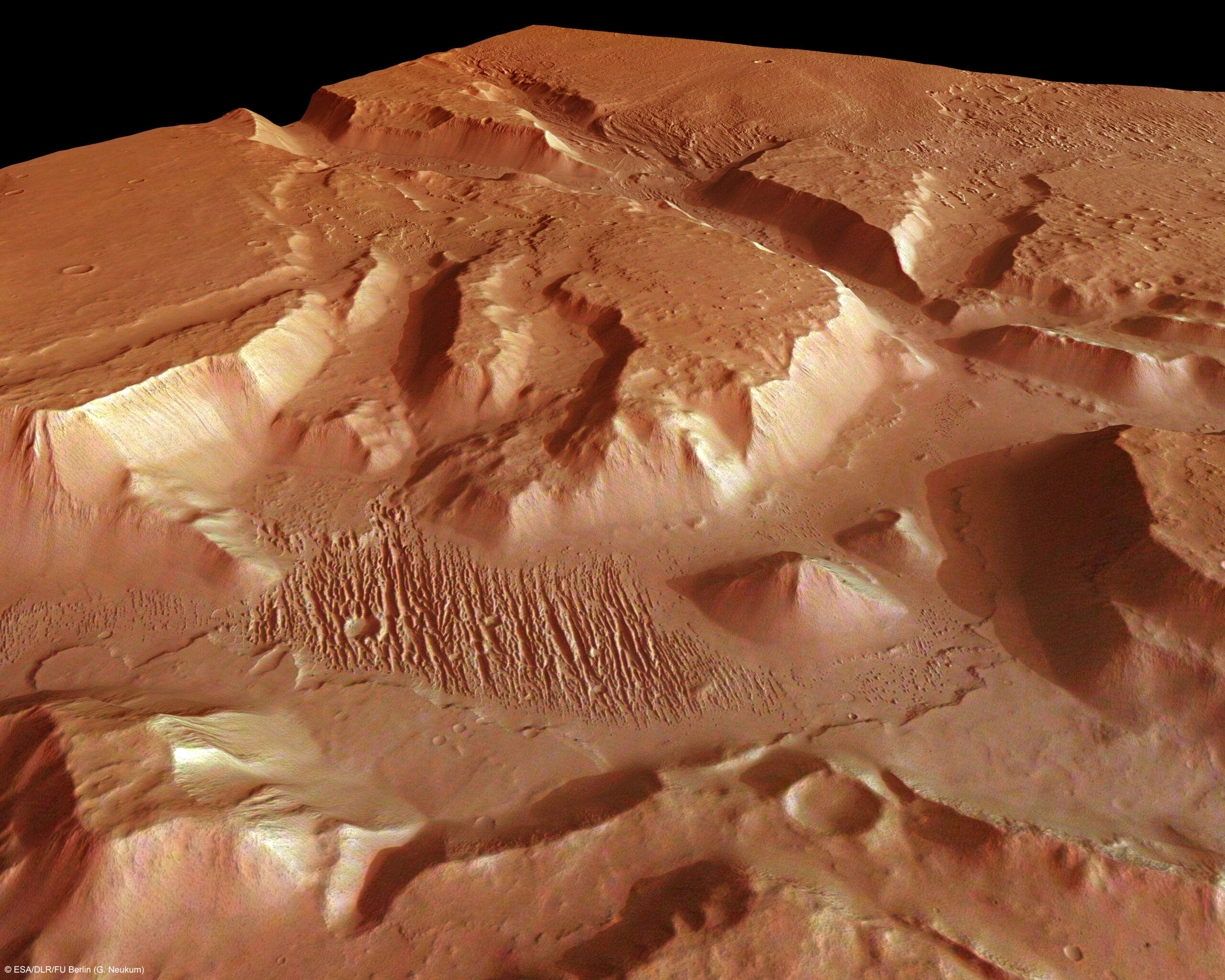
Mars Express: Strange Features at Aeolis Mensae
A new image taken by ESA’s Mars Express spacecraft shows the Aeolis Mensae region on Mars, an area known to be on a tectonic transition zone which separates the southern highlands and the northern lowlands. The area is nearby the volcanic region of Elysium.
Tectonic signatures at Aeolis Mensae