
NASA’s Hubble and Spitzer Space Telescopes have joined forces to discover nine of the smallest, faintest, most compact galaxies ever observed in the distant universe. Blazing with the brilliance of millions of stars, each of the newly discovered galaxies is a hundred to a thousand times smaller than our Milky Way Galaxy.
The conventional model for galaxy evolution predicts that small galaxies in the early universe evolved into the massive galaxies of today by coalescing. These nine Lego-like „building block“ galaxies initially detected by Hubble likely contributed to the construction of the universe as we know it.
https://hubblesite.org/contents/news-releases/2007/news-2007-31.html
Solscape
"Clearest" images taken of space
Astronomers from the University of Cambridge and the California Institute of Technology (Caltech) have developed a new camera that gives much more detailed pictures of stars and nebula than even the Hubble Space Telescope, and it does all this from the ground.
Images from ground-based telescopes are usually blurred out by the atmosphere. Scientists have tried to develop techniques to correct the blurring called „adaptive optics“ but so far they only work successfully in the infrared where the smearing is greatly reduced. However a new noise-free, high-speed camera has been developed at the Institute of Astronomy in Cambridge which makes very high resolution imaging possible in the visible light. The camera works by recording the images produced by an adaptive optics front-end at high speed (20 frames per second or more). Software then checks each one to pick the sharpest ones. Many are still quite significantly smeared but a good percentage are unaffected. These are combined to produce the image that astronomers want. They call the technique „Lucky Imaging“ because it depends on the chance fluctuations in the atmosphere sorting themselves out. The first images are of NGC 6543, the Cat’s Eye Nebula, and M13.
Lucky Cam Adaptive Optics on the 200-inch Hale Telescope at the Palomar Observatory
Das Schwarze Meer war wiederholt Opfer von "Sintfluten"
Ins Schwarze Meer haben sich nicht nur vor ca. 8.000 Jahren, sondern auch schon vor 130.000 Jahren Salzwasserfluten aus dem Mittelmeer ergossen. Das schließen Bremer Max-Planck-Forscher aus Bohrungen am Meeresgrund. In den Bohrkernen hebt sich der ältere Salzwassereinfluss deutlich von den Süßwasser-Ablagerungen ab.
Bohrkerne aus dem Schwarzen Meer belegen Überschwemmung vor über 100.000 Jahren
Geheimnisvolle Wellen in der Sonnenkorona
Wissenschaftlern gelang es erstmals, die schwer erkennbaren Schwingungen in der Sonnenkorona zu beobachten. Diese sog. Alfvén-Wellen transportieren Energie von der Sonnenoberfläche nach außen.
Wie die Sonne ihre Energie verschleudert
In search of landing sites on Mars
Planetary scientists have long been excited about the prospect of one day exploring the „grand canyon“ of Mars. Valles Marineris is a chasm vastly larger than Earth’s Grand Canyon that also has many layers of rock that serve as windows into the past. A corner of Valles Marineris known as Melas Chasma is one of 36 potential landing sites being considered for the next robotic wanderer to the red planet, the Mars Science Laboratory, to be launched in 2009. But because Mars exploration is risky, NASA’s planetary explorers are very careful about selecting a safe place to land. The proposed site is perched in a basin that rises above the canyon floor as high as a 4.000-foot mountain on Earth.
Mars Odyssey Mission THEMIS: Feature Image: East Melas Chasma
Blowing cosmic superbubbles
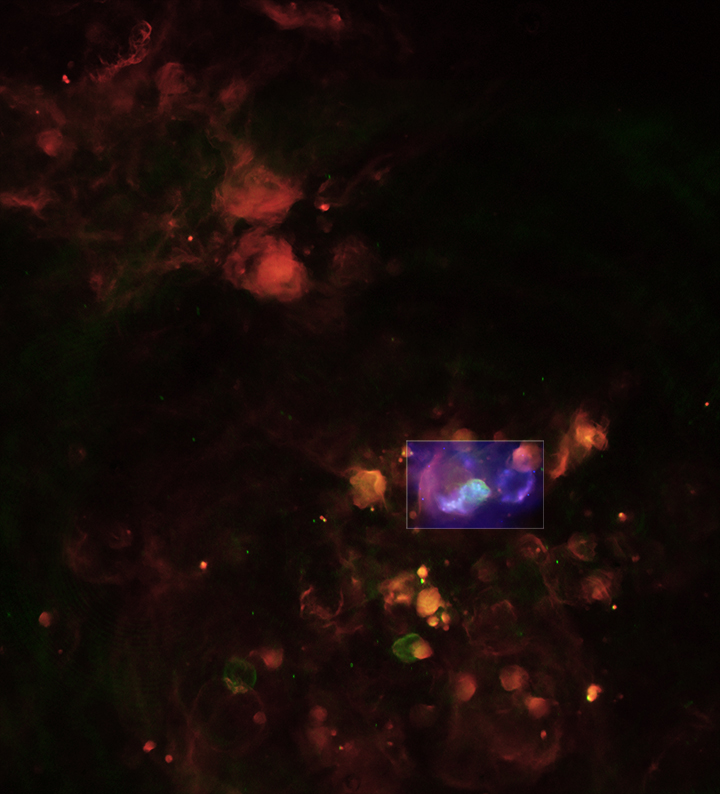
At a distance of only 200.000 light years, the Small Magellanic Cloud (SMC) is one of the Milky Way’s closest galactic neighbours. With its millions of stars, the SMC offers astronomers a chance to study phenomena across the stellar life cycle. In various regions of the SMC, massive stars and supernovas are creating expanding envelopes of dust and gas. Astronomers used Chandra to peer into one particular region of clouds of gas and plasma where stars are forming. This area, known as LHa115-N19, is filled with ionized hydrogen gas and it is where many massive stars are expelling dust and gas through stellar winds. When the X-ray data are combined with the other wavelengths, researchers find evidence for the formation of a so-called superbubble. Superbubbles are formed when smaller structures from individual stars and supernovas combine into one giant cavity. The Chandra data show evidence for three supernova explosions in this relatively small region. Furthermore, the Chandra observations suggest that each of these supernova remnants were caused by a similar process: the collapse of a very massive star. There are hints that these stars were members of a so-called OB association, a group of stars that formed from the same interstellar cloud.
Download JPEG (343,8 KB)
Nofretetes Schatzinsel
Die Berliner Museumsinsel, die „Tempelstadt der Künste“, ist eine der größten Attraktionen der deutschen Hauptstadt. Hunderttausende besuchen jährlich den Pergamon-Altar und das Ischtar-Tor von Babylon – märchenhafte Orte wie aus Tausendundeiner Nacht.
Der preußische König Friedrich Wilhelm III. verfügte im Jahr 1810, eine öffentliche Kunstsammlung in Berlin anzulegen. 1830 wurde das von Karl Friedrich Schinkel erbaute Alte Museum eröffnet. Anschließend wurden das Neue Museum, die Nationalgalerie und das Kaiser-Friedrich-Museum (heute Bode-Museum) verwirklicht. Als letzter und größter Neubau kam das Pergamon-Museum, das 1930 vollendet wurde, hinzu.
Die Sammlungen auf der Museumsinsel gestatten einen ausgiebigen Blick auf die Kunst von der Antike bis zum 19. Jahrhundert. Auf der Museumsinsel werden aber nicht nur großartige Sammlungen präsentiert, sondern die Gebäude ihrerseits spiegeln die Entwicklung der Institution „Museum“ wider: vom universalen Bildungsideal Wilhelm von Humboldts – veranschaulicht in Schinkels Altem Museum – bis zur wissenschaftlichen Rekonstruktion von Grabungsfunden, wie sie im Pergamon-Museum zu finden sind. Deshalb hat die UNESCO nicht die einzelnen Sammlungen, sondern das gesamte Ensemble der Museen im Jahr 1999 zum Weltkulturerbe erklärt.
Keine Frage, dass dies ein würdiger Ort für eine der Schönsten der Weltgeschichte ist: nach ihrer rund 60 Jahre dauernden „Auslagerung“ kehrte die viel bewunderte Büste der altägyptischen Königin Nofretete ins Alte Museum auf die Museumsinsel zurück. Hier ist sie endlich wieder vereint mit ihrem Gatten, dem Pharao Echnaton. Gemeinsam wartet das Paar, das vor über 3.000 Jahren in Stein geschnitzt wurde, auf seinen letzten Umzug: im Rahmen der vollständigen Neustrukturierung der Museen, die 2015 abgeschlossen sein soll, werden beide im Jahr 2009 ihren endgültigen Platz im Neuen Museum finden.
Masterplan Museumsinsel Berlin
visitBerlin.de – Die Büste der Nofretete im Chipperfield-Bau
One species' entire genome inside another's
Scientists at the University of Rochester and the J. Craig Venter Institute have discovered a copy of the entire genome of a bacterial parasite residing inside the genome of its host species.
Bacteria Get Promiscuous
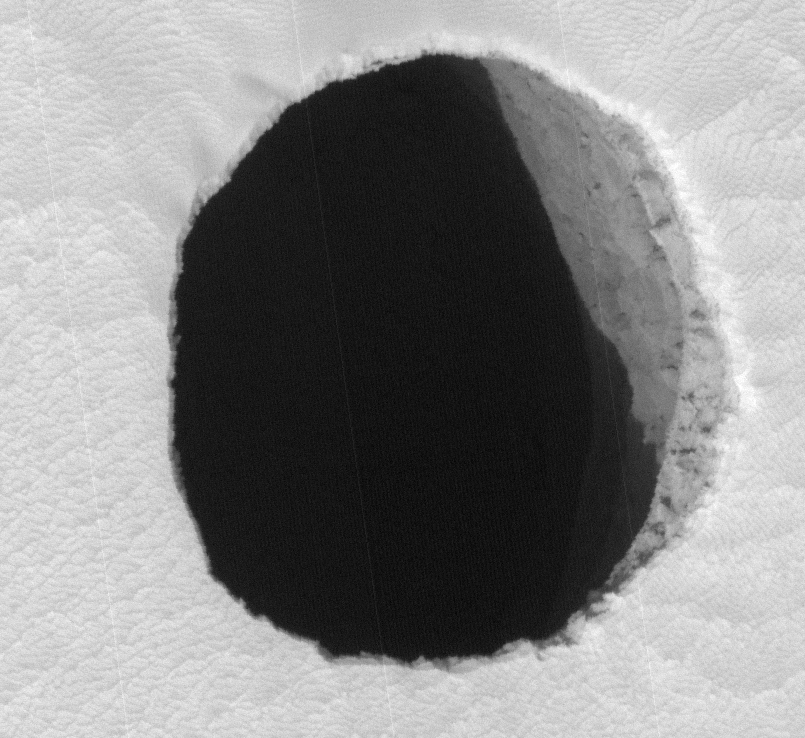
HiRISE Confirms Existence of "Pit Craters" On Mars
The High Resolution Imaging Science Experiment (HiRISE) has confirmed that a dark pit seen on Mars in an earlier HiRISE image really is a vertical shaft that cuts through lava flow on the flank of the Arsia Mons volcano. Such pits form on similar volcanoes in Hawaii and are called „pit craters“.
The HiRISE camera, orbiting the red planet on NASA’s Mars Reconnaissance Orbiter, is the most powerful camera ever to orbit another planet. It is operated at the University of Arizona in Tucson. HiRISE Principal Investigator Alfred McEwen of the UA’s Lunar and Planetary Laboratory and his team released the new image of the dark pit on Arsia Mons and several other stunning images yesterday on the HiRISE Website. New HiRISE images are released on the site every Wednesday.
Candidate Cavern Entrance Northeast of Arsia Mons

Turbulente Strömungen helfen bei Planetengeburt
Planeten werden aus kosmischen Gas- und Staubwolken geboren. Darin bilden sich im Lauf der Zeit kleine Materiebrocken, die dann zu Bausteinen von der Größe eines Asteroiden verklumpen. Ein internationales Team – darunter Forscher des Max-Planck-Instituts für Astronomie in Heidelberg – hat nun simuliert, wie diese Asteroiden zu Planeten heranwachsen. Eine wichtige Rolle dabei spielen turbulente Strömungen in der zirkumstellaren Scheibe.
Wie Planeten trotz widriger Umstände innerhalb kurzer Zeit entstehen können