
The High Resolution Stereo Camera (HRSC) on board ESA’s Mars Express obtained images of the Tyrrhena Terra region on Mars. Tyrrhena Terra is part of the ancient, heavily cratered southern Martian highlands. The region is located north of Hellas Planitia, the largest impact basin on Mars.
https://www.esa.int/Science_Exploration/Space_Science/Mars_Express/Impact_Craters_in_Tyrrhena_Terra
Kategorie: Mars
Tiny asteroid found trailing after Mars
A new space rock has been found that devotedly travels around with Mars as it orbits the Sun, bringing the total number of such „groupies“ to four. The asteroid, called 2007 NS2, was discovered by astronomers at the La Sagra Observatory in southern Spain on July 14, 2007. Based on its brightness, it is estimated to be about one kilometre across. It follows Mars in its orbit, occupying the L5 spot, which lags the Red Planet by 60° as it moves around the Sun. It shares L5 with two other objects, while a fourth object orbits 60° ahead of Mars at the L4 point. Objects that wander into the L4 and L5 points of a planet tend to be confined there by the combined gravity of the planet and the Sun. Mars is one of just three planets known to have such „Trojan“ objects in its orbit. About 2200 Trojans are known to accompany Jupiter in its orbit, and a handful have been discovered in Neptune’s orbit as well.
List Of Martian Trojans
Mars Rovers Braving Severe Dust Storms
Having explored Mars for three-and-a-half years in what were missions originally designed for three months, NASA’s Mars rovers are facing perhaps their biggest challenge. For nearly a month, a series of severe Martian summer dust storms has affected the rover Opportunity and, to a lesser extent, its companion, Spirit. The dust in the Martian atmosphere over Opportunity has blocked 99 percent of direct sunlight to the rover, leaving only the limited diffuse sky light to power it. Scientists fear the storms might continue for several days, if not weeks.
https://mars.nasa.gov/mer/gallery/press/opportunity/20070720a.html
Mars Odyssey: A surface changed by floods
Channels scoured by ancient outbursts of flood waters are seen in a new orbital view from Odyssey’s Thermal Emission Imaging System:
https://mars.nasa.gov/odyssey/gallery/martianterrain/aresoutflow.html
Opportunity is ready to descend into Victoria Crater
NASA’s Mars rover Opportunity has been tentatively checking out the northern rim of Victoria Crater, gathering as much science data as it can before going down inside. Mission controllers announced yesterday that they’re ready to push the rover „over the edge“, and send it on a potentially one-way journey down into the crater.
The plan is that Opportunity will head into the crater on either July 7th or July 9th.
NASA Mars Rover Ready for Descent Into Crater
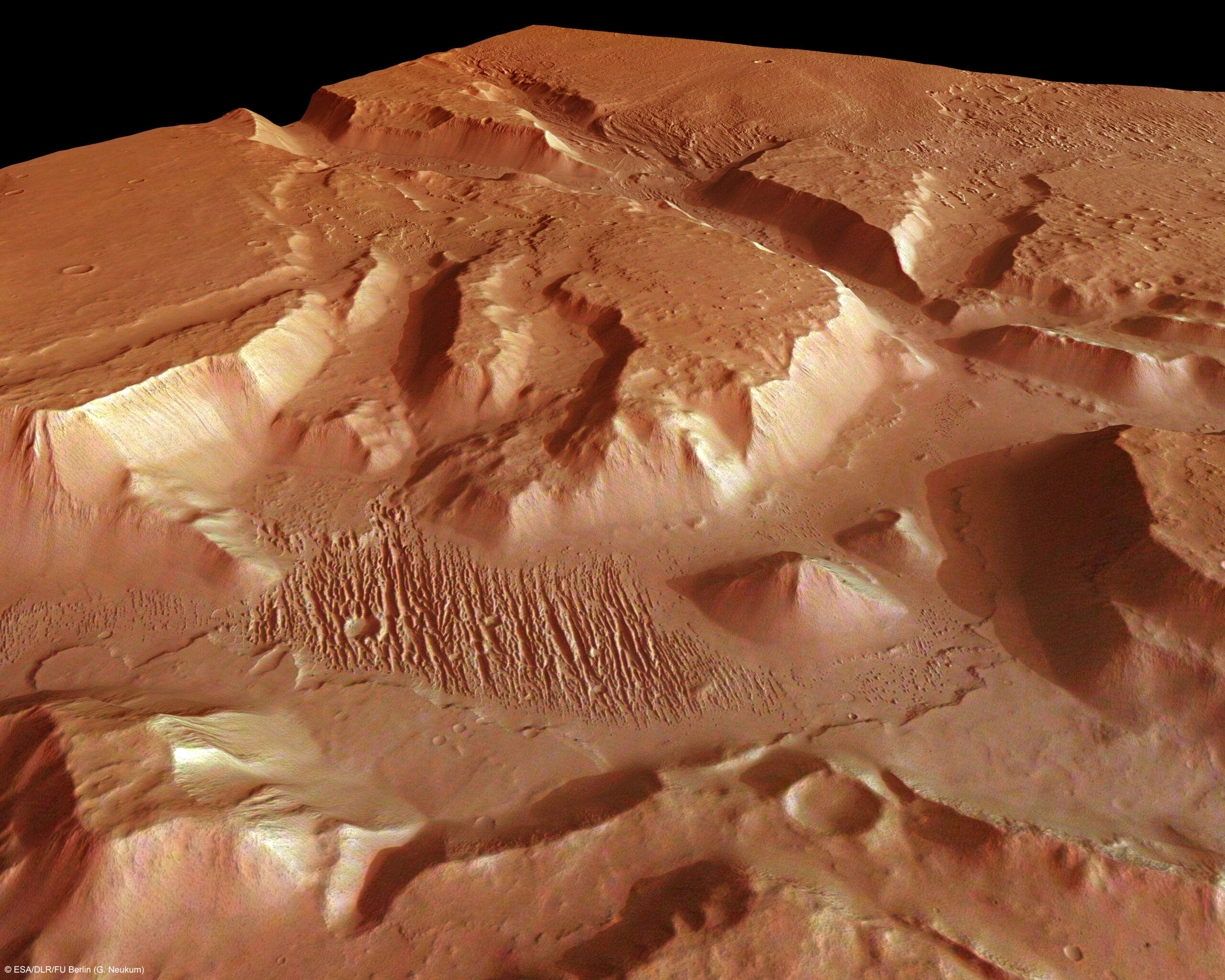
Mars Express: Strange Features at Aeolis Mensae
A new image taken by ESA’s Mars Express spacecraft shows the Aeolis Mensae region on Mars, an area known to be on a tectonic transition zone which separates the southern highlands and the northern lowlands. The area is nearby the volcanic region of Elysium.
Tectonic signatures at Aeolis Mensae
Mars was once covered with vast oceans
Mars, the rugged Red Planet, may have once been blue, according to new research that suggests massive ancient oceans that once covered a third of its surface. The new findings by a joint Canada-U.S. research team provide strong evidence that kilometre-high features seen on the planet’s surface today are actually the shorelines of ancient seas.
http://www.berkeley.edu/news/media/releases/2007/06/13_mars.shtml
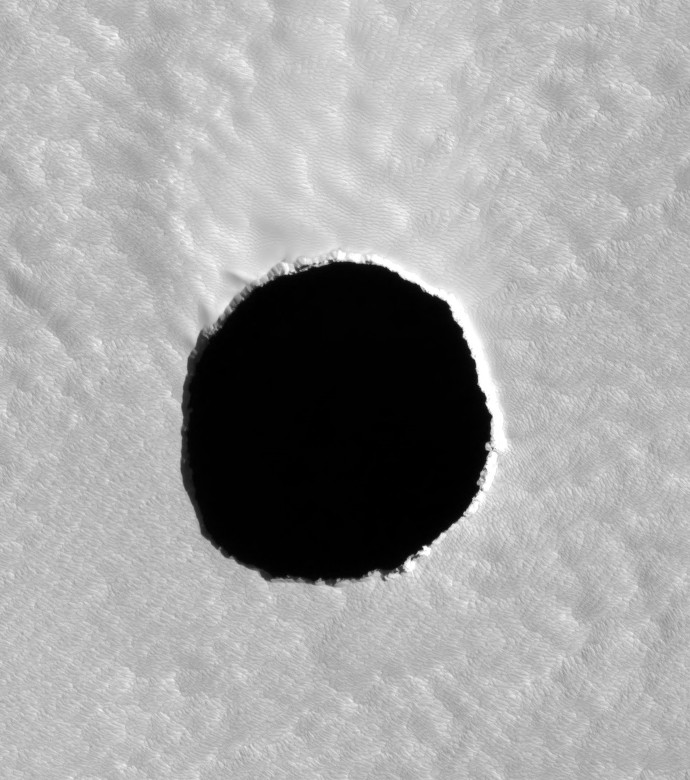
The Bottomless Pit of Tharsis
This cavern opening, about 100 meters across, is found on a lava plain in the volcanic Tharsis region of Mars. It’s so dark and deep that even the Mars Reconnaissance Orbiter’s sensitive cameras cannot peer into its depths (although the shot was taken at 03:27 p.m. Mars time, so the sun was about 38 degrees above the horizon). It’s probably a collapse pit formed when a lava tube or similar structure underneath the surface gave way. The entrance walls may actually be overhanging, concealing a space who knows how large that hides who knows what.
https://hirise.lpl.arizona.edu/PSP_003647_1745
Spirit Unearths Evidence Of Mars' Wetter Past
A patch of Martian soil analyzed by NASA’s rover Spirit is so rich in silica that it may provide some of the strongest evidence yet that ancient Mars was much wetter than it is now. The processes that could have produced such a concentrated deposit of silica require the presence of water.
https://mars.nasa.gov/mer/newsroom/pressreleases/20070521a.html
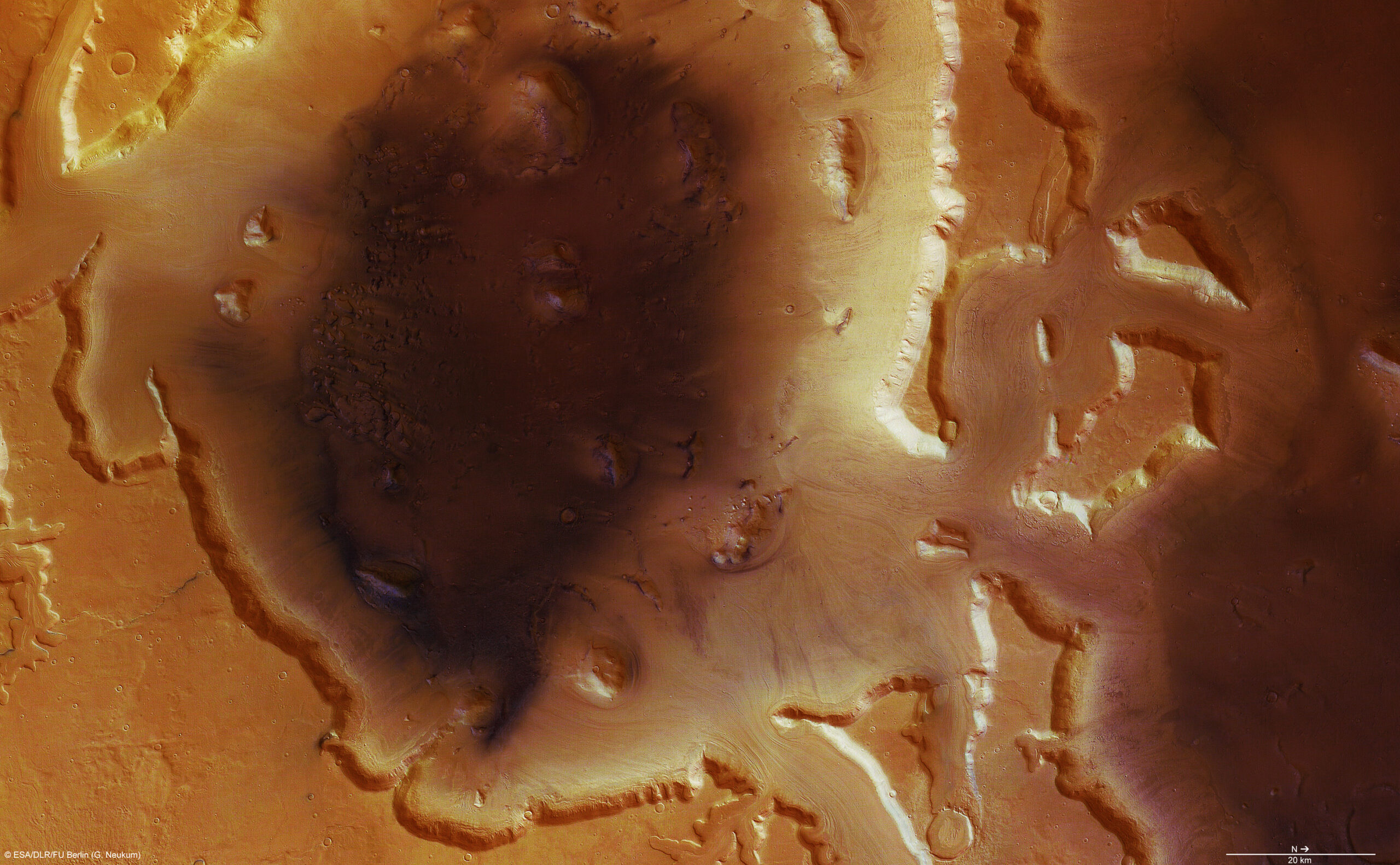
Catastrophic Floods on Mars
A new amazing image captured by ESA’s Mars Express spacecraft shows the Deuteronilus Mensae on Mars, a region shaped by melting glaciers millions of years ago. The large depression in the middle of the image is approximately 2 km deep, and measures 110 km across.