Kategorie: Mars

Ungewöhnliche Ablagerungen auf dem Roten Planeten

Die Radarantenne MARSIS an Bord der europäischen Sonde Mars Express hat neue Daten über eine der ungewöhnlichsten Sedimentstrukturen auf dem Mars geliefert: die Medusae Fossae-Formation. Das Instrument hat erstmals direkte Messungen der Tiefe und der elektrischen Eigenschaften des hier vorkommenden Materials durchgeführt, wodurch neue Rückschlüsse auf dessen Ursprung möglich sind.

Mars Express untersucht ungewöhnliche Ablagerungen auf dem Roten Planeten
Noch mehr Wasser für den Mars

NASA Extends Operations For Its Long-Lived Mars Rovers

NASA is extending, for a fifth time, the activities of the Mars Exploration Rovers, Spirit and Opportunity. The decision keeps the trailblazing mobile robotic pioneers active on opposite sides of Mars, possibly through 2009. This extended mission and the associated science are dependent upon the continued productivity and operability of the rovers.
https://www.nasa.gov/home/hqnews/2007/oct/HQ_072088_Mars_Rovers_Funding_Ext.html

New observations downplay Mars water

Data and pictures from NASA’s Mars Reconnaissance Orbiter (MRO) suggest that gullies that recently formed in some Martian craters were not created by liquid water. The gullies had formed in crater walls some time between two sets of Mars Global Surveyor images taken several years apart, and scientists speculated that groundwater leaking out the side of the crater could have caused the gullies. However, more detailed observations by MRO now argue that the gullies were formed by landslides of loose, dry material.
NASA Orbiter Provides Insights About Mars Water and Climate

HiRISE – Science in Motion

Rotation Wobbles Cause Ice Ages on Mars

Researchers have found evidence that Mars has experienced a number of ice ages and speculate that wobbles in the planet’s rotation are the cause. These wobbles alter the amount of sunlight that reaches the surface and that might cause temperature variations significant enough to trigger an „ice age“.
New Theory Explains Ice on Mars

Mars rovers survive dust storms!

Two months after sky-darkening dust from severe storms nearly killed NASA’s Mars Exploration Rovers, the solar powered robots are awake and ready to continue their missions.
Opportunity’s planned descent into the giant Victoria Crater was delayed by the storms, but now the rover is preparing to drive into the 800-meter-diameter crater as early as September 11.
Spirit also survived the global dust storms. On September 5, the robot climbed onto its long-term destination called Home Plate, a plateau of layered bedrock bearing clues to an explosive mixture of lava and water.
Both rovers are now 43 months into their missions originally planned to last three months.
Mars Exploration Rover Mission

In search of landing sites on Mars

Planetary scientists have long been excited about the prospect of one day exploring the „grand canyon“ of Mars. Valles Marineris is a chasm vastly larger than Earth’s Grand Canyon that also has many layers of rock that serve as windows into the past. A corner of Valles Marineris known as Melas Chasma is one of 36 potential landing sites being considered for the next robotic wanderer to the red planet, the Mars Science Laboratory, to be launched in 2009. But because Mars exploration is risky, NASA’s planetary explorers are very careful about selecting a safe place to land. The proposed site is perched in a basin that rises above the canyon floor as high as a 4.000-foot mountain on Earth.

Mars Odyssey Mission THEMIS: Feature Image: East Melas Chasma

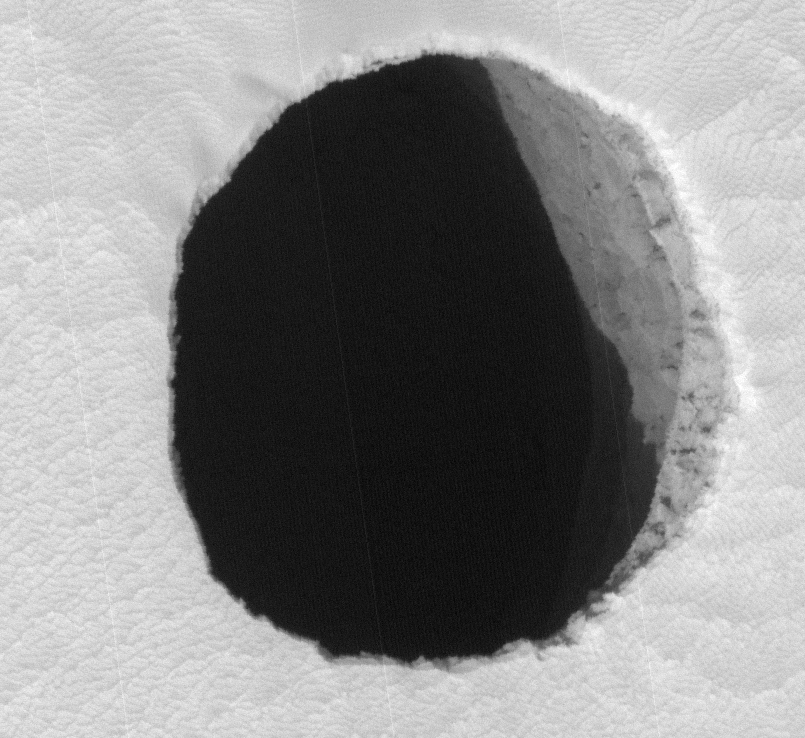
HiRISE Confirms Existence of "Pit Craters" On Mars

The High Resolution Imaging Science Experiment (HiRISE) has confirmed that a dark pit seen on Mars in an earlier HiRISE image really is a vertical shaft that cuts through lava flow on the flank of the Arsia Mons volcano. Such pits form on similar volcanoes in Hawaii and are called „pit craters“.
The HiRISE camera, orbiting the red planet on NASA’s Mars Reconnaissance Orbiter, is the most powerful camera ever to orbit another planet. It is operated at the University of Arizona in Tucson. HiRISE Principal Investigator Alfred McEwen of the UA’s Lunar and Planetary Laboratory and his team released the new image of the dark pit on Arsia Mons and several other stunning images yesterday on the HiRISE Website. New HiRISE images are released on the site every Wednesday.
Candidate Cavern Entrance Northeast of Arsia Mons

New View of Dark Pit on Arsia Mons

Pit Crater

Video: Phoenix Launch – August 4

A Delta II rocket lit up the early morning sky over Cape Canaveral Air Force Station in Florida as it carried the Phoenix spacecraft on the first leg of its journey to Mars. The powerful three-stage rocket with nine solid rocket motors lifted off on Saturday at 5:26 a.m. EDT.