Kategorie: Kosmologie

Panorama reveals thousands of growing galaxies

Hundreds of images snapped by the Hubble Space Telescope have been woven together to create a rich tapestry of thousands of galaxies. Astronomers created the panoramic view as part of a five-year project called AEGIS (All-wavelength Extended Groth strip International Survey). Eight of the world’s best space- and ground-based observatories, including Hubble, made surveys inside one patch of the night sky with an area about twice the size of the full Moon. The observatories peered up to 9 billion light years away to see about 150.000 galaxies evolving when the universe was much younger than today. Hubble recorded images of more than 50.000 galaxies in visible light by taking more than 500 separate exposures.
Watch a MPEG-video of the AEGIS strip beginning with its location in the constellation Ursa Major (courtesy NASA/ESA/L. Barranger/STScI):
https://hubblesite.org/contents/media/videos/2007/06/540-Video.html

Hubble Pans Across Heavens to Harvest 50.000 Evolving Galaxies

AEGIS – All-wavelength Extended Groth strip International Survey
Staubscheiben um Weiße Zwerge

Im Jahr 1987 wurde bei der 500 Millionen Jahre alten Sternleiche G29-38 (ZZ Piscium) erstmalig eine Staubscheibe um einen Weißen Zwerg entdeckt. Spektren, die das Weltraumteleskop „Spitzer“ Ende November/Anfang Dezember 2004 aufgenommen hatte, wiesen dabei auf Spuren von Kometenmaterial hin: bei 10 Mikrometer zeigten sich Anzeichen von Silikatkörnern, die denen in Kometen glichen.
NASA’s Spitzer Finds Possible Comet Dust Around Dead Star
18 Jahre nach dieser Entdeckung wurde ein weiteres Exemplar einer Staubscheibe gefunden: um den Weißen Zwerg GD 362.
A Dusty Disk Around GD 362, a White Dwarf With a Uniquely High Photospheric Metal Abundance
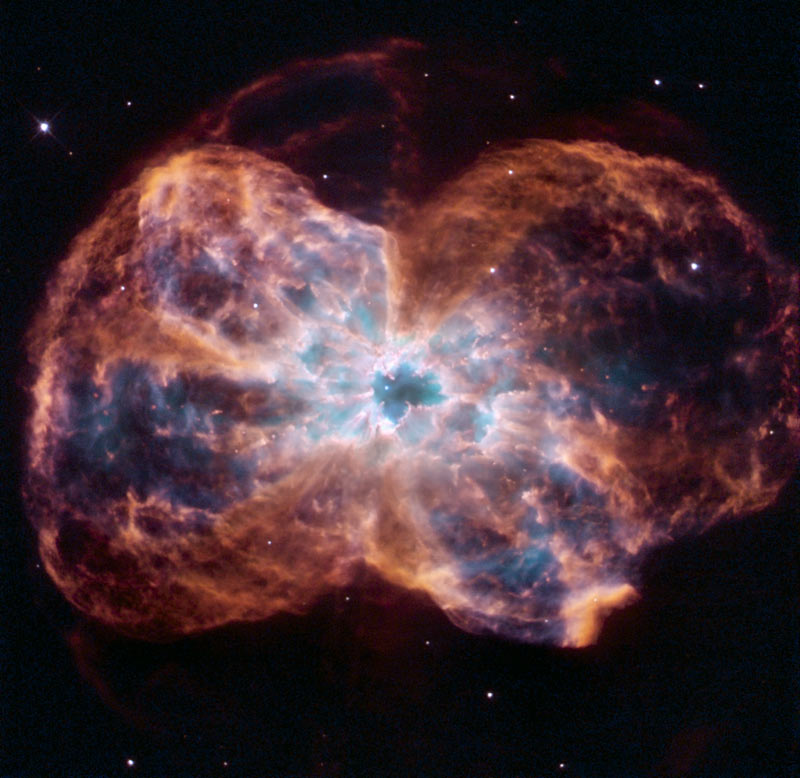
Ein Forscherteam um Kate Su von der University of Arizona hat nun eine dritte solche Staubscheibe entdeckt; die Spektren wurden mit Spitzer ebenfalls im Herbst 2004 aufgenommen. Diese Staubscheibe umgibt WD 2226–210, den Weißen Zwerg im Zentrum des Helixnebels (NGC 7293). Der Staub befindet sich in einem Ring, der sich von der heißen Sternleiche zwischen 35 und 150 AU ausdehnt. Bei 24 Mikrometer weist ein rotes Leuchten, welches den Zentralstern umgibt, auf den Staubgürtel hin. Dieses rote Leuchten ist auch in der neu veröffentlichten Spitzer-Aufnahme zu sehen:
Comets Clash at Heart of Helix Nebula
Während bei den zuerst genannten Objekten der Staub von Kollisionen in einem Asteroidengürtel (um G29-38 bei Radien von nur 0,005 und 0,03 AU!) stammen könnte, ist es beim Weißen Zwerg im Helixnebel wahrscheinlicher, dass dieser Staub bei Kollisionen von kometenähnlichen Objekten eines „Kuiper-Gürtels“ oder einer „Oortschen Wolke“ (analog zu unserem Sonnensystem) produziert wird:
A Debris Disk around the Central Star of the Helix Nebula?

Distant Quasars Live in Massive Dark Matter Halos

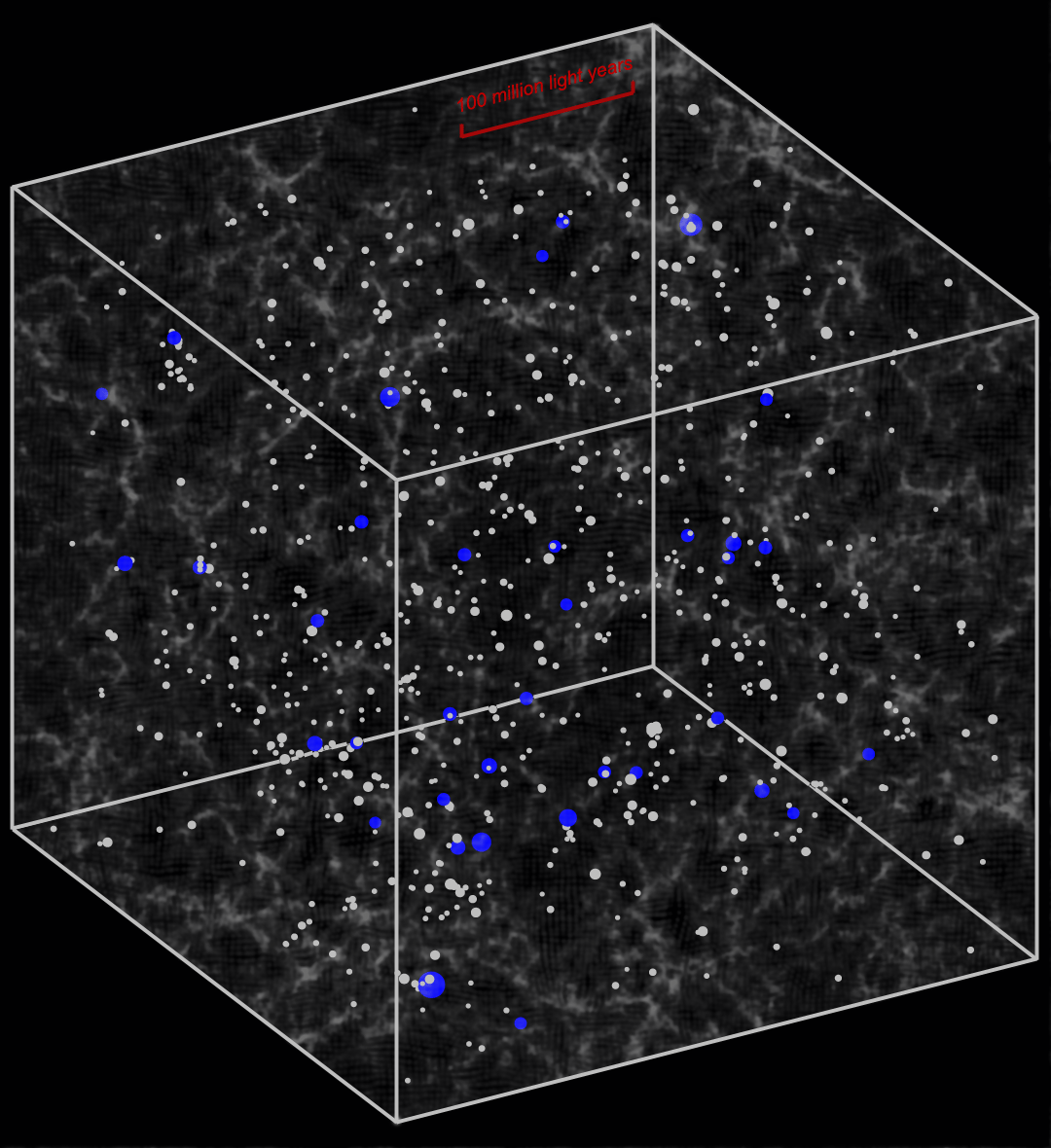
Using a map of more than 4.000 luminous quasars in the distant universe, scientists from the Sloan Digital Sky Survey (SDSS-II) have shown that these brilliant beacons are strongly clumped, with huge quasar superclusters separated by vast stretches of empty space. The strong clustering shows that the quasars lie within massive concentrations of dark matter.

Article @ Sloan Digital Sky Survey

Illustration

Yue Shen et al.: Clustering of High Redshift (Z > 2.9) Quasars from the Sloan Digital Sky Survey

Schwarzer Diamant aus dem All?

Kohlschwarze Diamanten stammen nicht aus dem Schoß der Erde, sondern aus dem Weltraum. Diese Vermutung bekräftigen neue Messungen amerikanischer Geowissenschaftler. In vielerlei Hinsicht ähnelt die Zusammensetzung der „Carbonados“ demnach der von Diamanten, wie sie in Meteoriten gefunden und im All beobachtet worden sind. Carbonados fand man bislang nur in Brasilien und Zentralafrika. Anders als „normale“ Diamanten, sind sie undurchsichtig und porös, weisen eine matte Oberfläche auf und erinnern insgesamt eher an Koks. Schon ihr Gehalt an metallischen Spurenelementen spreche gegen einen Ursprung im Erdmantel, erläutern die Forscher um Jozsef Garai von der Florida International University. Um mehr über den Aufbau der schwarzen Diamanten zu erfahren, bombardierten Garai und Kollegen vier Carbonados mit intensiver Infrarot-Strahlung. Frühere Untersuchungen dieser Art waren auf das Problem gestoßen, dass die Poren der Steine Silikatmineralien enthalten, welche ausgerechnet im besonders interessanten Wellenlängenbereich zwischen 7,7 und 10 Mikrometern absorbieren. Um diesen Störfaktor zu beseitigen, zermahlten die Forscher ihre Carbonados zunächst zu feinem Pulver, das sie mehrere Tage lang mit Salz- und Flusssäure behandelten. Wie die Gruppe in den „Astrophysical Journal Letters“ berichtet, enthält das Material sowohl Stickstoff als auch Wasserstoff in Form und Menge, wie es typisch für Diamanten aus dem All ist. Daher sei es denkbar, dass sich der Kohlenstoff der Carbonados in einer wasserstoffreichen Region im All zusammengelagert habe. Vermutlich seien die schwarzen Diamanten dann vor 2,6 bis 3,8 Milliarden Jahren mit Asteroiden auf die Erde gelangt.

Infrared Absorption Investigations Confirm the Extraterrestrial Origin of Carbonado-Diamonds

NOVA Online: Diamonds in the Sky

New Multiple Star Systems In Ophiuchus Star Forming Region

After three years of observations using the 10-meter Keck II telescope in Hawaii, Lowell Observatory astronomer Lisa Prato announces the discovery of four new low-mass double star systems with separations similar to the Earth-Sun distance or smaller. This survey also serendipitously revealed five new wider binaries with separations of about 14 to 140 times the Earth-Sun distance. The results provide significant new evidence to better characterize the star and planet forming region in Ophiuchus. The research features the first such analysis for young, low-mass spectroscopic (closely spaced) binary stars undertaken in infrared light.

Lisa Prato: „A Survey for Young Spectroscopic Binary K7-M4 Stars in Ophiuchus“

Large Telescopes Team Up to Help Astronomers Discover a Trio of Quasars

Using ESO’s Very Large Telescope and the W.M. Keck Observatory, astronomers at the Ecole Polytechnique Fédérale de Lausanne in Switzerland and the California Institute of Technology, USA, have discovered what appears to be the first known triplet of quasars. This close trio of supermassive black holes lies about 10,5 billion light-years away towards the Virgo constellation.

https://www.eso.org/public/news/eso0702/

http://www.keckobservatory.org/recent/entry/first_triple_quasar_discovered_at_w._m._keck_observatory/

Famous Space Pillars Feel the Heat of Star’s Explosion

The three iconic space pillars photographed by NASA’s Hubble Space Telescope in 1995 might have met their demise, according to new evidence from NASA’s Spitzer Space Telescope. The striking image from Spitzer shows the intact dust towers next to a giant cloud of hot dust thought to have been scorched by the blast of a star that exploded. Astronomers speculate that the supernova’s shock wave could have already reached the dusty towers, causing them to topple about 6.000 years ago. However, because light from this region takes 7.000 years to reach Earth, we won’t be able to capture photos of the destruction for another 1.000 years or so.

https://www.spitzer.caltech.edu/news/ssc2007-01-famous-space-pillars-feel-the-heat-of-stars-explosion

Seven or Eight Dwarf Galaxies Discovered Orbiting the Milky Way

Researchers from the Sloan Digital Sky Survey (SDSS-II) announced the discovery of eight new dwarf galaxies, seven of them satellites orbiting the Milky Way. The objects resemble systems cannibalized by the Milky Way billions of years ago to build up its stellar halo and thick disk, characterized as „crumbs from the galactic feast“. The systems discovered by the SDSS-II in the last three years are comparable in number to all the Milky Way satellites detected in the preceding 70 years. They help close the gap between the observed number of dwarf satellites and theoretical predictions.

http://classic.sdss.org/news/releases/20070109.dwarfs.html