Kategorie: Kosmologie

Computer simulation verifies relationships between black holes and galaxies

By incorporating the physics of black holes into a highly sophisticated model running on a powerful supercomputing system, an international team of scientists has produced an unprecedented simulation of cosmic evolution that verifies and deepens our understanding of relationships between black holes and the galaxies in which they reside. Called BHCosmo, the simulation shows that black holes are integral to the structure of the cosmos.

Direct cosmological simulations of the growth of black holes and galaxies
Fixing the Holes

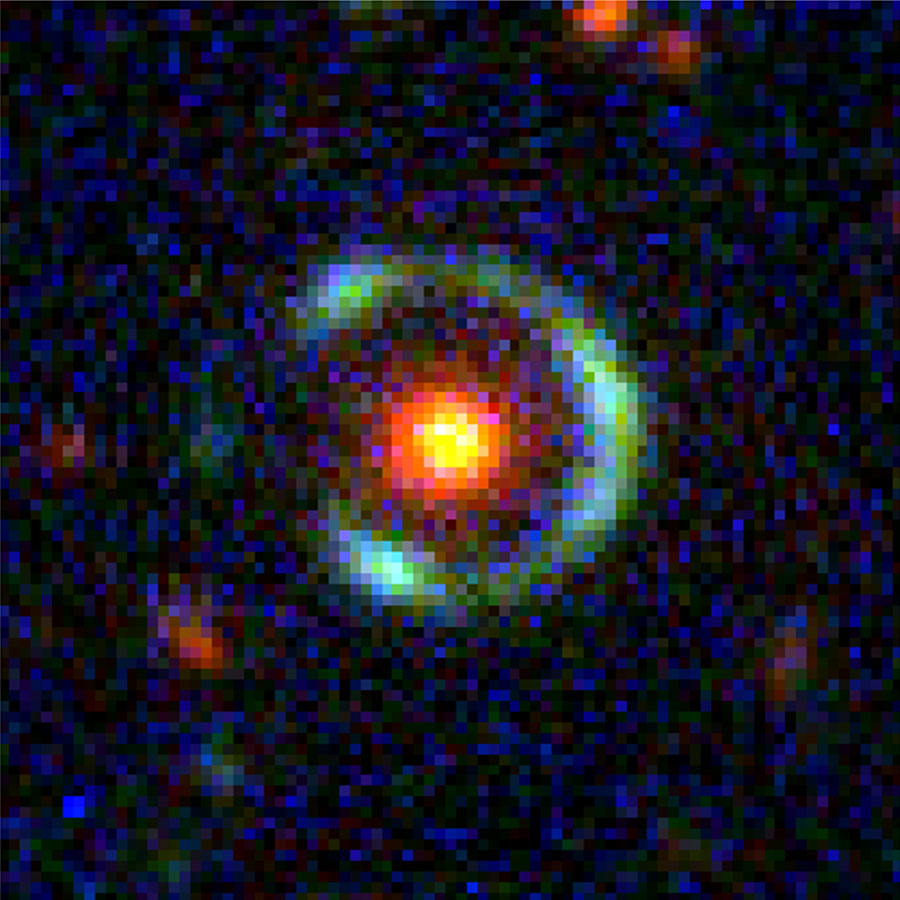
SDSS finds a "Cosmic Horseshoe"

A team led by Vasily Belokurov at the University of Cambridge has found the largest and most complete optical Einstein ring known to date. The object, which was dubbed the „Cosmic Horseshoe“, provides a unique laboratory for studying what the universe was like at less than a quarter of its present age.
An Einstein ring is a kind of cosmic mirage. Gravity from a foreground galaxy distorts light from a background galaxy into an arc. If the alignment between the background galaxy and the foreground „lensing“ galaxy is precise enough, the distant galaxy’s light becomes warped into a complete ring.

https://arxiv.org/abs/0706.2326v3

How Supermassive Black Holes Merge

For astronomers it’s clear that galaxies get bigger through galactic mergers. But they have always wondered what happens with the supermassive black holes that seem to always lurk at the heart of galaxies. What happens when two compact objects with millions of times the mass of our sun collide? An international team of physicists has developed a computer simulation designed to answer this question. It turns out that the interaction depends a lot on the amount of hot gas surrounding each black hole. As the black holes start to interact, this gas exerts a frictional force on the black holes, slowing down their spin rate. Once they get within the width of our solar system, they start emitting gravitational waves, which continues to extract energy from the system. This causes them to continue coming together, and eventually merge. These mergers should be so energetic, they’ll generate gravitational waves detectable across space.

http://news.stanford.edu/pr/2007/pr-hole-061307.html

Image:
merging-bh-large.jpg

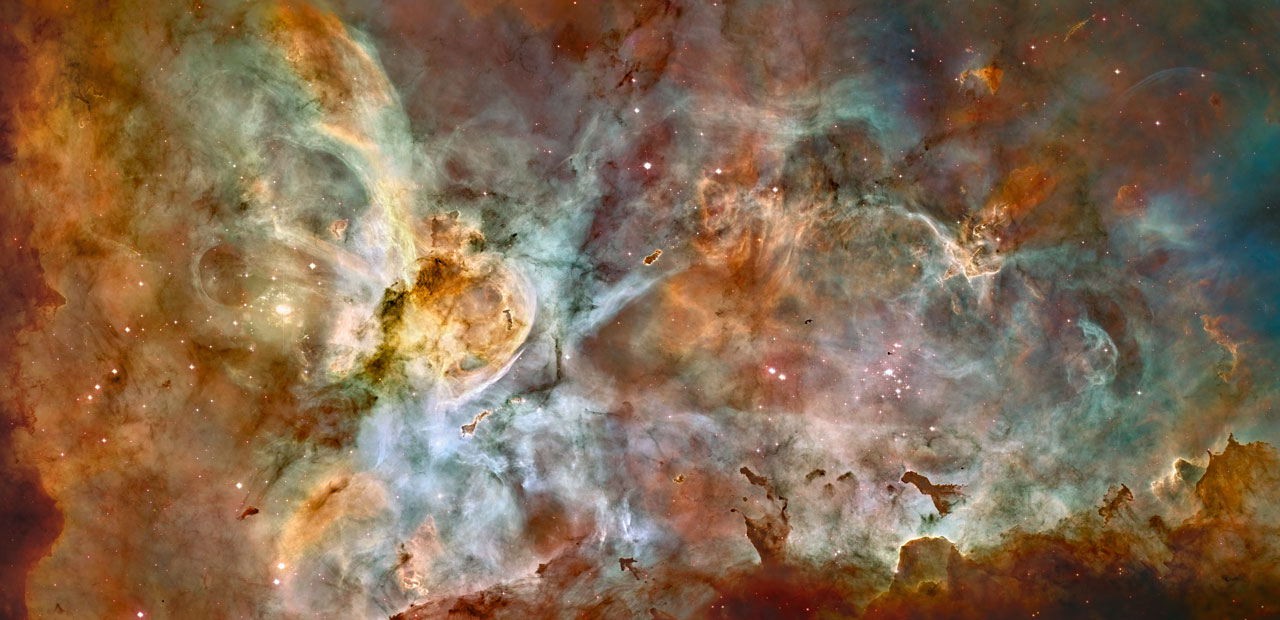
Hubble’s 17th anniversary

One of the largest panoramic images ever taken with Hubble’s cameras has been released to celebrate the 17th anniversary of the launch and deployment of the NASA/ESA Hubble Space Telescope. The image shows a 50 light-year-wide view of the tumultuous central region of the Carina Nebula where a maelstrom of star birth – and death – is taking place.

https://esahubble.org/news/heic0707/

Black Holes May Fill The Universe With Seeds Of Life

New research shows that black holes are not the ultimate destroyers as they are often portrayed in popular culture. Instead, warm gas escaping from the clutches of enormous black holes could be one source of the chemical elements that make life possible. Immediately after the Big Bang, the universe contained only hydrogen and helium. Heavier chemical elements had to be cooked up inside the first stars, then scattered throughout space to be incorporated in next-generation stars and their planets. Black holes may have helped to distribute those elements across the cosmos.
An international team of astronomers has found that hot winds from giant black holes in galactic centers may blow heavy elements like carbon and oxygen into the vast tracts of space between galaxies. The team, led by Yair Krongold of the Universidad Nacional Autonoma de Mexico, studied the supermassive black hole at the center of the galaxy NGC 4051. They found that gas was escaping from much closer to the black hole than previously thought. The outflow source is located about 2.000 Schwarzschild radii from the black hole, or about five times the size of Neptune’s orbit.
CfA Press Release

XMM-Newton pinpoints intergalactic polluters

Krongold et al.: The Compact, Conical, Accretion-Disk Warm Absorber of the Seyfert 1 Galaxy NGC 4051 and its Implications for IGM-Galaxy Feedback Processes

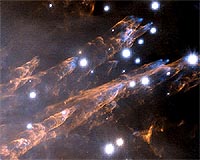
Supersonic bullets shoot through the Orion Nebula

Orion "bullets"
(Gemini Observatory)

Bullet-like clumps of gas hurtle through the Orion stellar nursery at supersonic speed in this new image from the Gemini North observatory. The unusual structures are revealed in unprecedented detail by newly commissioned laser-equipped optics. The so-called „bullets“ are located in the Orion Nebula, a star-forming region about 1500 light years from Earth. Each of the few dozen observed is a dense clump of gas about ten times as wide as Pluto’s orbit around the Sun. Tearing through the surrounding medium of thin gas at 400 kilometres per second, the bullets create shock waves in front of them. As the shock waves propagate, they produce lengthy glowing trails – each about 400 times longer than our entire solar system.

Gemini’s Laser Vision Reveals Striking New Details in Orion Nebula

AEGIS Survey Reveals Principle Of Galaxy Formation

Faced with the bewildering array of galaxies in the universe, from orderly spirals to chaotic mergers, it is hard to imagine a unifying principle that describes them all with mathematical precision. But that is just what astronomers have now discovered. The relation between a galaxy’s mass and the orbital speed of its stars and gas is remarkably consistent over a wide range of galaxy morphologies and over billions of years of galaxy evolution, according to new results from a major survey of distant galaxies. The findings show that certain fundamental properties of galaxies have actually changed very little over the past 8 billion years (this is about half the age of the universe).

http://news.ucsc.edu/2007/03/1080.html

AEGIS – All-wavelength Extended Groth strip International Survey