A US scientist has created a robot that can find a way to keep working on its own after suffering damage, an invention that could prove useful for robotic space missions on distant planets, according to a study. Joshua Bongard, a University of Vermont engineer whose research article appeared in Friday’s Science Magazine, pulled off one of a homemade robot’s four legs for his experiment. The robot was programmed to assess the damage by moving in playful-looking sequences allowing it to find the problem. Once the damage was identified, the robot created a new way to move without the missing limb, allowing it to continue its mission.
‚Science‘ Features Professor’s Resilient Robot
Solscape
Dark Energy Has Been With Us For a Long Time
Dark energy isn’t new. In fact, it’s been around for at least 9 billion years. According to new data gathered by the Hubble Space Telescope, this mysterious force was already working to speed up the expansion of the Universe when it was only a few billion years old. Hubble measured the light from 24 of the most distant supernovae ever seen, and found that the Universe is further apart than it should be if only gravity was around to slow things down.
Hubble Finds Evidence for Dark Energy in the Young Universe
https://www.nasa.gov/mission_pages/hubble/news/dark_energy.html
Detailed Look at Twin Asteroid 1999 KW4
Asteroid 1999 KW4 was first discovered by astronomers in 1999. When it got closer, in 2001, astronomers realized it wasn’t a single asteroid, but two clusters of rubble orbiting each other. It’s been classified as a Potentially Hazardous Asteroid, but astronomers have calculated a safe trajectory out for at least 1.000 years. Since it’s a binary object, astronomers are able to calculate the mass and density of the two asteroids. New observations from the Arecibo Observatory have mapped the twin objects in tremendous detail.
Observations of double asteroid stress Arecibo radar’s vital role in identifying threats in Earth’s vicinity
Radar Imaging of Binary Near-Earth Asteroid (66391) 1999 KW4
Dynamical Configuration of Binary Near-Earth Asteroid (66391) 1999 KW4
Solar wind particles solve lunar mystery
Trace chemicals ejected from the Sun and collected by NASA’s Genesis mission have solved a long-standing lunar mystery that threatened to rewrite our understanding of how the Sun evolved. For the last 4 billion years, energetic solar particles have bombarded the Moon. But studies of these particles in rocks brought back by the Apollo astronauts have mystified scientists. That is because the ratio of two isotopes of neon have varied according to depth in the rocks, with comparatively more neon-22 than neon-20 at lower depths. That suggested that counter to theory, the Sun had once been significantly more active than it is today, shooting out higher energy particles that could travel farther into the rocks. Now, Ansgar Grimberg at the Swiss Federal Institute of Technology in Zurich, and colleagues have resolved the conundrum. When they measured the neon distribution in the exposed solar wind samples, they found the top layer had considerably higher proportions of neon-20 than observed in the lunar samples, while the underlying layers were similar to those seen in the Moon rocks. That suggests that erosion from micrometeorites and space particles removed some of the original neon from the top surface of all lunar rocks. It also shows that the solar wind alone can explain the puzzling neon variations in the Moon rocks, with the heavier neon-22 simply implanting itself more deeply than neon-20.
https://solarsystem.nasa.gov/genesismission/
Planck Instruments Ready For Integration
Engineers are ready to begin integrating the scientific instruments into ESA’s Planck satellite. The pair of instruments will allow the spacecraft to make the most precise map yet of the cosmic microwave background, a relic radiation left behind by the formation of the Universe. The integration of Planck’s two instruments marks a major milestone for the mission, which is scheduled to launch in mid-2008.
Planck @ ESA
Ein junger Stern macht FU(r)ore
Dr. Bringfried Stecklum, Wissenschaftler an der Thüringer Landessternwarte Tautenburg (TLS), hat mit dem 2-m Alfred-Jensch-Teleskop des Instituts einen jungen Stern im Sternbild Giraffe entdeckt, dessen Helligkeit innerhalb kurzer Zeit um das Dreißigfache zunahm. Der Stern gehört zur Klasse von Objekten, die nach ihren Prototypen, den veränderlichen Sternen FU im Sternbild Orion und EX im Sternbild Wolf, als FUore bzw. EXore bezeichnet werden. Von ihnen sind bisher nur etwa ein Dutzend bekannt. Das neue Mitglied weist von allen die bei weitem geringste Leuchtkraft und damit auch die kleinste Masse auf. Es konnte nur gefunden werden, weil der starke Anstieg der Helligkeit zu einer besseren Ausleuchtung der Gas- und Staubwolke führte, aus der sich der Stern bildete. Der dabei entstandene neue Nebel ist auf Archivaufnahmen aus dem Jahr 2001 noch nicht zu sehen! Der Helligkeitsanstieg vollzog sich daher innerhalb von fünf Jahren. Er weist auf eine Phase besonders intensiven Wachstums des Sterns hin.
Junge Sterne sind von einer Scheibe aus Gas und Staub umgeben. Sie wachsen, indem Materie aus der Scheibe auf sie herabfällt. Dabei wird die beim Aufprall freigesetzte Energie als Strahlung abgegeben. Die starke Helligkeitszunahme weist also auf eine Episode besonders intensiven Masseneinfalls hin. Bei EXoren kann diese Monate und Jahre andauern; bei FUoren sogar Jahrzehnte.
Die Thüringer Landessternwarte Tautenburg liegt zirka 15 Kilometer nördlich der Universitätsstadt Jena. Das astronomische Institut forscht auf den Gebieten der stellaren Astrophysik und der extragalaktischen Astronomie. Forschungsschwerpunkte sind die Suche nach extrasolaren Planeten, die Entstehung und das Sterben von Sternen, Gamma-Ray Bursts sowie die Entwicklung von Galaxien. Die Thüringer Landessternwarte Tautenburg betreibt das größte optische Teleskop Deutschlands.
The Milky Way Shaped Life On Earth
Frenzied star-making in the Milky Way Galaxy starting about 2.4 billion years ago had extraordinary effects on life on Earth. Harvests of bacteria in the sea soared and crashed in a succession of booms and busts, with an instability not seen before or since. According to new results published by Dr. Henrik Svensmark of the Danish National Space Center, the variability in the productivity of life is closely linked to the cosmic rays, the atomic bullets that rain down on the Earth from exploded stars. Most likely, the variations in cosmic radiation affected biological productivity through their influence on cloud formation. Hence, the stellar baby boom 2.4 billion years ago, which resulted in an extraordinarily large number of supernova explosions, had a chilling effect on Earth probably by increasing the cloud cover.
http://www.space.dtu.dk/English/Research/Research_divisions/Sun_Climate/SC_The_Milky_Way_shaped_life_on_Earth.aspx
Twenty new stars in the neighbourhood
Astronomers have identified 20 new stellar systems in our local solar neighbourhood, including the twenty-third and twenty-fourth closest stars to the Sun. When added to eight other systems announced by this team and six by other groups since 2000, the known population of the Milky Way galaxy within 33 light-years of Earth has grown by 16 percent in just the past six years. The discoveries were made by a group called the „Research Consortium on Nearby Stars“ (RECONS), which has been using small telescopes at the National Science Foundation’s Cerro Tololo Inter-American Observatory in the Chilean Andes since 1999. The new results will appear in the December 2006 issue of the Astronomical Journal.
https://noirlab.edu/public/news/noao0615/
European Mars mission delayed
The European Space Agency (ESA) has elected to delay the launch of its next Mars mission, ExoMars, by two years. The decision gives ESA scientists extra time to test key technologies and to lobby for an expansion of the mission, which could almost double its cost. ExoMars is Europe’s first planned rover mission to Mars. Originally slated to launch in 2011, the mission will now blast off in 2013. The new launch date will allow ESA to spend more time refining technologies like airbags, supersonic parachutes, descent control, and stability systems. The rover’s drive systems and navigation controls are also likely to come under further scrutiny. The delay also gives mission planners time to expand the scope of the mission, something scientists have been pushing for since the mission was first mooted.
ExoMars @ ESA
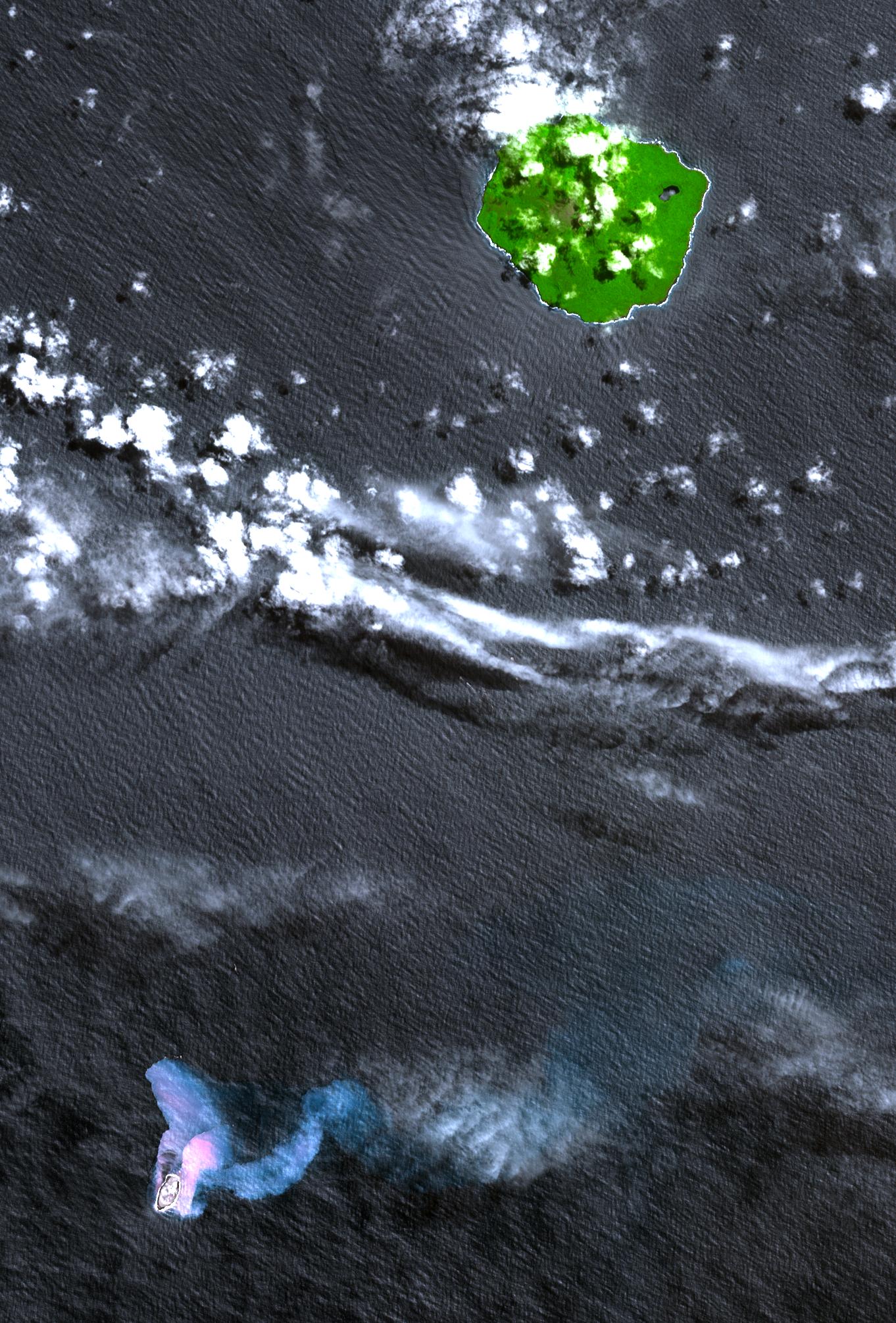
Pacific Ocean Gives Birth To New Volcanic Island
In the South Pacific, south of Late Island along the Tofua volcanic arc in Tonga, a new volcanic island Home Reef is being re-born. The island is thought to have emerged after a volcanic eruption in mid-August that has also spewed large amounts of floating pumice into Tongan waters and sweeping across to Fiji about 350 km to the west of where the new island has formed. In 2004, a similar eruption created an ephemeral island about 0.5 by 1.5 km in size; it was no longer visible in an ASTER image acquired in November 2005. The following simulated natural color image shows the vegetation-covered stratovolcanic island of Late in the upper right. Home Reef is found in the lower left. The two bluish plumes are hot seawater that is laden with volcanic ash and chemicals; the larger one can be traced for more than 14 km to the east. The image was acquired on October 10, 2006, and covers an area of 24.3 by 30.2 km.
https://photojournal.jpl.nasa.gov/jpeg/PIA01899.jpg