
Identification of the oldest preserved pieces of Earth’s crust in southern Greenland has provided evidence of active plate tectonics as early as 3.8 billion years ago, according to a report by an international team of geoscientists in the March 23 edition of „Science“. The finding pushes back the date of continent-forming processes previously determined as 2.5 billion years ago to a much earlier era considerably closer to Earth’s formation some 4.5 billion years ago. Geochemical analysis of rocks has previously suggested an earlier date for plate tectonics, but this is the first study to find physical evidence of tectonics among Earth’s oldest known rock structures.
Article @ Scripps Institution of Oceanography
Solscape
SpaceX launches second Falcon 1
A Falcon 1 rocket lifted off late Tuesday on a test flight that the rocket’s developer, SpaceX, declared a success even though the rocket failed to reach orbit. The Falcon 1 lifted off from Omelek Island, part of Kwajalein Atoll in the Pacific Ocean, at 9:10 p.m. EDT Tuesday carrying a test payload. The launch initially went well, but telemetry from the rocket was lost about five minutes into flight. Company officials said that the rocket experienced a roll control anomaly during the second stage burn which apparently kept the rocket from achieving orbit, although it did fly to an altitude of approximately 300 kilometers. While the root cause of the problem isn’t known, SpaceX believes it can be fixed relatively easily and that the flight overall retired 90 percent of the risk associated with the vehicle, including operation of the first stage, stage separation, and payload fairing separation. Tuesday’s launch took place about an hour after a previous launch attempt was aborted at T-0 seconds when sensors detected a low chamber pressure in the main engine, caused by colder-than-normal kerosene fuel. SpaceX, which developed the small launch vehicle privately, is not planning to perform another test flight before its first operational mission, the launch of the TacSat 1 experimental satellite for the Defense Department, later this year.
Researchers Successfully Control Wireless Device Inside Artery
Some 40 years after the release of the classic science fiction movie „Fantastic Voyage“, researchers in the NanoRobotics Laboratory of École Polytechnique de Montréal’s Department of Computer Engineering and Institute of Biomedical Engineering have achieved a major technological breakthrough in the field of medical robotics. They have succeeded for the first time in guiding, in vivo and via computer control, a microdevice inside an artery, at a speed of 10 centimetres a second.
Article @ École Polytechnique de Montréal
Night Fires on Io
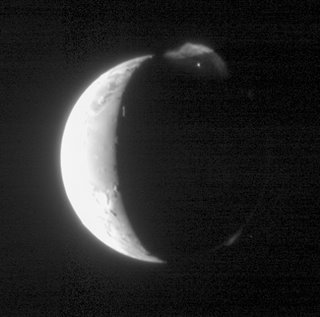
The Long Range Reconnaissance Imager (LORRI) on New Horizons captured another dramatic picture of Jupiter’s moon Io and its volcanic plumes, 19 hours after the spacecraft’s closest approach to Jupiter on February 28, 2007. Io’s dayside is deliberately overexposed to bring out faint details in the plumes and on the moon’s night side. The continuing eruption of the volcano Tvashtar, at the 1 o’clock position, produces an enormous plume roughly 330 kilometers high, which is illuminated both by sunlight and „Jupiter light“.
A Midnight Plume
Cassini radar shows evidence of seas on Titan
Instruments on NASA’s Cassini spacecraft have found evidence for seas, likely filled with liquid methane or ethane, in the high northern latitudes of Saturn’s moon Titan. One such feature is larger than any of the Great Lakes of North America and is about the same size as several seas on Earth.
https://solarsystem.nasa.gov/news/12381/cassini-spacecraft-images-seas-on-saturns-moon-titan/
Radioactive Core Might Explain Geysers on Enceladus
Since Cassini arrived at Saturn, it has made many impressive discoveries. One of the most intriguing is the discovery that Saturn’s icy moon Enceladus has geysers spewing water ice into space. Some planetary scientists theorize that there are pockets of liquid water near the surface of Enceladus that could harbour life. But where is the heat coming from to fuel these geysers? A new model proposes that the rapid decay of radioactive elements might be keeping the moon hotter than it would normally be. This heat is released through cracks in the moon’s surface, and since Enceladus is covered with ice, it has water geysers. The theory says that Enceladus started out as a ball of ice and rock, with rapidly decaying isotopes of aluminum and iron. Over the course of just a few million years, this decay produced a tremendous amount of heat, creating a rocky core and a surrounding shell of ice. The moon then slowly cooled over the course of billions of more years. The theory matches some of the elements seen in Enceladus‘ geysers, such as gaseous nitrogen, methane, carbon dioxide, propane and acetylene. These could come from the decomposition of ammonia deep inside the moon where the warm core and water meet.
A Hot Start Might Explain Geysers on Enceladus
New Globular Cluster Found in Milky Way
Images made with ESO’s New Technology Telescope at La Silla by a team of German astronomers reveal a rich circular cluster of stars in the inner parts of our Galaxy. Located 30.000 light-years away, this previously unknown closely-packed group of about 100.000 stars is most likely a new globular cluster.
Beautiful Details in the Crab Nebula
A new image of the Crab Nebula supernova remnant taken using the Prime Focus Camera on the Subaru telescope highlights the beauty of stellar debris expanding away from the site of this ancient blast. The high-resolution image captures details of an elongated tendril of gas rushing out at roughly 1.500 kilometers per second. While the nebula has been observed many times using both ground- and space-based telescopes, the new image is giving astronomers another opportunity to study the mechanics of the expanding gas in much greater detail.
https://www.subarutelescope.org/Pressrelease/2007/03/12/index.html
Mars mineral deposits linked to groundwater
Mineral salt deposits found on the surface of Mars by one of NASA’s Mars rovers may have been created by seeping groundwater rather than an ocean, scientists reported this week. Early in its mission, the Mars rover Opportunity found deposits of sulfur-rich evaporite minerals in the Meridiani Planum region of the planet, which to scientists suggested the presence of a liquid water ocean earlier in the planet’s history. In a paper published in Thursday’s issue of the journal „Nature“, scientists said the minerals could instead have formed when volcanic activity pushed up groundwater to the surface, where it evaporated and left behind the mineral deposits found by Opportunity. The new results don’t preclude the existence of an ocean on the Martian surface in the past, only that the ocean did not extend to the Meridiani Planum region.
Prototype Space Probe Will Explore Earth’s Deepest Sinkhole
Scientists return this week to the world’s deepest known sinkhole for tests of a NASA-funded robot called DEPTHX, designed to survey and explore for life in one of Earth’s most extreme regions and potentially in outer space. DEPTHX’s technology could aid future space probes of Jupiter’s moon Europa, where scientists believe that deep cracks and holes in the ice offer a chance of finding extraterrestrial life.