Kategorie: Kosmologie

Der Tanz zweier Galaxien

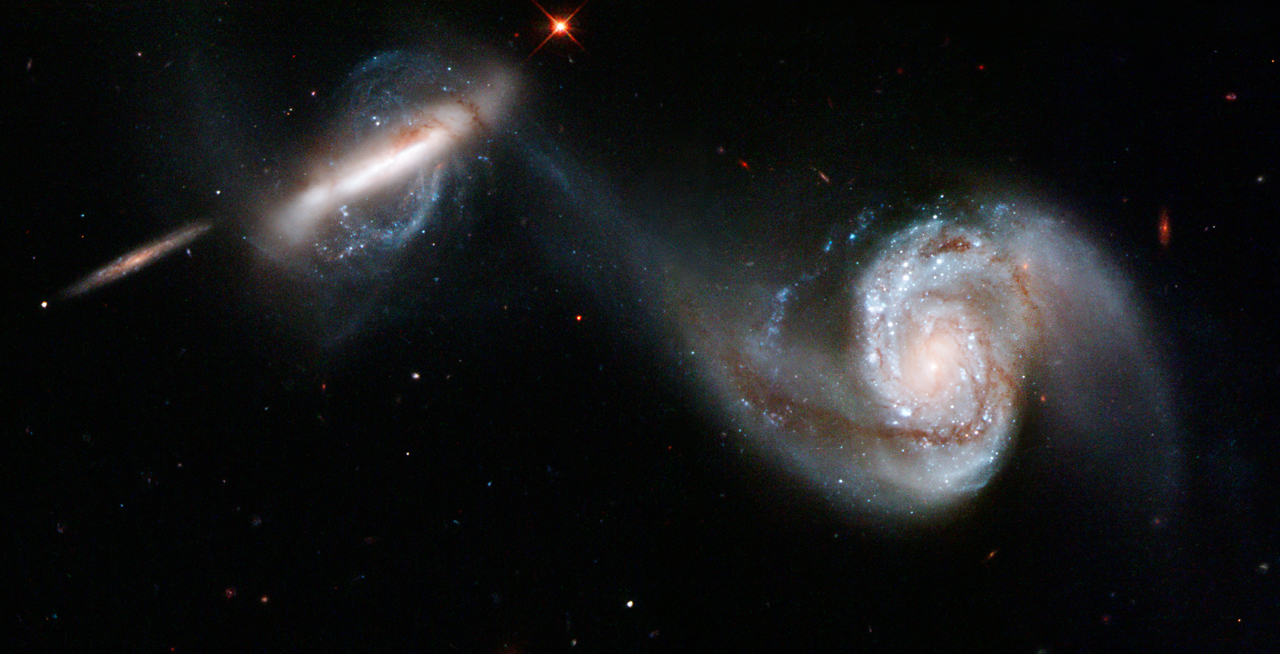
Eine heute veröffentlichte Aufnahme des Weltraumteleskops Hubble zeigt den graziösen Tanz zweier Galaxien, bekannt unter dem Namen Arp 87. Die galaktische Choreographie wird allein durch die gegenseitige Gravitation bestimmt. Entdeckt wurden die beiden Galaxien in den 1960er Jahren, doch erst jetzt werden dank Hubbles hoher Auflösung Details sichtbar. Sterne, Gas und Staub fließen von der größeren Galaxie NGC 3808 zu ihrem Begleiter NGC 3808A und schlingen sich um diesen herum. Die ständige Wechselwirkung zwischen den beiden hat dafür gesorgt, dass die Welteninseln allmählich aus der Form geraten. Arp 87 befindet sich im Sternbild Löwe und ist etwa 300 Millionen Lichtjahre von der Erde entfernt. Die Beobachtungen, auf denen das jetzt veröffentlichte Bild basiert, wurden im Februar 2007 gemacht.
Interacting Galaxy Pair Arp 87

Entwicklung von Sternhaufen aufgeklärt

Sterne entstehen im Universum stets in großen Gruppen, in sog. Sternhaufen. Astronomen unterscheiden diese Gebilde nach Alter und Größe. Wie sich Sternhaufen aus interstellaren Gaswolken bilden und warum sie sich dann unterschiedlich entwickeln, das haben Forscher der Universität Bonn jetzt mit Hilfe von Computersimulationen herausgefunden. Sie lösten damit ein altes astronomisches Rätsel – die Frage nämlich, ob sich Sternhaufen in ihrem Aufbau voneinander unterscheiden.
Sterne und Sternhaufen entstehen aus der Verdichtung interstellarer Gaswolken. Innerhalb dieser Wolken bilden sich einzelne Klumpen, die sich unter dem Einfluss ihrer eigenen Schwerkraft immer weiter zusammenziehen und schließlich zu Sternen werden. Ähnlich unserem Sonnenwind strahlen die Sterne starke Winde aus geladenen Teilchen aus. Diese fegen das übrig gebliebene Gas aus der Wolke heraus. Übrig bleibt ein Sternhaufen, der sich nach und nach auflöst, bis seine Sterne sich frei im interstellaren Raum bewegen.
Um das Entstehen und Vergehen von Sternenansammlungen besser verstehen zu können, haben Professor Pavel Kroupa und sein Kollege Holger Baumgardt ein Rechenprogramm entwickelt, das den Einfluss des im Haufen verbliebenen Gases auf die Bahnen der Sterne simuliert. Das Hauptaugenmerk der Forscher lag auf der Frage, wie die anfänglichen Bedingungen aussehen müssen, damit ein gerade entstandener Sternhaufen für längere Zeit überleben kann. Die Bonner Astronomen fanden dabei heraus, dass zu kleine Haufen sehr leicht durch die Strahlung ihrer Mitgliedssterne zerstört werden. Große und massereiche Sternhaufen haben dagegen deutlich bessere Überlebenschancen.
Baumgardt, H.; Kroupa, P.:A comprehensive set of simulations studying the influence of gas expulsion on star cluster evolution

Gieles, M.; Lamers, H.; Baumgardt, H.:Star cluster life-times: dependence on mass, radius and environment

Striking new image from Chandra

A spectacular new image shows how complex a star’s afterlife can be. By studying the details of this image made from a long observation by NASA’s Chandra X-ray Observatory, astronomers can better understand how some stars die and disperse elements like oxygen into the next generation of stars and planets. At a distance of about 20.000 light years, G292.0+1.8 is one of only three supernova remnants in the Milky Way known to contain large amounts of oxygen.
G292.0+1.8: Stellar Forensics with Striking Image from Chandra

Schwerstes Schwarzes Loch in naher Galaxie entdeckt

Schwarze Löcher lassen sich in zwei Gruppen unterteilen: supermassereiche Schwarze Löcher, die sich im Zentrum der meisten Galaxien befinden, und stellare Schwarze Löcher, die am Ende der Entwicklung eines massereichen Sterns stehen. Jetzt haben Wissenschaftler das bislang massereichste Exemplar eines stellaren Schwarzen Lochs aufgespürt, das zudem noch einen äußerst massereichen Begleiter hat.
Der neue Rekordhalter ist Teil eines Doppelsternsystems in der uns nahegelegenen Galaxie M33. Durch die Kombination von Daten der Röntgenteleskops Chandra und des Gemini-Teleskops auf Hawaii gelang es den Astronomen, die Masse des Schwarzen Lochs zu bestimmen: es ist fast 16-mal massereicher als unsere Sonne. Der Begleitstern hat die 70-fache Masse unserer Sonne und ist damit der bislang massereichste Begleitstern eines Schwarzen Lochs in einem Doppelsternsystem.
Die Entdeckung wirft eine ganze Reihe von Fragen auf, etwa die, wie solche großen stellaren Schwarzen Löcher überhaupt entstehen können. Und mit den bisherigen Modellen über die Entwicklung von massereichen Sternen ist die Existenz eines massereichen Schwarzen Lochs in einem dichten Orbit um einen massereichen Stern – wie im vorliegenden Fall – nur schwer zu erklären.
Ein gewichtiges Paar

M33 X-7: Heaviest Stellar Black Hole Discovered in Nearby Galaxy

Fifty Times sharper than Hubble

The Inner Jet of the Radio Galaxy M87, located in the center of the Virgo cluster some 50 million light years away from Earth, was observed by Yuri Kovalev from the Max Planck Institute for Radio Astronomy in Bonn and his colleagues with the Very Long Baseline Array (VLBA) at 2 cm wavelength. The resulting image provides details down to a resolution of one milli-arcsecond, corresponding to a linear resolution of only three light months. This is fifty times better than the resolution of the Hubble Space Telescope at optical wavelengths.

https://www.mpifr-bonn.mpg.de/pressreleases/2007/3

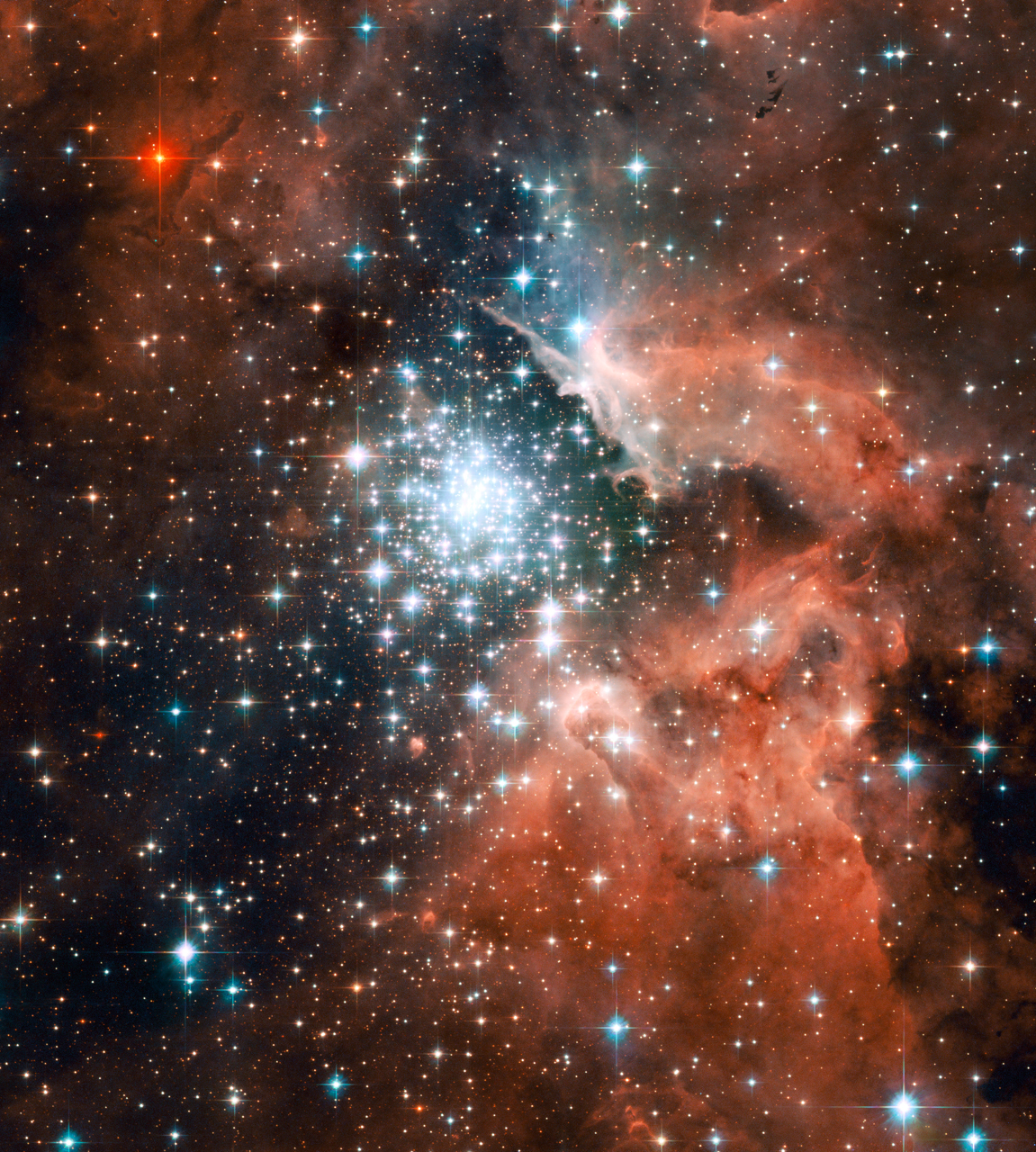
Star Cluster Bursts Into Life in New Hubble Image

The Hubble Space Telescope has captured a spectacular image of NGC 3603, a giant nebula hosting one of the most prominent massive young star clusters in the Milky Way, thus supplying a prime template for star formation studies. NGC 3603 lies about 20.000 light-years away from Earth in the Carina spiral arm.
Images, videos and additional information about NGC 3603 are available at:
https://hubblesite.org/contents/news-releases/2007/news-2007-34.html

https://esahubble.org/news/heic0715/

https://www.esa.int/Science_Exploration/Space_Science/Extreme_star_cluster_in_new_Hubble_images

Space Telescopes Find Lego-Block Galaxies In Early Universe

NASA’s Hubble and Spitzer Space Telescopes have joined forces to discover nine of the smallest, faintest, most compact galaxies ever observed in the distant universe. Blazing with the brilliance of millions of stars, each of the newly discovered galaxies is a hundred to a thousand times smaller than our Milky Way Galaxy.
The conventional model for galaxy evolution predicts that small galaxies in the early universe evolved into the massive galaxies of today by coalescing. These nine Lego-like „building block“ galaxies initially detected by Hubble likely contributed to the construction of the universe as we know it.
https://hubblesite.org/contents/news-releases/2007/news-2007-31.html

https://www.spitzer.caltech.edu/news/ssc2007-15-nasa-space-telescopes-find-lego-block-galaxies-in-early-universe

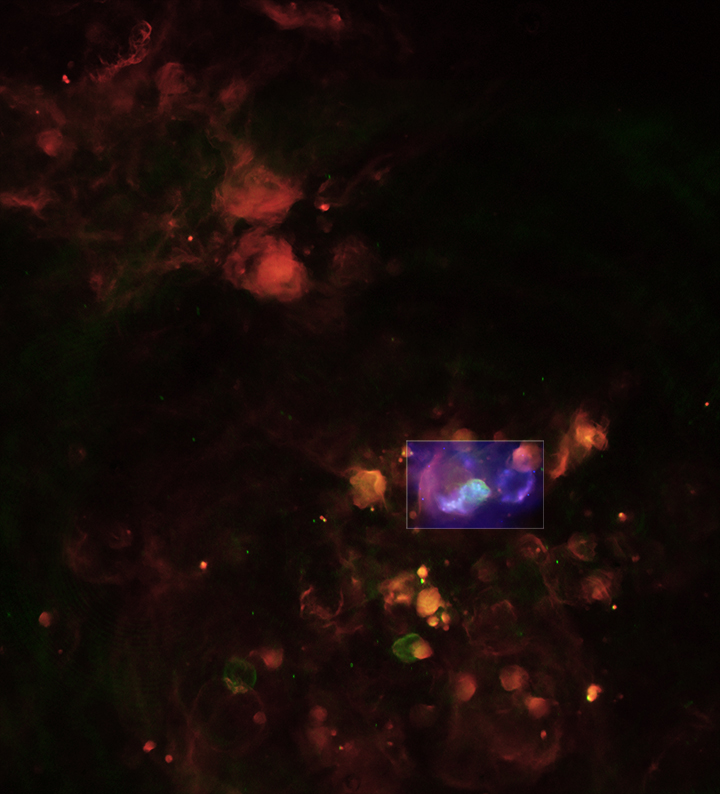
Blowing cosmic superbubbles

At a distance of only 200.000 light years, the Small Magellanic Cloud (SMC) is one of the Milky Way’s closest galactic neighbours. With its millions of stars, the SMC offers astronomers a chance to study phenomena across the stellar life cycle. In various regions of the SMC, massive stars and supernovas are creating expanding envelopes of dust and gas. Astronomers used Chandra to peer into one particular region of clouds of gas and plasma where stars are forming. This area, known as LHa115-N19, is filled with ionized hydrogen gas and it is where many massive stars are expelling dust and gas through stellar winds. When the X-ray data are combined with the other wavelengths, researchers find evidence for the formation of a so-called superbubble. Superbubbles are formed when smaller structures from individual stars and supernovas combine into one giant cavity. The Chandra data show evidence for three supernova explosions in this relatively small region. Furthermore, the Chandra observations suggest that each of these supernova remnants were caused by a similar process: the collapse of a very massive star. There are hints that these stars were members of a so-called OB association, a group of stars that formed from the same interstellar cloud.
Download JPEG (343,8 KB)

Astronomers find giant void in universe

Radio astronomers have discovered a giant „hole“ in a region of the universe nearly devoid of any sort of matter, they announced Thursday. In a paper to be published in the Astrophysical Journal, University of Minnesota astronomers reported the discovery of the void, nearly a billion light-years across and about 6 to 10 billion light-years from Earth in the direction of the constellation Eridanus. The void was detected in data collected in a sky survey by the Very Large Array radio telescope in New Mexico. The void appears to lack any sort of matter, including invisible dark matter, and coincides with a „cold spot“ in the cosmic microwave background as measured by NASA’s WMAP spacecraft. The cause of the void is unclear.
Astronomers Find Enormous Hole in the Universe