Kategorie: Exoplaneten

Astronomers discovered largest known exoplanet

Astronomers announced that they have discovered an extrasolar planet with the largest radius measured to date, making the planet’s density unexpectedly low. The planet, designated TrES-4, closely orbits the star GSC02620-00648, some 1.435 light-years away from Earth. The planet was discovered by detecting periodic decreases in the star’s brightness as the planet transited the star’s disk as seen from Earth. Those studies found that the planet has a radius 1,67 times that of Jupiter, the largest radius of any planet so far measured. Separate observations found that the planet’s mass is only 0,84 times that of Jupiter, giving the planet a density of 0,22 grams per cubic centimeter – too low to be explained by current models of giant planets.
Astronomers Find Largest Exoplanet to Date

Largest Transiting Extrasolar Planet Found Around A Distant Star

Spitzer Finds Water Vapor On Alien Planet

A scorching-hot gas planet beyond our solar system is steaming up with water vapor, according to new observations from NASA’s Spitzer Space Telescope. The planet, called HD 189733b, swelters as it zips closely around its star every two days or so. Astronomers had predicted that planets of this class, termed „hot Jupiters“, would contain water vapor in their atmospheres. Yet finding solid evidence for this has been slippery. These latest data are the most convincing yet that hot Jupiters are „wet“.
https://www.spitzer.caltech.edu/news/ssc2007-12-nasas-spitzer-finds-water-vapor-on-hot-alien-planet

Astronomers Discover 28 New Exoplanets

Astronomers have announced the discovery of 28 new planets outside our solar system, increasing the total number of known exoplanets to 236. The planets are among 37 new objects discovered by the teams within the past year. Seven of the 37 are confirmed brown dwarfs, which are failed stars that nevertheless are much more massive than the largest, Jupiter-sized planets.
California, Carnegie team reports 28 new exoplanets, 7 new brown dwarfs

First Map of an Extrasolar Planet

For the first time, astronomers have created a rough map of a planet orbiting a distant sun-like star, employing a technique that may one day enable mapping of Earth-like worlds.

CfA Press Release: First Map of an Extrasolar Planet

CfA Press Release Images

Extreme Winds Rule Exoplanet’s Weather

NASA Finds Extremely Hot Planet, Makes First Exoplanet Weather Map

Scientists Map Weather on Distant World

A Tale of Two Exoplanets: One Incredibly Hot, the Other Extremely Windy

Earthlike exoplanet found

Astronomers have discovered the most earthlike planet outside our solar system to date.
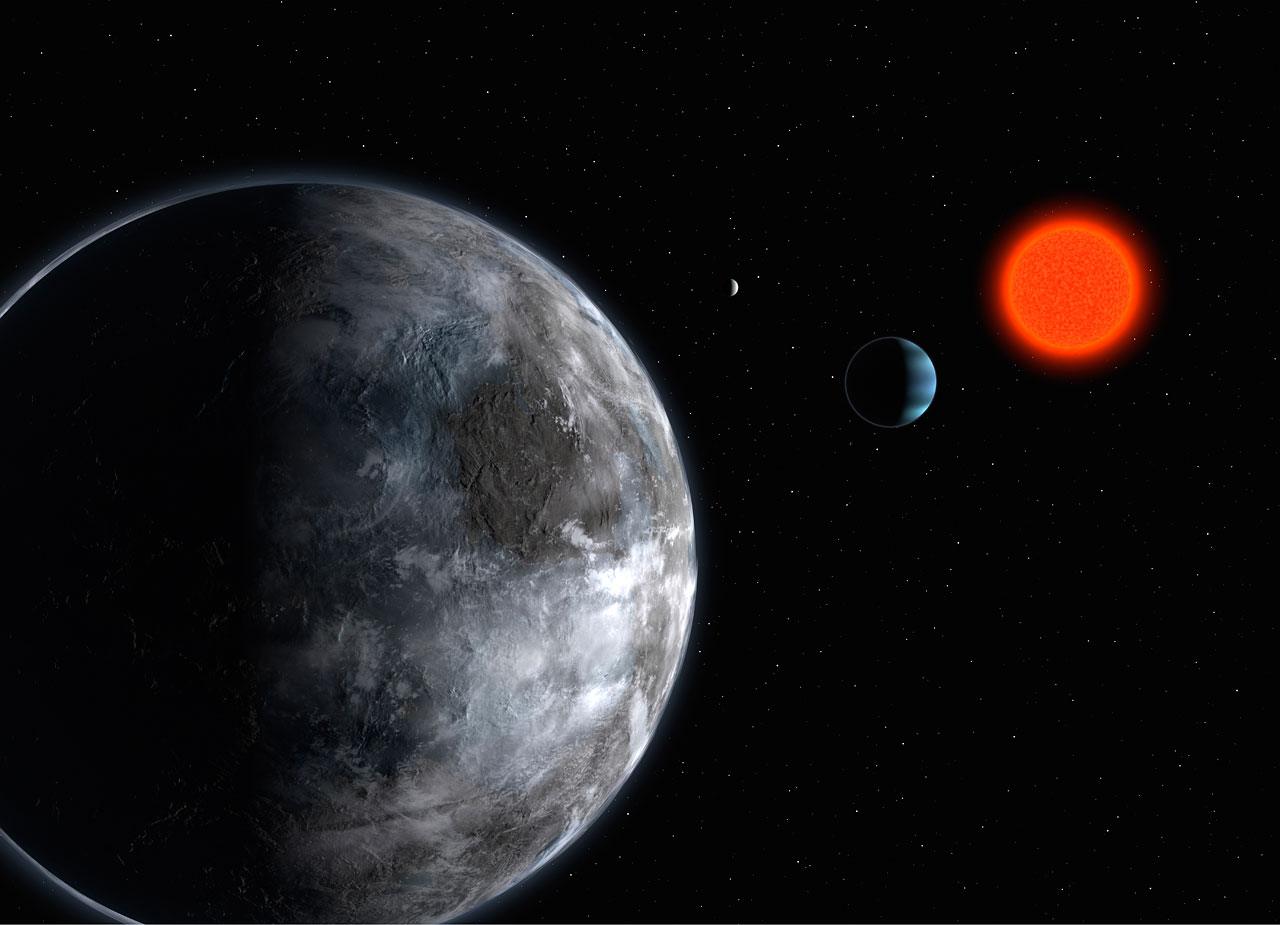
Using the ESO 3.6m telescope at La Silla, Chile, a team of Swiss, French, and Portuguese scientists discovered a super-Earth about 5 times the mass of the Earth that orbits a red dwarf, already known to harbour a Neptune-mass planet. The astronomers have also strong evidence for the presence of a third planet with a mass about 8 Earth masses. The newly discovered exoplanet is the smallest ever found up to now and it completes a full orbit in 13 days. It is 14 times closer to its star than the Earth is from the Sun. However, given that its host star, the red dwarf Gliese 581, is smaller and colder than the Sun, the planet nevertheless lies in the habitable zone, the region around a star where water could be liquid!
„We have estimated that the mean temperature of this super-Earth lies between 0 and 40 degrees Celsius, and water would thus be liquid,“ explains Stephane Udry from the Geneva Observatory (Switzerland) and lead-author of the paper reporting the result. „Moreover, its radius should be only 1,5 times the Earth’s radius, and models predict that such a planet should be either rocky or covered with oceans,“ he adds. „Because of its temperature and relative proximity, this planet will most probably be a very important target of the future space missions dedicated to the search for extra-terrestrial life. On the treasure map of the Universe, one would be tempted to mark this planet with an X.“
The host star, Gliese 581, is among the 100 closest stars to us, located only 20,5 light-years away in the constellation Libra. It has a mass of only one third the mass of the Sun. Such red dwarfs are at least 50 times fainter than the Sun and are the most common stars in our Galaxy: among the 100 closest stars to the Sun, 80 belong to this class.
Two years ago, the same team of astronomers already found a planet around Gliese 581. With a mass of 15 Earth-masses, i.e. similar to that of Neptune, it orbits its host star in 5,4 days. At the time, the astronomers had already seen hints of another planet. They therefore obtained a new set of measurements and found the new super-Earth, but also clear indications for another one, an 8 Earth-mass planet completing an orbit in 84 days. The planetary system surrounding Gliese 581 contains thus no fewer than 3 planets of 15 Earth masses or less, and as such is a quite remarkable system.
Story adapted from the ESO Press Release:
Astronomers Find First Earth-like Planet in Habitable Zone

Astronomen vermessen planetare Gefahrenzone

Ein Planetensystem kann nur dann entstehen, wenn sein Zentralgestirn fast zwei Lichtjahre von extrem heißen Nachbarsternen entfernt liegt, berechneten Astronomen. Andernfalls würden Winde und Strahlung dieser hellen Sterne die Staub- und Gasscheiben der kühleren Gestirne ins All blasen, bevor sich aus dem darin enthaltenen Material Planeten formen können.
Mit dem Infrarotteleskop Spitzer suchten Astronomen um Zoltan Balog von der University of Arizona in Tucson systematisch nach Gas- und Staubscheiben, die um junge Sterne mit bis zu zehn Sonnenmassen rotieren. Dazu begutachteten sie etwa tausend Gestirne im Rosetten-Nebel, einer 5.200 Lichtjahre entfernten Sternentstehungsregion. Waren die untersuchten Objekte weiter als 1,6 Lichtjahre von sog. O-Sternen, den massereichsten (mindestens die 20-fache Masse der Sonne) und heißesten Sternen (ein O-Stern mit der 50-fachen Masse der Sonne gibt etwa eine Million Mal so viel Energie ab wie unsere Sonne) im Universum, entfernt, besaß fast die Hälfte von ihnen Materiescheiben. Denselben Anteil beobachten Astronomen bei Sternen, die sich ungestört entwickeln. Lagen die Sterne allerdings innerhalb der Gefahrenzone, wiesen weniger als dreißig Prozent eine Materiescheibe auf. Hier verdampften Gas und Staub im Laufe von etwa einer Million Jahren durch die ultraviolette Strahlung des O-Sterns. Dessen Wind trug die aufgeheizte Materie dann ins All.
Die Studie hilft den Astronomen, Umgebungen im All zu finden, in denen sich bevorzugt Planeten bilden können. Planeten entstehen aus Masseverdichtungen in den Gas- und Staubscheiben um junge Sterne. Der uns nächste Stern, Proxima Centauri, liegt mehr als vier Lichtjahre entfernt und ist zudem masseärmer als die Sonne. Allerdings gehen manche Astronomen davon aus, dass auch die Sonne in der Nähe von O-Sternen geboren wurde und sich erst später aus der Gefahrenzone hinausbewegte.

Astronomers Map Out Planetary Danger Zone

Dramatic step forward in hunt for an Earth twin

For the first time ever, NASA researchers have successfully demonstrated in the laboratory that a space telescope rigged with special masks and mirrors could snap a photo of an Earth-like planet orbiting a nearby star. This accomplishment marks a dramatic step forward for missions like the proposed Terrestrial Planet Finder, designed to hunt for an Earth twin that might harbor life.

https://www.jpl.nasa.gov/news/nasa-shows-future-space-telescopes-could-detect-earth-twin

The color of plants on planets in other solar systems

NASA scientists believe they have found a way to predict the color of plants on planets in other solar systems. Green, yellow or even red-dominant plants may live on extra-solar planets, according to scientists whose two scientific papers appear in the March issue of the journal „Astrobiology“. The scientists studied light absorbed and reflected by organisms on Earth, and determined that if astronomers were to look at the light given off by planets circling distant stars, they might predict that some planets have mostly non-green plants.
https://www.nasa.gov/centers/goddard/news/topstory/2007/spectrum_plants.html

Spectral Signatures of Photosynthesis. I. Review of Earth Organisms

Spectral Signatures of Photosynthesis. II. Coevolution with Other Stars And The Atmosphere on Extrasolar Worlds

Virtual Planetary Laboratory

Water Found in Extrasolar Planet’s Atmosphere

Astronomers have detected water in the atmosphere of a planet outside our solar system for the first time. Using a combination of previously published Hubble Space Telescope measurements and new theoretical models, they found strong evidence for water absorption in the atmosphere of the extrasolar planet HD209458b. HD209458b is a world well-known among planet hunters. In 1999, it became the first planet to be directly observed around a normal star outside our solar system and, a few years later, was the first exoplanet confirmed to have oxygen and carbon in its atmosphere. HD209458b is separated from its star by only 7 million kilometres – about 100 times closer than Jupiter is to our Sun – and is so hot scientists think it is losing about 10.000 tons of material every second as vented gas.

Water Identified in Extrasolar Planet Atmosphere (PDF; 14 KB)

T. S. Barman: Identification of Absorption Features in an Extrasolar Planet Atmosphere

COROT started its science mission

COROT, the satellite to probe into the interiors of stars and to look for extra-solar planets, has completed its in-orbit verification and started its science observations on February 3rd this year.
Images