
As of March 14, 2007, an epic space mission and one of the founding fathers of the European space endeavour will be forever linked. ESA, the international Committee for Space Research (COSPAR) and NASA have decided to honour Professor Hubert Curien’s contribution to the European space endeavour by naming the Huygens landing site on Saturn’s largest moon Titan after him. The naming ceremony for the Huygens landing site, which will be known as the „Hubert Curien Memorial Station“, will be held at ESA’s Headquarters on March 14, 2007, in the presence of ESA Council delegates and of Professor Curien’s wife, Mrs Perrine Curien, and one of their sons. Huygens‘ landing on Saturn’s largest moon in January 2005 represented one of the greatest successes achieved by ESA. This was made possible thanks to the commitment of a man who, for several decades, worked to promote and strengthen the role of scientific research in his home country France, and in Europe.
Source: ESA
Wikipedia: Hubert Curien
Kategorie: Saturn
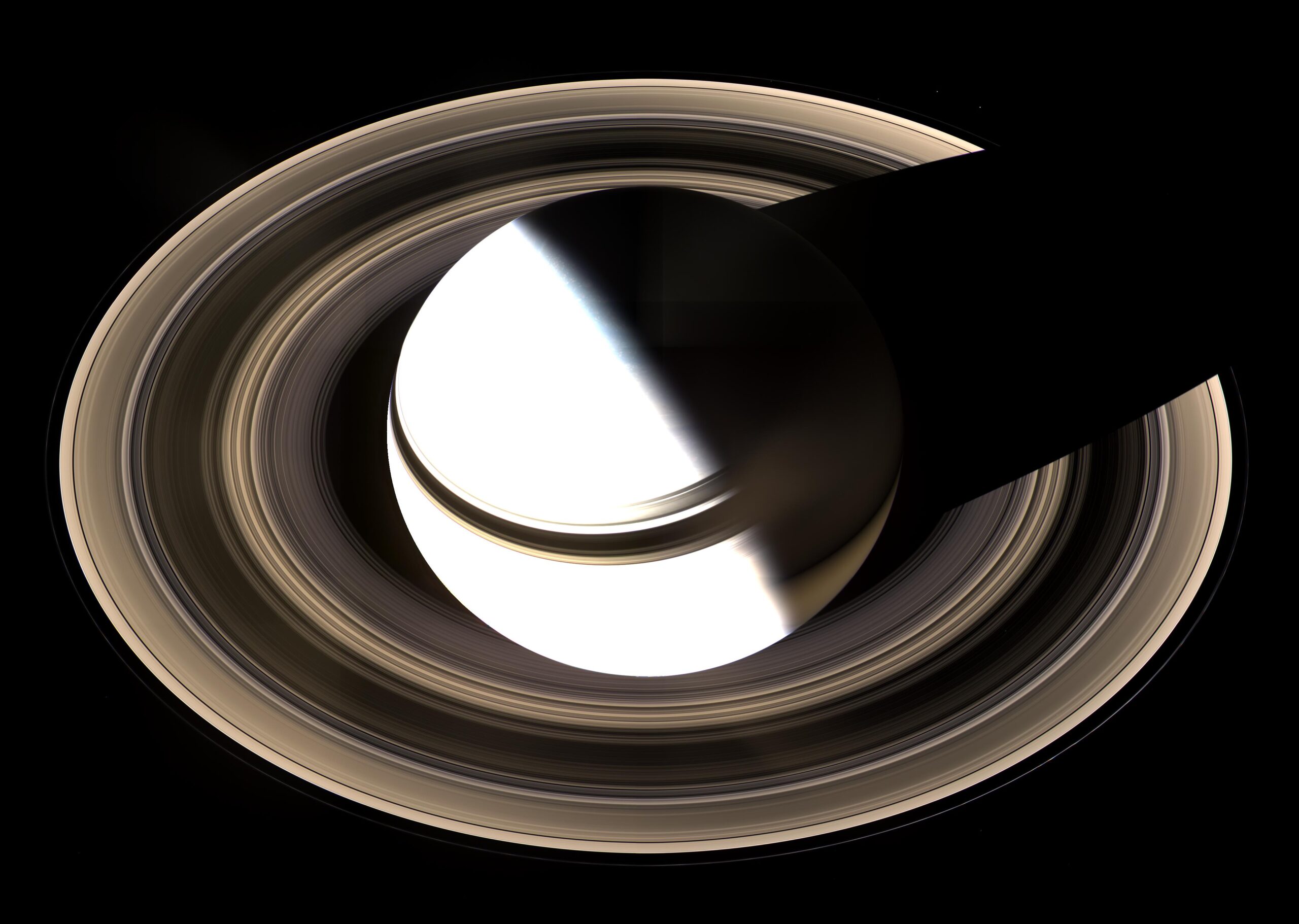
Unique New Perspectives of Saturn
Flying in a polar orbit around Saturn for the last two months, NASA’s Cassini spacecraft is now sending back completely unique images of Saturn, seen from overhead.
https://www.nasa.gov/mission_pages/cassini/media/20070301.html
Large Lake Surrounds an Island on Titan
NASA’s Cassini spacecraft has been turning up new images of features that look like lakes on the surface of Saturn’s moon Titan. The latest image shows a large lake that appears to be surrounding an island. Unlike the familar lakes here on Earth, this lake is likely filled with liquid hydrocarbons.
https://photojournal.jpl.nasa.gov/catalog/PIA09180
Saturn moon sprays neighbors with ice
A Saturnian moon with active geysers is coating a number of other moons with ice particles. In a paper published in the journal „Science“, researchers found that ice geysers on the moon Enceladus had ejected ice particles that were coating the surfaces of at least 11 other moons of Saturn. That coating of ice particles explains why those small moons, which are themselves not geologically active, have bright surfaces that must be renewed regularly to remain highly reflective. Enceladus and the other moons all orbit in Saturn’s E-ring, which itself is formed by ice particles from Enceladus.
University of Virginia Press Release
Tour de Saturn Set For Extended Play
The Cassini spacecraft is now two and half years through its official „primary tour“ of the Saturn system which is scheduled to last another 17 months before ending on June 30, 2008. During this primary tour Cassini will have made 46 close flybys of Titan (during one of which it dropped off the successful European Space Agency’s Huygens Titan lander), four close flybys of the unexpectedly fascinating moon Enceladus, and one each of Tethys, Dione, Rhea, Hyperion, Iapetus and Phoebe. On the basis of what is done so far Cassini must be considered a scientific and space art spectacular. It has revealed major new mysteries about Titan and Enceladus which have a direct relevance to the possibility that one or both moons have evolved microscopic life. Moreover, Cassini has apparently solved at least two of the biggest scientific mysteries about the Saturn system: the mysterious longevity of its ring system, and the remarkable difference between Iapetus‘ black leading side and its bright whitish trailing side. Later this year in September, having completed most of the planned flybys of Saturn’s smaller moons, Cassini will make its one close flyby of the distant and hard-to-reach moon Iapetus. Coming within 1.500 km it will be able to make its best observations of Iapetus and hopefully solve the remaining puzzles about it. The following March in 2008 Cassini will make its closest flyby of Enceladus skimming a mere 23 km above the geyser-like water and ice plumes which are erupting from the south polar region. Scientists working with Cassini are looking at how an extended mission would work. From the time Cassini first entered orbit around Saturn, they have been working on the design of a possible extended tour, re-planning it on the basis of the craft’s new discoveries about the Saturn system.
Cassini: Mission to Saturn
Cassini Images Mammoth Cloud Engulfing Titan's North Pole
A giant cloud half the size of the United States has been imaged on Saturn’s moon Titan by the Cassini spacecraft. The cloud may be responsible for the material that fills the lakes discovered last year by Cassini’s radar instrument.
https://solarsystem.nasa.gov/news/12377/cassini-images-mammoth-cloud-engulfing-titans-north-pole/
Huygens’s second landing anniversary – the surprises continue
Two years ago, planetary scientists across the world watched as Europe and the US did something amazing. The Huygens descent module drifted down through the hazy atmosphere of Saturn’s moon Titan, beaming its data back to Earth via the Cassini mothership. Today, Huygens’s data are still continuing to surprise researchers.
Seen aus flüssigem Methan
Den Verdacht gab es schon länger, doch dank der detaillierten Auswertung von Radardaten der Raumsonde Cassini vom 22. Juli 2006 glauben amerikanische Wissenschaftler nun, eindeutige Belege dafür gefunden zu haben, dass es auf dem Saturnmond Titan tatsächlich Seen aus flüssigem Methan gibt. Die Forscher berichten über ihre Ergebnisse in der neuen Ausgabe des Wissenschaftsmagazins „Nature“.
Titan Has Liquid Lakes, Scientists Report in Nature
Saturn spectacular
In recognition of the past year, the Cassini imaging team has released an amazing Saturnian photo collection:
Cassini Sends End-of-Year Greetings From Across the Solar System
Massive Mountain Range Imaged on Saturn’s Moon Titan
The tallest mountains ever seen on Titan – coated with layers of organic material and blanketed by clouds – have been imaged by NASA’s Cassini spacecraft.
https://solarsystem.nasa.gov/news/12375/massive-mountain-range-imaged-on-saturns-moon-titan/