Kategorie: Allgemein

Earth celebrates Sputnik's 50th birthday

sputnik

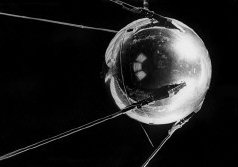
Modell von Sputnik

Fifty years ago today, on October 4, 1957, the world’s first artificial satellite was launched by the former Soviet Union, marking the start of the Space Age.
Called Sputnik, meaning „fellow traveler“, it was about the size of a basketball, weighed only 83 kilograms, and took about 98 minutes to orbit the Earth while transmitting a series of rapid beeps. Then, on November 3rd, 1957, the Soviets launched Sputnik II, carrying a heavier payload including a dog named Laika. On January 31, 1958, the United States entered the space race by launching Explorer I, a satellite that discovered the magnetic radiation belts surrounding the Earth. The Sputnik launch also led to the creation of NASA on October 1st, 1958. Since then, humans have walked on the moon, created the International Space Station, sent robots to Mars and dispatched numerous spacecraft to explore the universe.

Satellite Images Show Human Rights Abuses In Burma

An analysis of high-resolution satellite images – completed by the American Association for the Advancement of Science (AAAS) – pinpoints evidence consistent with village destruction, forced relocations, and a growing military presence at 25 sites across eastern Burma where eye-witnesses have reported human rights violations.

High-Resolution Satellite Imagery and the Conflict in Eastern Burma – Summary Report (PDF; 14,8 MB)

"Clearest" images taken of space

Astronomers from the University of Cambridge and the California Institute of Technology (Caltech) have developed a new camera that gives much more detailed pictures of stars and nebula than even the Hubble Space Telescope, and it does all this from the ground.
Images from ground-based telescopes are usually blurred out by the atmosphere. Scientists have tried to develop techniques to correct the blurring called „adaptive optics“ but so far they only work successfully in the infrared where the smearing is greatly reduced. However a new noise-free, high-speed camera has been developed at the Institute of Astronomy in Cambridge which makes very high resolution imaging possible in the visible light. The camera works by recording the images produced by an adaptive optics front-end at high speed (20 frames per second or more). Software then checks each one to pick the sharpest ones. Many are still quite significantly smeared but a good percentage are unaffected. These are combined to produce the image that astronomers want. They call the technique „Lucky Imaging“ because it depends on the chance fluctuations in the atmosphere sorting themselves out. The first images are of NGC 6543, the Cat’s Eye Nebula, and M13.
Lucky Cam Adaptive Optics on the 200-inch Hale Telescope at the Palomar Observatory

Lucky Imaging Website

Wie der Sauerstoff in die Luft kam

Nicht die Biologie, sondern die Geologie gab den Startschuss für die Bildung der irdischen, sauerstoffreichen Atmosphäre. Diese Hypothese stellen zwei Geologen im Fachmagazin „Nature“ auf. Sauerstoff konnte sich demnach erst in nennenswertem Maße in der Gashülle der Erde anreichern, nachdem sich vor etwa 2,5 Milliarden Jahren ein Teil des Vulkanismus aus den Meeren an Land verlagert hatte.
Volcanic Activity Key to Oxygen-rich Atmosphere

Die Entwicklung der Atmosphäre

Eine Projektion kann als eigener Körper erlebt werden

Die räumliche Einheit von Körper und Selbst lässt sich auflösen, ein virtueller Körper kann als eigener empfunden werden. In Experimenten deutscher und schweizerischer Forscher nahmen Probanden einen virtuellen Körper als ihren eigenen wahr und identifizierten sich teilweise mit einer dreidimensionalen Projektion. Die Teilnehmer waren am Rücken gestreichelt worden und hatten gleichzeitig gesehen, wie eine scheinbar vor ihnen stehende Projektion ebenfalls am Rücken gestreichelt wurde. Forscher Thomas Metzinger von der Uni Mainz dazu: „Es handelt sich dabei aber noch nicht um eine komplette außerkörperliche Erfahrung, weil zum Beispiel der Gleichgewichtssinn und das Bewegungsgefühl bei dem „wirklichen“ Körper verbleiben. Letztlich ist aber natürlich auch das, was wir im Normalfall als den „wirklichen“ Körper erleben, nur der Inhalt dessen, was in meiner eigenen Theorie als das „phänomenale Selbstmodell“ bezeichnet wird.“
Wahrnehmung des Selbst in virtuellem Körper experimentell nachgewiesen

Video Ergo Sum: Manipulating Bodily Self-Consciousness