
Just when you thought Mars was dead, it goes and surprises you. Images released from the Mars Global Surveyor show new gullies on the surface of Mars that formed within the last 7 years. The shape and path taken down the slope suggests that they were carved by rushing liquid water. It’s possible that there are quantities of liquid water underneath the surface, which can escape to the surface from time to time. Even though Mars can get cold, researchers think that water spurting out of the ground could last long enough to carry debris down the slope of a hill before freezing solid.
NASA Images Suggest Water Still Flows in Brief Spurts on Mars
Solscape

The Antikythera Mechanism
Anthony Ayiomamitis, an amateur astronomer living in Greece, has posted pictures of the Antikythera mechanism as it is exhibited at the National Museum of Archaeology in Athens:
https://www.perseus.gr/Astro-Greek-Archae-Astr-Antikythera.htm
Solar probe films plasma loops in action
Flickering loops of plasma above the Sun’s churning surface have been captured in movies made by Japan’s Hinode spacecraft, providing a preview of what the probe will do once it begins its main phase of scientific observations. The spacecraft was launched by the Japan Aerospace Exploration Agency (JAXA) on 22 September 2006. JAXA is collaborating with NASA, ESA, and other organisations for the mission. Hinode’s three telescopes will make simultaneous observations in visible light, ultraviolet, and X-rays to help scientists understand the Sun’s ever-changing magnetic field. It is hoped that its observations will shed light on what triggers solar eruptions – so-called coronal mass ejections (CMEs). These ejections spew out radiation that poses a health risk for astronauts and they can also knock out satellites.
Development of loops of hot plasma above the Sun’s surface (15.9 MB; MPEG format)
Telescopes – a 400-year history
Geoff Anderson describes the history of the telescope, from the very beginning, to today’s space telescopes. He discusses the problems which occurred with the Hubble space telescope. Now there are plans for even bigger instruments. Current telescopes are up to 10 metres in diameter. And there are plans for instruments up to 100 metres in diameter!
https://www.abc.net.au/radionational/programs/scienceshow/telescopes—a-400-year-history/3380628
Mars Orbiter Spies Rover Landing Site
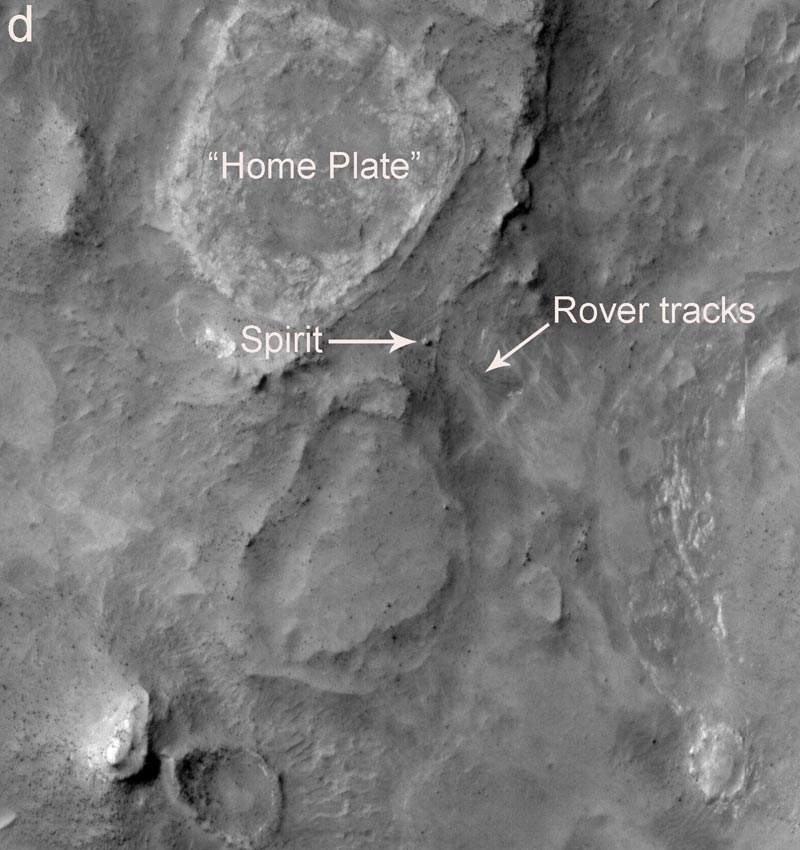
A new HiRISE image shows the landing site of the Mars Exploration Rover Opportunity. The prominent impact crater on the right-hand side of the image is „Endurance crater“ where Opportunity spent about ten months of its now nearly three-year mission. The bright irregularly-shaped feature in area „a“ of the image is Opportunity’s parachute, now lying on the martian surface. Near the parachute is the cone-shaped „backshell“ that helped protect Opportunity’s lander during its seven-month journey to Mars. Area „b“ of the image shows the impact point and the broken remnants of Opportunity’s heat shield. Area „c“ of the image shows „Eagle crater“, the small martian impact crater where Opportunity’s airbag-cushioned lander came to rest. The lander is still clearly visible on the floor of the crater.
Mars Exploration Rover Landing Site at Meridiani Planum
Stellar Debris in the Large Magellanic Cloud
A trio of space telescopes have combined to create a stunning image of the N49 supernova remnant in the Milky Way’s neighbouring galaxy, the Large Magellanic Cloud. The Spitzer Space Telescope imaged relatively cool gas toward the outer edge of the remnant in infrared, seen in red. The blue in the centre of the image, taken by the Chandra X-ray Observatory, indicates extremely hot gas. The Hubble Space Telescope is responsible for the optical view of white and yellow filaments.
https://chandra.harvard.edu/photo/2006/n49/
Enigmatic relic was an eclipse calculator
The mystery over the purpose of a sophisticated geared „calculator“ built in the 2nd century BC has finally been solved. The so-called „Antikythera mechanism“ was found in 1902 by sponge divers exploring a shipwreck off the Greek island of the same name, but its exact use had puzzled scientists. The relic consists of numerous fragments, including brass gears embedded in thick mineral encrustations. The device is thought to have once been housed in a wooden box about the size of a carriage clock and is more complex by far than any other machine known to have existed on the planet for the following 1000 years. Now a team led by Mike Edmunds at Cardiff University in Wales has shown that the Antikythera mechanism was designed to predict solar and lunar eclipses from the relative positions of the Earth, Moon and Sun. Edmunds’s team used an industrial CT scanner to map out the gear trains within the mineral-encrusted fragments. The scans allowed them to determine how the components fit together and to work out their function. The team also found fragments of previously hidden text engraved on the metal.
The 2.000-year-old computer
Evidence from Hawaiian Volcanoes Shows That Earth Recycles its Crust
A geologist at Rutgers, The State University of New Jersey, has come up with evidence our planet practices recycling on a grand scale. Writing in the prestigious British science journal „Nature“, geological sciences professor Claude Herzberg offers new evidence that parts of the Earth’s crust that long ago dove hundreds or thousands of kilometers into the Earth’s interior have resurfaced in the hot lava flow of Hawaiian volcanoes.
https://www.rutgers.edu/news/evidence-hawaiian-volcanoes-shows-earth-recycles-its-crust