
Ein neues Modell des Saturnmondes Enceladus könnte die Hoffnungen, dort Leben zu finden, dämpfen. Das von Forschern der Universität von Illinois erstellte Modell erklärt die auffallendsten Erscheinungen auf Enceladus ohne das Vorhandensein von flüssigem Wasser.
Frigid enceladus: an unlikely harbor for life
Kategorie: Saturn
Cassini data points to origin of Saturn's G ring
Scientists studying data from NASA’s Cassini spacecraft have discovered what they thought is the origin for one of the more unusual rings surrounding the planet Saturn. In a paper published in the journal „Science“, they said Saturn’s G ring is likely linked to an arc of relatively large ice particles in a part of the ring’s inner edge, which are kept in line by the gravitational influence of Saturn’s moon Mimas. Collisions with micrometeoroids create smaller particles, which are then spread throughout the ring by plasma in Saturn’s magnetic field.
https://solarsystem.nasa.gov/news/12393/cassini-finds-possible-origin-of-one-of-saturns-rings/
Saturn’s Moon Iapetus Enjoys Eternal Youth
Saturn’s moon Iapetus is one of the strangest objects in our Solar System. Unlike other objects of this size, Iapetus is walnut-shaped, with a clearly defined chain of mountains along its equator. How could it have formed billions of years ago with the rest of the Solar System, and yet still have its unique shape? Researchers have developed a computer model that seems to accurately explain the series of events that Iapetus went through to arrive at its current shape. Billions of years ago, shortly after its formation, Iapetus spun quickly, taking just 5 hours to complete a rotation. This fast spin gave it the oblate walnut shape it has today. Over time, its rotation slowed down to about 16 hours. It also cooled down enough that its surface froze solid. It couldn’t absorb the excess surface material. Instead, this rubble built up the chain of mountains around its equator. At this point, its formation completely halted. The moon now orbits at a relatively slow rate, turning only once every 80 days. Scientists were able to confirm these computer model predictions for Iapetus, using observations of its rocks containing the short-lived isotopes aluminum-26 and iron-60. These decay at a rate that allowed scientists to carbon date the moon at roughly 4,564 billion years old.
https://www.jpl.nasa.gov/news/saturns-old-moon-iapetus-retains-its-youthful-figure
Two More of Saturn’s Moons are Blasting Out Particles
One of Cassini’s greatest discoveries are the ice geysers pouring out of Saturn’s moon Enceladus. Recent research by the NASA/ESA Cassini team suggests that this icy moon isn’t the only geologically-active world orbiting the ringed planet. Two other Saturnian moons, Tethys and Dione, are shooting streams of charged particles into space, and this may be a sign of geysers like those on Enceladus.
Clumps found in Saturn's rings
Scientists working with data from NASA’s Cassini spacecraft have concluded that one of Saturn’s major rings is composed of clumps of material rather than a more uniform distribution of smaller objects. Planetary scientists used a series of stellar occultations, where the rings passed in front of a star, to perform a „CAT scan“ of the rings, analyzing the distribution of particles within them. They found that one ring, the B ring, contains tightly-packed clumps of material with wider spacings between the clumps than previously expected. The clumps are constantly forming and being town apart by Saturn’s gravity, often colliding with one another. This clumpiness may mean that Saturn’s rings are two to three times as massive as previously thought.
Cassini ‚Cat Scan‘ Maps Clumps in Saturn’s Rings
Organic Chemicals in Titan’s High Atmosphere
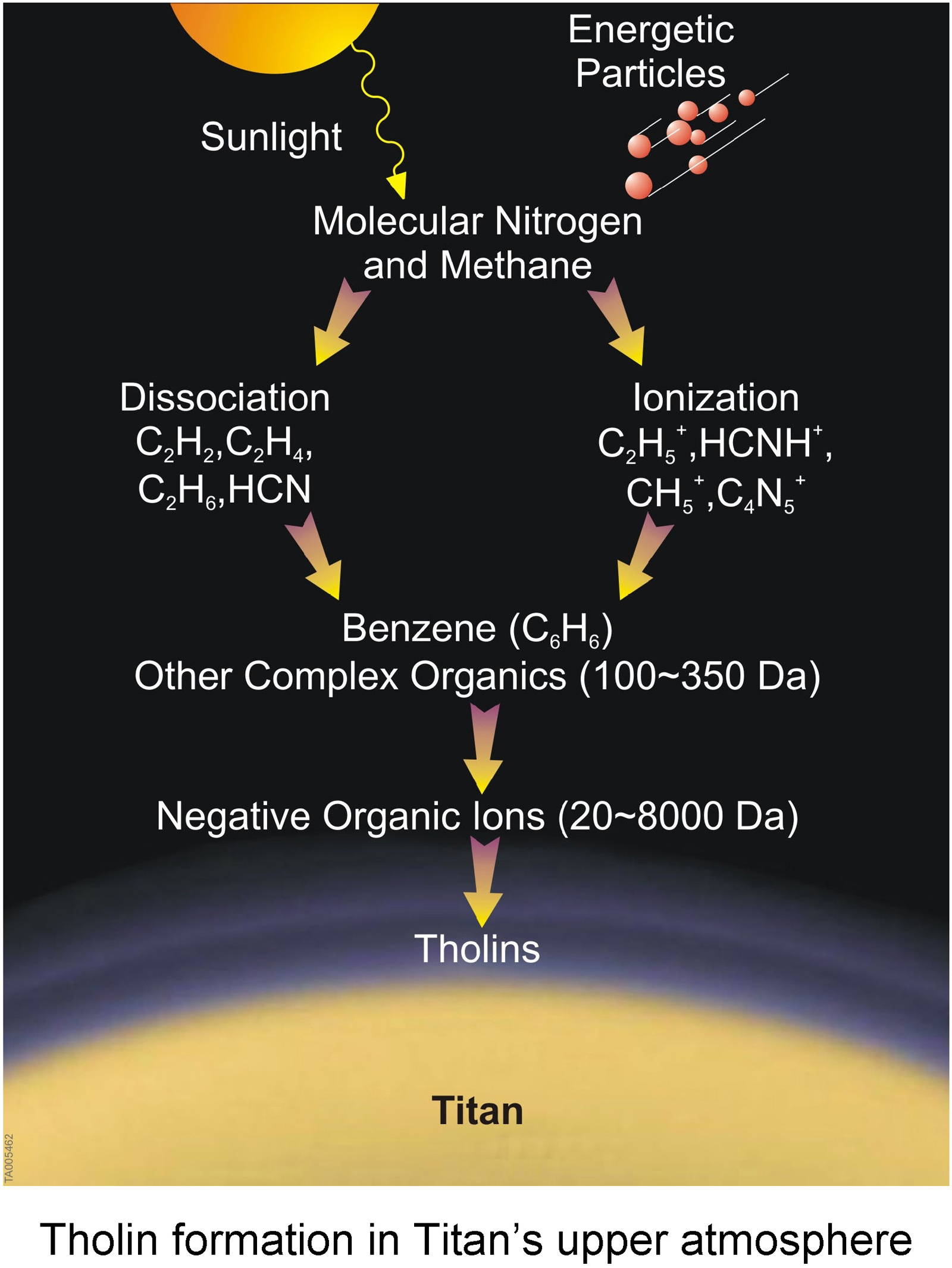
Since the twin Voyager spacecraft flew past Saturn’s moon Titan, scientists have been excited about what its hazy atmosphere can tell us about the earliest days of our own planet. The Voyagers discovered that Titan’s atmosphere is swirling with hydrocarbons and other complex organic molecules that could be the building blocks of life. The latest findings from NASA’s Cassini spacecraft have uncovered that these organic molecules are floating higher in Titan’s atmosphere than scientists originally thought. The latest research, published in the May 11 edition of the journal „Science“, shows that these organic aerosols, called tholins, have been found in altitudes higher than 1.000 kilometres above the surface of Titan. This is important because Titan’s environment is thought to be very similar to Earth’s early history, before the first life formed. A similar process could have happened here.
Hunter Waite et al.: „The Process of Tholin Formation in Titan’s Upper Atmosphere“
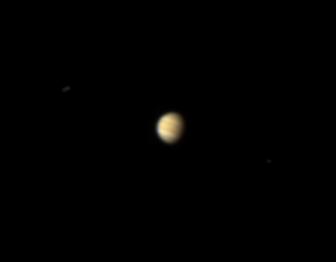
Jupiter As Seen From Saturn
It’s not a great picture of Jupiter, but that’s not the point. The point is that this photograph was taken by NASA’s Cassini spacecraft currently orbiting Saturn. When the picture was taken, Cassini was approximately 1.8 billion kilometres from Jupiter. So, at the time of the photograph, the distance from Saturn to Jupiter was roughly the same as the distance from the Earth to Saturn. A similar picture of Earth would only light up a single pixel in Cassini’s camera.
https://solarsystem.nasa.gov/resources/13540/hello-again-jupiter/
Moon affects Saturn's rotation period
Because Saturn doesn’t have a visible surface, scientists have used the rotation period of the planet’s magnetic field to measure the planet’s rotation, a technique used successfully for other gas giants. In a paper published in last week’s issue of „Science“, researchers said that geysers erupting from Saturn’s moon Enceladus eject water vapor and ice that interact with the planet’s magnetic field, weighing down the field and making the planet to appear to rotate more slowly. This effect may explain past observed changes in the planet’s rotation period.
Enceladus Geysers Mask the Length of Saturn’s Day
Cassini radar shows evidence of seas on Titan
Instruments on NASA’s Cassini spacecraft have found evidence for seas, likely filled with liquid methane or ethane, in the high northern latitudes of Saturn’s moon Titan. One such feature is larger than any of the Great Lakes of North America and is about the same size as several seas on Earth.
https://solarsystem.nasa.gov/news/12381/cassini-spacecraft-images-seas-on-saturns-moon-titan/
Radioactive Core Might Explain Geysers on Enceladus
Since Cassini arrived at Saturn, it has made many impressive discoveries. One of the most intriguing is the discovery that Saturn’s icy moon Enceladus has geysers spewing water ice into space. Some planetary scientists theorize that there are pockets of liquid water near the surface of Enceladus that could harbour life. But where is the heat coming from to fuel these geysers? A new model proposes that the rapid decay of radioactive elements might be keeping the moon hotter than it would normally be. This heat is released through cracks in the moon’s surface, and since Enceladus is covered with ice, it has water geysers. The theory says that Enceladus started out as a ball of ice and rock, with rapidly decaying isotopes of aluminum and iron. Over the course of just a few million years, this decay produced a tremendous amount of heat, creating a rocky core and a surrounding shell of ice. The moon then slowly cooled over the course of billions of more years. The theory matches some of the elements seen in Enceladus‘ geysers, such as gaseous nitrogen, methane, carbon dioxide, propane and acetylene. These could come from the decomposition of ammonia deep inside the moon where the warm core and water meet.
A Hot Start Might Explain Geysers on Enceladus